Intro to Power Systems: AC RLC circuit voltage calculations

Click For Summary

Discussion Overview

The discussion revolves around voltage calculations in an AC RLC circuit, specifically focusing on the resistor voltage when capacitance is omitted, determining the required capacitance to match the source voltage, and maximizing the resistor voltage. The scope includes mathematical reasoning and technical explanations related to circuit theory.

Discussion Character

  • Technical explanation
  • Mathematical reasoning
  • Debate/contested

Main Points Raised

  • Post 1 presents calculations for the resistor voltage and the required capacitance to equal the source voltage, leading to a derived capacitance of 265.258μF.
  • Post 2 suggests considering the magnitude of the voltage ratio and hints that two values for capacitance should be obtained.
  • Post 3 derives two equations for capacitance based on different conditions but expresses uncertainty about the correctness of the results.
  • Post 4 repeats the derivation of capacitance values and questions the correctness of the results, suspecting a mathematical error.
  • Post 5 discusses difficulties in rationalizing a complex fraction and expresses frustration over ending up with an imaginary component in the denominator.
  • Post 6 reiterates the challenge of separating real and imaginary parts after rationalization and seeks further guidance.
  • Post 7 attempts a new rationalization approach but questions its alignment with the expected solution method.
  • Post 8 defends the new approach and suggests setting the square root of the sum of squares equal to one for solving.
  • Post 9 provides a detailed breakdown of the voltage ratio and suggests a method for solving for capacitance based on the magnitude condition.
  • Post 10 points out a potential oversight regarding the treatment of the numerator in the magnitude calculation, suggesting it should be treated as an absolute value.

Areas of Agreement / Disagreement

Participants express differing views on the correct approach to solving for capacitance, with some proposing rationalization methods and others questioning the validity of their calculations. There is no consensus on the correct values for capacitance or the best method to derive them.

Contextual Notes

Participants note potential issues with mathematical substitutions and the complexity of the algebra involved in the calculations. There are unresolved steps in the derivations, and assumptions about the circuit parameters may affect the outcomes.

SumDood_
Messages
39
Reaction score
6
Homework Statement
I am getting the wrong answer for Part B.
I don't understand if what I am doing for part C is correct.
Relevant Equations
Voltage divider rule
1698054450724.png

##V_{S} = 120V ##
##f = 60Hz##
##L = 20mH##
##R = 10\Omega ##

(a) Assume the capacitance is omitted. What is the resistor voltage?
##X_{L} = j\omega L = j2.4\pi##
##V_{R} = Vs\cdot \frac{R}{R+X_{L}} = 76.5067-j57.6847##
##V_{L} = Vs\cdot \frac{X_{L}}{R+X_{L}} = 43.493+j57.6847##

(b) What value of capacitance is required to make the resistor voltage have the same magnitude as the source voltage?
$$V_{R} = Vs\cdot \frac{R//X_{C}}{R//X_{C}+X_{L}}$$
$$R//C = \frac{R\cdot X_{C}}{R+X_{C}} = \frac{R\cdot \frac{1}{j\omega C}}{R+\frac{1}{j\omega C}} = \frac{R}{j\omega RC + 1}$$
$$V_{R} = Vs\cdot \frac{\frac{R}{j\omega RC + 1}}{\frac{R}{j\omega RC + 1}+j\omega L} = Vs\cdot \frac{R}{R+(j\omega L)(j\omega RC+1)}$$
$$V_{S} = V_{R} \equiv \frac{V_{R}}{V_{S}} = 1$$
$$1= \frac{R}{R+(j\omega L)(j\omega RC+1)}$$
$$(j\omega L)(j\omega RC+1) = 0$$
$$j\omega RC+1 = 0$$
$$C = \frac{-1}{j\omega R} = \frac{1}{120\pi\cdot 10} = 265.258\mu F$$

(c) What value of capacitance maximizes the resistor voltage? What is that maximum voltage?
$$V_{O} = V_{R} = Vs\cdot \frac{R}{R+(j\omega L)(j\omega RC+1)}$$
To increase the output voltage, I need to reduce the value of the denominator. I can do this by ##(j\omega RC+1) = 0## but this brings me back to the previous part of the question, which is incorrect for me.
 
Physics news on Phys.org
I think you want to ponder what ##\left| \frac{V_{R}}{V_{S}}\right| ## actually is. It's magnitude is one, but that means you need to take the magnitude of the expression on the right hand side.
SumDood_ said:
$$V_{R} = Vs\cdot \frac{\frac{R}{j\omega RC + 1}}{\frac{R}{j\omega RC + 1}+j\omega L} = Vs\cdot \frac{R}{R+(j\omega L)(j\omega RC+1)}$$
$$V_{S} = V_{R} \equiv \frac{V_{R}}{V_{S}} = 1$$
You should get:
$$1=\left| \frac{R}{R+(j\omega L)(j\omega RC+1)}\right|$$

Then solve for C.

Edit: Hint: you should get two values for C.
 
Last edited:
  • Like
Likes   Reactions: SumDood_ and DaveE
$$1=\left| \frac{R}{R+(j\omega L)(j\omega RC+1)}\right|$$
I think I get it:
$$(j\omega L)(j\omega RC+1) = -2R$$
OR
$$(j\omega L)(j\omega RC+1) = 0$$

\begin{align*}
(j\omega L)(j\omega RC+1) &= -2R \\
-\omega ^{2}RLC + j\omega L &= -2R \\
-\omega ^{2}RLC &= -2R - j\omega L \\
C &= \frac{-2R - j\omega L}{-\omega ^{2}RL} = \frac{-20 - (j120\pi \cdot 20\cdot 10^{-3})}{-(120\pi)^{2}\cdot 10 \cdot 20\cdot 10^{-3}} = 751.96\mu F\angle 20.656^{\circ} \\ \\(j\omega L)(j\omega RC+1) &= 0 \\
(j\omega RC+1) &= 0 \\
C &= \frac{-1}{j\omega R} = \frac{-1}{j120\pi \cdot 10} = 265.258\mu F\angle 90^{\circ}

\end{align*}

I got the two values for C, but they are both wrong. Can you please tell me what I am doing wrong? I suspect I am making a mistake in the math, but I can't figure it out. Maybe I am not substituting correctly?
 
SumDood_ said:
$$1=\left| \frac{R}{R+(j\omega L)(j\omega RC+1)}\right|$$
I think I get it:
$$(j\omega L)(j\omega RC+1) = -2R$$
OR
$$(j\omega L)(j\omega RC+1) = 0$$

\begin{align*}
(j\omega L)(j\omega RC+1) &= -2R \\
-\omega ^{2}RLC + j\omega L &= -2R \\
-\omega ^{2}RLC &= -2R - j\omega L \\
C &= \frac{-2R - j\omega L}{-\omega ^{2}RL} = \frac{-20 - (j120\pi \cdot 20\cdot 10^{-3})}{-(120\pi)^{2}\cdot 10 \cdot 20\cdot 10^{-3}} = 751.96\mu F\angle 20.656^{\circ} \\ \\(j\omega L)(j\omega RC+1) &= 0 \\
(j\omega RC+1) &= 0 \\
C &= \frac{-1}{j\omega R} = \frac{-1}{j120\pi \cdot 10} = 265.258\mu F\angle 90^{\circ}

\end{align*}

I got the two values for C, but they are both wrong. Can you please tell me what I am doing wrong? I suspect I am making a mistake in the math, but I can't figure it out. Maybe I am not substituting correctly?
The first expression in this post shows a fraction embedded between absolute value bars. You must rationalize that fraction. Multiply out the two expressions in parentheses in the denominator, them multiply the numerator and denominator by the complex conjugate of the denominator. This gets rid of "j" in the denominator. Do it like this:

When this is done you can separate the new numerator into a real part and imaginary part so it will look like a+jb. The you can take the square root of the sum of the squares of both parts.

You'll get sqrt(a^2 + b^2) This will be the magnitude of the expression you started with and it won't contain any imaginary parts. You can set it equal to 1 and solve.
 
@The Electrician
So I tried rationalization, but ended up with an expression that has j in the denominator:
\begin{align*}
\frac{R}{R+(j\omega L)(j\omega RC+1)} \cdot \frac{R-(j\omega L)(j\omega RC+1)}{R-(j\omega L)(j\omega RC+1)} &= \frac{R^{2}-R(-\omega ^{2}RLC + j\omega L)}{R^{2}-[(-\omega L)(-\omega ^{2}R^{2}C^{2}+j2\omega RC+1)]} \\ \\
&= \frac{R^{2}+\omega ^{2}R^{2}LC-j\omega RC}{R^{2}-\omega ^{3}R^{2}LC^{2}+j2\omega ^{2}RLC+\omega L}
\end{align*}
So, I can't separate this into its real and imaginary parts, so I can then calculate the magnitude as you described. Any ideas what I shoud do instead?
 
SumDood_ said:
@The Electrician
So I tried rationalization, but ended up with an expression that has j in the denominator:
\begin{align*}
\frac{R}{R+(j\omega L)(j\omega RC+1)} \cdot \frac{R-(j\omega L)(j\omega RC+1)}{R-(j\omega L)(j\omega RC+1)} &= \frac{R^{2}-R(-\omega ^{2}RLC + j\omega L)}{R^{2}-[(-\omega L)(-\omega ^{2}R^{2}C^{2}+j2\omega RC+1)]} \\ \\
&= \frac{R^{2}+\omega ^{2}R^{2}LC-j\omega RC}{R^{2}-\omega ^{3}R^{2}LC^{2}+j2\omega ^{2}RLC+\omega L}
\end{align*}
So, I can't separate this into its real and imaginary parts, so I can then calculate the magnitude as you described. Any ideas what I shoud do instead?
You didn't do the rationalization correctly; you don't have the correct complex conjugate. You have to multiply out the two expressions in parentheses in the denominator. Multiply out (j w L)(j w R C); then you can form the correct complex conjugate.
 
@The Electrician
Tried again:
\begin{align*}

\frac{R}{R-(j\omega ^{2}RLC + j\omega L)} \cdot \frac{R-\omega ^{2}RLC-j\omega L}{R-\omega ^{2}RLC-j\omega L} &= \frac{R^{2}-\omega ^{2}R^{2}LC - j\omega RL}{(R-\omega ^{2}RLC)^{2}+(\omega L)^{2}} \\ \\
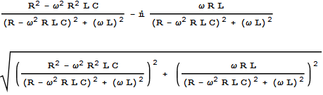
&=\frac{R^{2}-\omega ^{2}R^{2}LC}{(R-\omega ^{2}RLC)^{2}+(\omega L)^{2}}-j\frac{\omega RL}{(R-\omega ^{2}RLC)^{2}+(\omega L)^{2}}
\end{align*}

I appreciate the help, but I don't think this is how the question is supposed to be solved. I think the original approach I took was more inline with what is expected.
 
But what you were doing originally didn't work. What I'm showing you will work.

Part of what you posted in the previous post got cut off. Here's what you should get. Now set the square root of sum of squares equal to 1 and solve. It's a lot of complicated algebra. Would you be allowed to find a numerical solution?

powr1-png.png


Edit: gneill has shown how to have a lot less algebra! :smile: :smile:
 

Attachments

  • Powr1.png
    Powr1.png
    4.1 KB · Views: 113
Last edited:
Start with:
$$ \frac{V_R}{V_S} = \frac{R}{R + \left( j \omega L \right) \left(j \omega R C + 1 \right)}$$
$$\left| \frac{V_R}{V_S} \right| = \left| \frac{R}{R - \omega^2 LRC + j \omega L} \right|$$
But ##\left| \frac{V_R}{V_S} \right| = 1##, so:
$$1 = \frac{R}{\left| R - \omega^2 LRC + j \omega L \right|}$$
$$1 = \frac{R}{\sqrt{ \left( R - \omega^2 LRC\right)^2 + \left(\omega L\right)^2}}$$
$$1 = \frac{R^2}{\left( R - \omega^2 LRC\right)^2 + \left(\omega L\right)^2} $$
Solve for C.
 
  • Like
Likes   Reactions: The Electrician
  • #10
I have a small nit to pick.
In steps 3 and 4 you show the numerator as R, but for the transition from step 2 to step 3, the numerator in step 3 (and then step 4) should be |R| rather than just R. Doing this would make the step 2 to step 3 transition be true even if the numerator had been complex, with a non-zero imaginary part, and the whole procedure would be rigorously true :smile:.

Fortunately in this case it's true that |R| is identical to R, because in general (|x + jy|) is not identical to (x + jy)
 
  • #11
The Electrician said:
I have a small nit to pick.
In steps 3 and 4 you show the numerator as R, but for the transition from step 2 to step 3, the numerator in step 3 (and then step 4) should be |R| rather than just R. Doing this would make the step 2 to step 3 transition be true even if the numerator had been complex, with a non-zero imaginary part, and the whole procedure would be rigorously true :smile:.

Fortunately in this case it's true that |R| is identical to R, because in general (|x + jy|) is not identical to (x + jy)
True. I admit I took a shortcut where ##\left| R \right| = R##, since ##R## is positive real.
 
  • #12
gneill said:
True. I admit I took a shortcut where ##\left| R \right| = R##, since ##R## is positive real.
Fortunately for SumDood_ your much simpler expression will make for far less algebra in part C of his problem, what with derivatives and all. :smile:
 
  • Like
Likes   Reactions: gneill
  • #13
You guy's help is extremely appreciated!
\begin{align*}
1 &= \frac{R^2}{\left( R - \omega^2 LRC\right)^2 + \left(\omega L\right)^2} \\ \\
R^2 &= \left(R - \omega^2 LRC\right)^2 + \left(\omega L\right)^2 \\ \\
R^2 &= R^{2}-2\omega^2R^2LC+\omega^4R^2L^2C^2 + \left(\omega L\right)^2 \\ \\
0 &= \omega^4R^2L^2C^2 - 2\omega^2R^2LC +(\omega L)^2
\end{align*}
After substitution:
## C = 582.911\mu F## OR ## C = 120.7077\mu F##, how do I determine which value is the correct one?
 
  • #14
SumDood_ said:
You guy's help is extremely appreciated!
\begin{align*}
1 &= \frac{R^2}{\left( R - \omega^2 LRC\right)^2 + \left(\omega L\right)^2} \\ \\
R^2 &= \left(R - \omega^2 LRC\right)^2 + \left(\omega L\right)^2 \\ \\
R^2 &= R^{2}-2\omega^2R^2LC+\omega^4R^2L^2C^2 + \left(\omega L\right)^2 \\ \\
0 &= \omega^4R^2L^2C^2 - 2\omega^2R^2LC +(\omega L)^2
\end{align*}
After substitution:
## C = 582.911\mu F## OR ## C = 120.7077\mu F##, how do I determine which value is the correct one?
They're both correct; they both satisfy the original equation.

Now can you solve part C?
 
  • #15
@The Electrician
I tried this:
\begin{align*}
V_R &= V_S \cdot \frac{R}{R + \left( j \omega L \right) \left(j \omega R C + 1 \right)} \\ \\
V_R &= R\cdot V_S \cdot \left( R-\omega^2RLC+j\omega L\right)^{-1} \\ \\
\frac {dV_R} {dC} &= -R\cdot V_S \cdot \left( R-\omega^2RLC+j\omega L\right)^{-2} \left(-\omega^2RL\right)\\ \\
\frac {dV_R} {dC} &= V_S\cdot\frac{\omega^2RL}{\left( R-\omega^2RLC+j\omega L\right)^{2}} \\ \\
\text{To find the maximum:} \\
0 &= V_S\cdot\frac{\omega^2RL}{\left( R-\omega^2RLC+j\omega L\right)^{2}}
\end{align*}

Doesn't look like it is right.
 
  • #16
I think it would be simpler to work from the magnitudes:
$$\left| \frac{V_R}{V_S} \right| = \frac{\left| R \right|}{\left| R - \omega^2 R L C + j \omega L \right| }$$
Take the magnitudes and clear the square root on the right hand side by squaring; it doesn't matter if you maximize the left side value or its square, they will give the same value for C.
$$\left| \frac{V_R}{V_S} \right| ^2 = \frac{R^2}{R^2 - 2R^2 \omega^2 L C + R^2 \omega^4 L^2 C^2 + \omega^2 L^2 }$$
Find the derivative with respect to C and set it equal to zero to find the maximum. Note that you only need the numerator portion of the derivative.
 
  • Like
Likes   Reactions: SumDood_ and The Electrician
  • #17
SumDood_ said:
@The Electrician
I tried this:
\begin{align*}
V_R &= V_S \cdot \frac{R}{R + \left( j \omega L \right) \left(j \omega R C + 1 \right)} \\ \\
V_R &= R\cdot V_S \cdot \left( R-\omega^2RLC+j\omega L\right)^{-1} \\ \\
\frac {dV_R} {dC} &= -R\cdot V_S \cdot \left( R-\omega^2RLC+j\omega L\right)^{-2} \left(-\omega^2RL\right)\\ \\
\frac {dV_R} {dC} &= V_S\cdot\frac{\omega^2RL}{\left( R-\omega^2RLC+j\omega L\right)^{2}} \\ \\
\text{To find the maximum:} \\
0 &= V_S\cdot\frac{\omega^2RL}{\left( R-\omega^2RLC+j\omega L\right)^{2}}
\end{align*}

Doesn't look like it is right.
The expression you got for the derivative only has "C" in the denominator. The only way that expression can be zero is if "C" is infinite. The insight you had not yet experienced way back in post #1 is that you must work with magnitudes and get rid of the imaginary parts of expressions. gneill has shown you the way. :smile:
 
  • Like
Likes   Reactions: SumDood_
  • #18
$$\left| \frac{V_R}{V_S} \right| ^2 = \frac{R^2}{R^2 - 2R^2 \omega^2 L C + R^2 \omega^4 L^2 C^2 + \omega^2 L^2 }$$

Let's try one more time:
\begin{align*}
\frac{d}{dC}\left| \frac{V_R}{V_S} \right| ^2 &= \frac{d}{dC}\left(\frac{R^2}{R^2 - 2R^2 \omega^2 L C + R^2 \omega^4 L^2 C^2 + \omega^2 L^2 }\right) \\ \\
&=\frac{d}{dC}\left[R^2(R^2 - 2R^2 \omega^2 L C + R^2 \omega^4 L^2 C^2 + \omega^2 L^2 )^{-1}\right] \\ \\
&= -R^2(-2\omega^2R^2L + 2\omega^4R^2L^2C)(R^2 - 2R^2 \omega^2 L C + R^2 \omega^4 L^2 C^2 + \omega^2 L^2)^{-2} \\ \\
&= -R^2\cdot\frac{-2\omega^2R^2L + 2\omega^4R^2L^2C}{(R^2 - 2R^2 \omega^2 L C + R^2 \omega^4 L^2 C^2 + \omega^2 L^2)^{2}}
\end{align*}

To find the maximum:
\begin{align*}
0 &= -R^2\cdot\frac{-2\omega^2R^2L + 2\omega^4R^2L^2C}{(R^2 - 2R^2 \omega^2 L C + R^2 \omega^4 L^2 C^2 + \omega^2 L^2)^{2}} \\ \\
0 &= -2\omega^2R^2L + 2\omega^4R^2L^2C \\ \\
C &= \frac{1}{\omega^2 L} = \frac{1}{(120\pi)^2\cdot 20\text{m}} = 351.81\mu F
\end{align*}

Never have I spent this much time on one question. Thank you for helping me!
Edit: It seems I need to take advantage of working with magnitudes. Though I am not sure when is it appropriate to do so.
 
  • Like
Likes   Reactions: DaveE and gneill

Similar threads

Replies
19
Views
3K
  • · Replies 7 ·
Replies
7
Views
2K
Replies
0
Views
2K
  • · Replies 10 ·
Replies
10
Views
3K
  • · Replies 1 ·
Replies
1
Views
2K
  • · Replies 21 ·
Replies
21
Views
2K
  • · Replies 3 ·
Replies
3
Views
2K
  • · Replies 3 ·
Replies
3
Views
1K
  • · Replies 5 ·
Replies
5
Views
2K
  • · Replies 20 ·
Replies
20
Views
4K