Math Amateur
Gold Member
MHB
- 3,920
- 48
I am reading Matej Bresar's book, "Introduction to Noncommutative Algebra" and am currently focussed on Chapter 1: Finite Dimensional Division Algebras ... ...
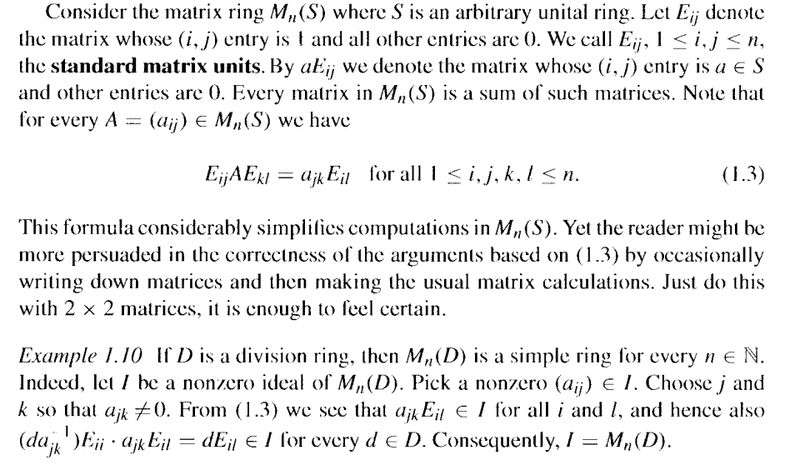
I need help with some aspects of Bresar's Example 1.10 on a simple matrix ring over a division ring ...
Example 1.10, including some preamble, reads as follows:
 In the above text from Bresar we read the following:
" ... and hence also ##(d a_{jk}^{-1} ) E_{ii} \cdot a_{jk} E_{il} = d E_{il} \in I ## for every ##d \in D##. Consequently, ##I = M_n(D)##. ... ... "My questions are as follows:Question 1I am assuming that ##(d a_{jk}^{-1} ) E_{ii} \cdot a_{jk} E_{il} = d E_{il}## because you can take the "scalars" out of the multiplication and multiply them as in
##c_1 (a_{ij} ) \cdot c_2 (b_{ij} ) = c_1 c_2 (a_{ij} ) \cdot (b_{ij} )##Is that correct?(Note: why we are messing with multiplications by scalars in a problem on rings, I don't know ... we seem to be treating the ring ##M_n (D)## as an algebra over ##D## ... )
Question 2Bresar seems to be assuming that ##d E_{il} \in I ## for all ##1 \le i, l \le n## and for every ##d \in D## implies that ##I = M_n (D)## ...
But ... ... why exactly is this true ...My thoughts ... maybe it is true because the ##E_{il}## generate the ring ##M_n (D)## ... or to put it another way ... any element in ##I## or ##M_n (D)## can be written uniquely in the form ##\sum_{i, j = 1}^n d_{ij} E_{ij}## ...and further, that all the ##E_{ij}## belong to I ...Help with these questions will be appreciated ...
Peter==============================================================================
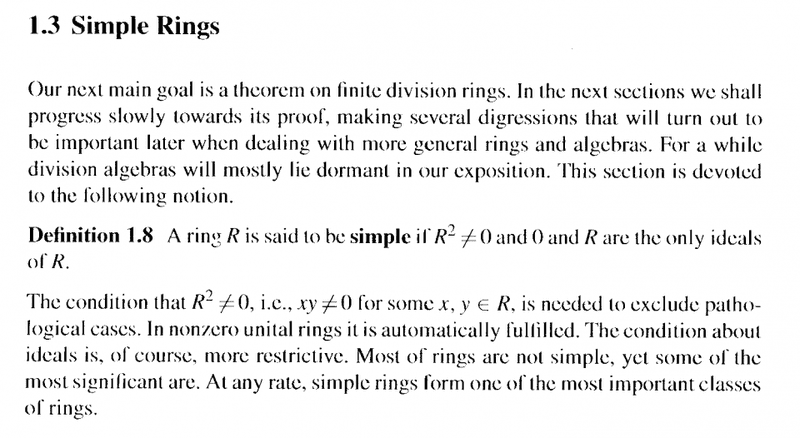
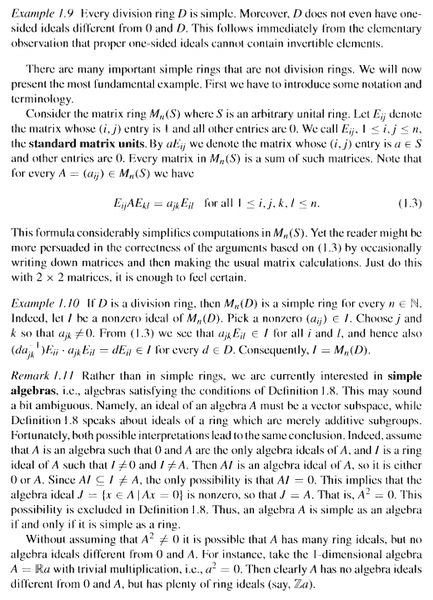
So that readers of the above post can appreciate the relevant context of the post, I am providing the introduction to Section 1.3 Simple Rings ... as follows:
I need help with some aspects of Bresar's Example 1.10 on a simple matrix ring over a division ring ...
Example 1.10, including some preamble, reads as follows:
" ... and hence also ##(d a_{jk}^{-1} ) E_{ii} \cdot a_{jk} E_{il} = d E_{il} \in I ## for every ##d \in D##. Consequently, ##I = M_n(D)##. ... ... "My questions are as follows:Question 1I am assuming that ##(d a_{jk}^{-1} ) E_{ii} \cdot a_{jk} E_{il} = d E_{il}## because you can take the "scalars" out of the multiplication and multiply them as in
##c_1 (a_{ij} ) \cdot c_2 (b_{ij} ) = c_1 c_2 (a_{ij} ) \cdot (b_{ij} )##Is that correct?(Note: why we are messing with multiplications by scalars in a problem on rings, I don't know ... we seem to be treating the ring ##M_n (D)## as an algebra over ##D## ... )
Question 2Bresar seems to be assuming that ##d E_{il} \in I ## for all ##1 \le i, l \le n## and for every ##d \in D## implies that ##I = M_n (D)## ...
But ... ... why exactly is this true ...My thoughts ... maybe it is true because the ##E_{il}## generate the ring ##M_n (D)## ... or to put it another way ... any element in ##I## or ##M_n (D)## can be written uniquely in the form ##\sum_{i, j = 1}^n d_{ij} E_{ij}## ...and further, that all the ##E_{ij}## belong to I ...Help with these questions will be appreciated ...
Peter==============================================================================
So that readers of the above post can appreciate the relevant context of the post, I am providing the introduction to Section 1.3 Simple Rings ... as follows:


