Irreversible cycles, Carnot's Principle and volume-pressure diagrams

Click For Summary
SUMMARY

The discussion centers on Carnot's Principle and the differences between reversible and irreversible thermodynamic cycles, specifically in the context of high school physics. According to "Physics - 9th ed." by Cutnell and Johnson, no irreversible engine can exceed the efficiency of a reversible engine operating between the same temperature reservoirs. The participants clarify that while the Carnot cycle serves as a prototype for reversible cycles, non-Carnot cycles may not achieve the same efficiency due to the need for gradual heat exchange across multiple reservoirs. This highlights the importance of understanding the conditions under which Carnot's Principle applies.

PREREQUISITES
  • Carnot's Principle and its implications
  • Understanding of reversible and irreversible thermodynamic cycles
  • Basic concepts of entropy and heat exchange
  • Familiarity with p-V diagrams and isothermal processes
NEXT STEPS
  • Study the derivation and applications of Carnot's efficiency formula
  • Explore the concept of quasi-static processes in thermodynamics
  • Learn about the implications of entropy changes in irreversible processes
  • Investigate the differences between isothermal and adiabatic processes in detail
USEFUL FOR

High school physics students, educators teaching thermodynamics, and anyone interested in understanding the principles of heat engines and efficiency in thermodynamic cycles.

FranzDiCoccio
Messages
350
Reaction score
43
Hi all,
this question is related to a similar one I posted a couple of weeks back.
Please keep in mind that the level here is high school. I'm looking for a way of describing the concepts in the title that is not overly technical. I keep circling back to these concepts because it seems to me that there is something I'm missing, but I'm not able to put my finger on it.

So my question has basically to do with Carnot's principle, and reversible vs irreversible cycles.
From "Physics - 9th ed." by Cutnell and Johnson:

No irreversible engine operating between two reservoirs at constant temperatures can have a greater efficiency than a reversible engine operating between the same temperatures. Furthermore, all reversible engines operating between the same temperatures have the same efficiency

According to this principle, one must conclude that all reversible cycles between the same two temperatures should attain the same efficiency. Since the Carnot cycle is the prototype of reversible cycle, all reversible cycles between the same two temperatures should attain the same efficiency as the Carnot cycle.

Now in high-school textbooks I find problems about "non-Carnot" cycles. For instance, problem 29 of chapter 20 in "Fundamentals of Physics" by Halliday-Resnick/Walker shows this cycle, specifying that it is reversible,
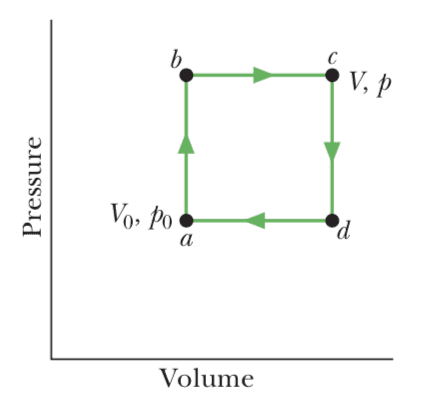
H_P29C20.png
and asks the student for the work done during the cycle, the heat added during stroke abc, the efficiency of the cycle, and the efficiency of a Carnot cycle operating between the highest and lowest temperature in the cycle.

The efficiency of the cycle turns out to be (of course) less than the Carnot cycle. I'm not exactly clear about why it is not equal to it, being the cycle reversible.

One possible answer is that, in order to make that cycle reversible, heat should be exchanged gradually, i.e. via a series of "small" isothermal processes, and for that one needs many reservoirs at different constant temperatures.
If this is the case, the Carnot Principle cannot be applied to this cycle in a straightforward way, because this cycle is not "operating between two reservoirs".

Is that it?

I have further questions about this kind of situation, but I'll ask them later.
 
Science news on Phys.org
FranzDiCoccio said:
Summary:: I have some doubts about the concepts in the title, at the level they are presented in high-school physics

Hi all,
this question is related to a similar one I posted a couple of weeks back.
Please keep in mind that the level here is high school. I'm looking for a way of describing the concepts in the title that is not overly technical. I keep circling back to these concepts because it seems to me that there is something I'm missing, but I'm not able to put my finger on it.

So my question has basically to do with Carnot's principle, and reversible vs irreversible cycles.
From "Physics - 9th ed." by Cutnell and Johnson:
According to this principle, one must conclude that all reversible cycles between the same two temperatures should attain the same efficiency. Since the Carnot cycle is the prototype of reversible cycle, all reversible cycles between the same two temperatures should attain the same efficiency as the Carnot cycle.

Now in high-school textbooks I find problems about "non-Carnot" cycles. For instance, problem 29 of chapter 20 in "Fundamentals of Physics" by Halliday-Resnick/Walker shows this cycle, specifying that it is reversible,
and asks the student for the work done during the cycle, the heat added during stroke abc, the efficiency of the cycle, and the efficiency of a Carnot cycle operating between the highest and lowest temperature in the cycle.

The efficiency of the cycle turns out to be (of course) less than the Carnot cycle. I'm not exactly clear about why it is not equal to it, being the cycle reversible.

One possible answer is that, in order to make that cycle reversible, heat should be exchanged gradually, i.e. via a series of "small" isothermal processes, and for that one needs many reservoirs at different constant temperatures.
If this is the case, the Carnot Principle cannot be applied to this cycle in a straightforward way, because this cycle is not "operating between two reservoirs".

Is that it?

I have further questions about this kind of situation, but I'll ask them later.
That's exactly it. The reversible cycle in the figure is not operating between two constant temperature reservoirs. It makes use of a sequence of reservoirs at different temperatures (between the extreme maximum and minimum temperatures).
 
  • Like
Likes   Reactions: Lord Jestocost and vanhees71
Hi Chestermiller,
thanks again for your help.
Below I'm asking three more questions, just to make sure I have the correct picture.
I guess that after those I have a couple more, but they are probably not "critical". It is just a matter of curiosity

Question 1
Since we have a lot of isothermal processes with different reservoirs we cannot use the simple formula \Delta S = Q/T. We need to use the formulas where the temperature varies, like
<br /> \Delta S_{1,2} = n C_v \ln\left(\frac{T_2}{T_1}\right)+n R \ln\left(\frac{V_2}{V_1}\right)<br />
and the other one with C_p and the pressures.

Anyway, since the gas goes through a cycle it will be \Delta S_{\rm gas} = 0, and since the cycle is reversible it will be \Delta S_{\rm reservoirs} = - \Delta S_{\rm gas} = 0.

Is this correct?

Question 2
Would it make sense to consider that same cycle between just two reservoirs?
Would the same diagram describe such cycle? In this case the processes (or at least some of them) would be irreversible. Could they be drawn in a p-V diagram?
Or else, irreversibility means that we do not really know the relation between pressure and volume (assuming these are well defined concept for the working substance in this case).

Question 3
If the same cycle happens between only two reservoirs (and is hence irreversible), can we say the following?
  • Since the gas goes through a cycle anyway, \Delta S_{\rm gas} = 0.
  • Since there are only two reservoirs, their change in entropy is \Delta S_{\rm res.} =|Q_c|/T_c- |Q_h|/T_h, exactly as for the Carnot cycle.
  • since this is a reversible engine \eta&lt;\eta_{\rm Carnot}, which entails |Q_c|/|Q_h|&gt; T_c/T_h, and hence \Delta S_{\rm res} &gt;0
  • although the gas goes through a cycle, the reservoirs won't. That makes sort of sense, because the hot reservoir keeps giving away energy, and the cold one keeps absorbing (a smaller amount of) energy. Also these processes happen at different temperatures.
 
FranzDiCoccio said:
Hi Chestermiller,
thanks again for your help.
Below I'm asking three more questions, just to make sure I have the correct picture.
I guess that after those I have a couple more, but they are probably not "critical". It is just a matter of curiosity

Question 1
Since we have a lot of isothermal processes with different reservoirs we cannot use the simple formula \Delta S = Q/T. We need to use the formulas where the temperature varies, like
<br /> \Delta S_{1,2} = n C_v \ln\left(\frac{T_2}{T_1}\right)+n R \ln\left(\frac{V_2}{V_1}\right)<br />
and the other one with C_p and the pressures.

Anyway, since the gas goes through a cycle it will be \Delta S_{\rm gas} = 0, and since the cycle is reversible it will be \Delta S_{\rm reservoirs} = - \Delta S_{\rm gas} = 0.

Is this correct?
Yes
Question 2
Would it make sense to consider that same cycle between just two reservoirs?
Would the same diagram describe such cycle? In this case the processes (or at least some of them) would be irreversible. Could they be drawn in a p-V diagram?
Or else, irreversibility means that we do not really know the relation between pressure and volume (assuming these are well defined concept for the working substance in this case).

Question 3
If the same cycle happens between only two reservoirs (and is hence irreversible), can we say the following?
  • Since the gas goes through a cycle anyway, \Delta S_{\rm gas} = 0.
  • Since there are only two reservoirs, their change in entropy is \Delta S_{\rm res.} =|Q_c|/T_c- |Q_h|/T_h, exactly as for the Carnot cycle.
  • since this is a reversible engine \eta&lt;\eta_{\rm Carnot}, which entails |Q_c|/|Q_h|&gt; T_c/T_h, and hence \Delta S_{\rm res} &gt;0
  • although the gas goes through a cycle, the reservoirs won't. That makes sort of sense, because the hot reservoir keeps giving away energy, and the cold one keeps absorbing (a smaller amount of) energy. Also these processes happen at different temperatures.
With regard to questions 2 and 3, let's consider in detail what is happening inside the cylinder during the kind of irreversible change involving only 2 temperatures. Let's start out with the constant volume heating at the high temperature TH. What do you think is happening inside the gas when the cylinder is brought into contact with the high temperature reservoir, with regard to the temperature variations with spatial position in the gas and time? What about the variations in specific volume? Is the gas inside the cylinder deforming significantly with time? What about the spatial and time variations in pressure?
 
FranzDiCoccio said:
One possible answer is that, in order to make that cycle reversible, heat should be exchanged gradually, i.e. via a series of "small" isothermal processes, and for that one needs many reservoirs at different constant temperatures.

You can immediately tell that none of the curves on the pV diagram are isotherms.
 
Hi Chestermiller,
thanks again for your help, and apologies for the delay in my reply. It was not for lack of interest. The last few days have been quite hectic for me.

Chestermiller said:
With regard to questions 2 and 3, let's consider in detail what is happening inside the cylinder during the kind of irreversible change involving only 2 temperatures. Let's start out with the constant volume heating at the high temperature TH. What do you think is happening inside the gas when the cylinder is brought into contact with the high temperature reservoir, with regard to the temperature variations with spatial position in the gas and time? What about the variations in specific volume? Is the gas inside the cylinder deforming significantly with time? What about the spatial and time variations in pressure?

I guess that we cannot say that the gas as a whole has one temperature, or one pressure. Very likely it's possible to introduce these quantities locally in the gas.
Anyway, since it is not possible to have a single meaningful value for these quantities (because the process is not quasi static), probably representing the process in a (V,p) diagram would make little sense.

So I guess that every time I see a diagram such as the one in the original post, I have to assume that all the processes are quasi static and reversible.
 
Mister T said:
You can immediately tell that none of the curves on the pV diagram are isotherms.

Ok, but I never said that.
I'm aware of the fact that this particular cycle is two isobaric and two isochoric processes, and that the temperature varies continuously during such processes.

I was referring to the fact that temperature must be varied quasi statically, in little isothermal steps. I think one other way of viewing this is "slicing" this cycle into a sequence of many contiguous Carnot cycles.
 
FranzDiCoccio said:
Hi Chestermiller,
thanks again for your help, and apologies for the delay in my reply. It was not for lack of interest. The last few days have been quite hectic for me.
I guess that we cannot say that the gas as a whole has one temperature, or one pressure. Very likely it's possible to introduce these quantities locally in the gas.
Anyway, since it is not possible to have a single meaningful value for these quantities (because the process is not quasi static), probably representing the process in a (V,p) diagram would make little sense.

So I guess that every time I see a diagram such as the one in the original post, I have to assume that all the processes are quasi static and reversible.
You are correct that there are pressure and temperature non-uniformities within the system in various types of irreversible changes. This particularly applies to the temperature if the system is held in contact with a constant temperature reservoir. In irreversible non-quasi-static changes, we replace the pressure with the stress(es), which includes viscous effects that depend on instantaneous local velocity gradients in the fluid. This can be even more complicated if the fluid movement is turbulent.

That said, if we know the external pressure on the fluid (i.e., also equal to the fluid stress at the interface with the moving boundary), we can plot that vs the volume change, and use that to get the work on a diagram of the kind you refer to. But this stress is not equal to the pressure calculated from the ideal gas law.
 

Similar threads

  • · Replies 5 ·
Replies
5
Views
3K
Replies
12
Views
3K
  • · Replies 1 ·
Replies
1
Views
2K
  • · Replies 8 ·
Replies
8
Views
14K
  • · Replies 8 ·
Replies
8
Views
3K
  • · Replies 19 ·
Replies
19
Views
4K
Replies
8
Views
2K
  • · Replies 5 ·
Replies
5
Views
2K
  • · Replies 4 ·
Replies
4
Views
780
  • · Replies 15 ·
Replies
15
Views
3K