Reversible Otto Cycle Efficiency: Investigating the Difference from Carnot's

Join the discussion
Ask a follow-up here, or get your own question answered by working scientists, mathematicians and engineers — people, not an autocomplete.
Real named experts · corrections over time · the nuance an AI answer skips
8 replies · 3K views
Jacob White
Messages
55
Reaction score
12
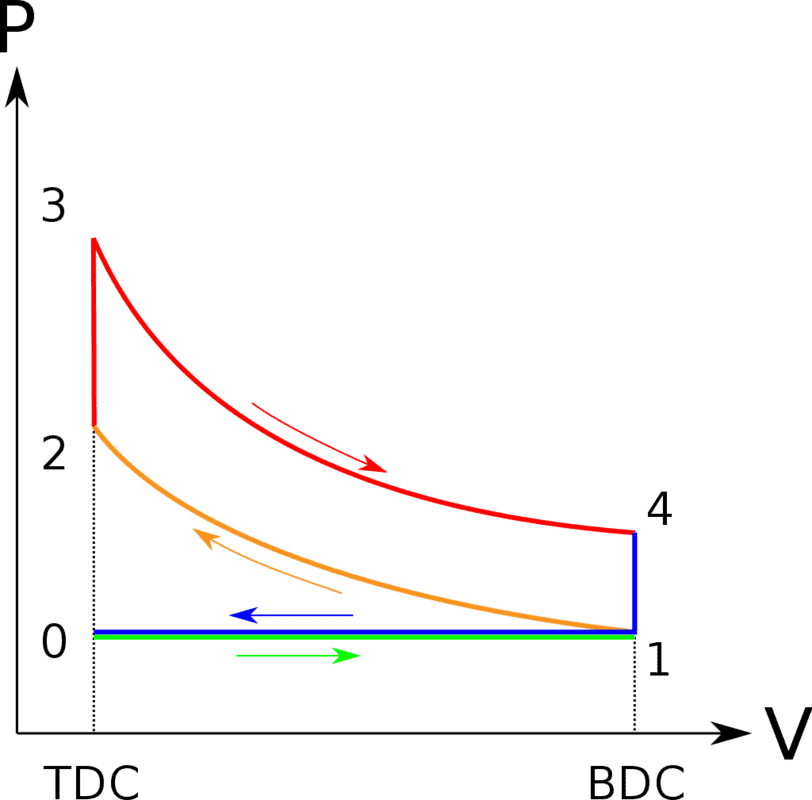
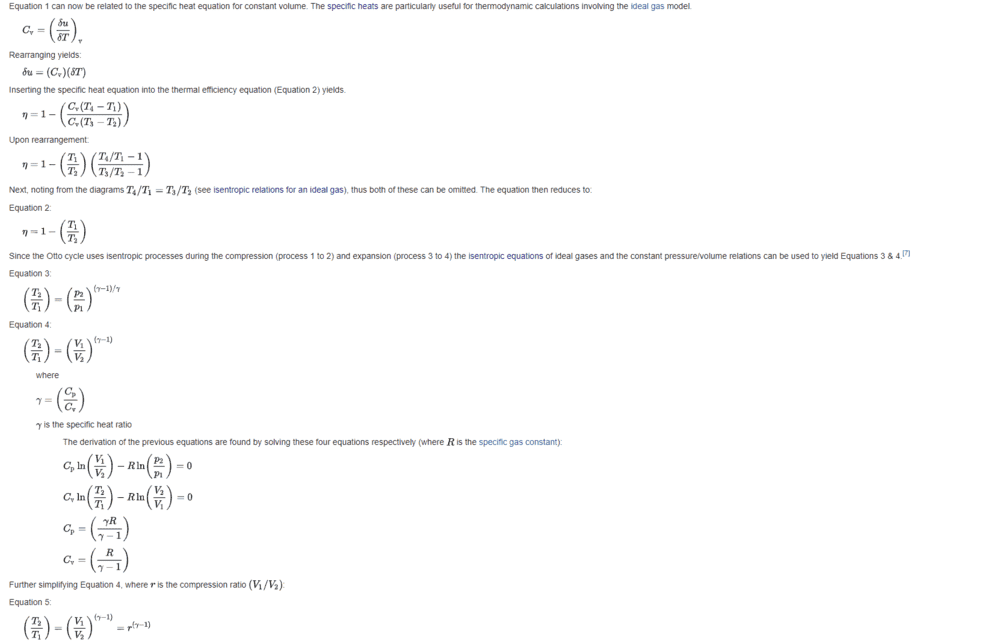
So we know that every reversible engine working between the same temperatures will have the same efficiency(the same as Carnot engine). So let's consider for example reversible Otto cycle. So as you can see on the picture it is operating between ##T_1## and ##T_3##, so I was thinking that it should have efficiency ##f = 1 - \frac {T_1} {T_3}## Below there is a derivation assuming reversibility(Indeed it is reversible there is no entropy increase), however we don't get Carnot but: ##f = 1 - \frac {T_1} {T_2}## which is lower. How is it possible?
1595065101468.png
1595065130512.png
https://en.wikipedia.org/wiki/Otto_cycle
 
Last edited by a moderator:
on Phys.org
They are different efficiencies! What you refer to is better stated that every reversible heat engine working between two heat reservoirs ##T_H## and ##T_C## have the same efficiency, the Carnot efficiency. This is what pertains to Carnot's theorem, that ##\eta_{CE} \geq \eta_{X}## with the equality only holding if the engine ##X##, which also operates between two temperatures ##T_H## and ##T_C##, is reversible. The Otto cycle is a different type of cycle which operates between different configuration of reservoirs.
 
Last edited by a moderator:
  • Like
Likes   Reactions: Jacob White
Jacob White said:
So we know that every reversible engine working between the same temperatures will have the same efficiency(the same as Carnot engine).
That is not true. Reversible engines do not necessarily have the same efficiencies. And the Carnot cycle provides an upper limit on the efficiency that any classical thermodynamic engine can achieve during the conversion of heat into work. (Wikipedia)
 
  • Like
Likes   Reactions: Jacob White and etotheipi
jack action said:
Reversible engines do not necessarily have the same efficiencies. And the Carnot cycle provides an upper limit on the efficiency that any classical thermodynamic engine can achieve during the conversion of heat into work. (Wikipedia)

That is fine, but statement you quoted is true if we make the assertion that the heat engine necessarily operates between two heat reservoirs.
 
  • Like
Likes   Reactions: Jacob White
Ok, now I see that indeed reversible engines would have the Carnot efficiency only when working between 2 heat reservoirs at given temperatures. And with different temperatures this argument of reversing cycle and using to produce additional work just doesn't work.
 
  • Like
Likes   Reactions: etotheipi
Jacob White said:
And with different temperatures this argument of reversing cycle and using to produce additional work just doesn't work.

I don't understand this part... wouldn't reversing a cycle involve doing work on the engine to move heat from the lower temperature reservoir to the higher temperature reservoir (e.g. a refrigerator?).
 
I have said that too briefly. I have seen proof like this: If we had two heat reservoirs at T1 and T2 and two reversible engines A and B. So suppose A takes heat Q1 from T1 and doing work W1. B is also reversible so we can reverse it's cycle so it would use work W1 to transfer heat from T2 to T1. And if B would have better efficiency the same work W1 would be enough to bring back Q1 to T1 and we still have some energy to use - contradiction to second law. And then I realized that it really works only for 2 reservoirs and couldn't be generalised.
 
  • Like
Likes   Reactions: etotheipi
Cool, that makes more sense. Thanks for explaining to me!
 
Thanks for realizing me that it works only when we take heat only from 2 reservoirs!
 
  • Like
Likes   Reactions: etotheipi