Is a Rainbow Close to the Ground Possible? A Camera Optics Mystery

  • Context: High School 
  • Thread starter Thread starter Thalles
  • Start date Start date
  • Tags Tags
    Rainbows
Click For Summary
SUMMARY

The discussion centers on the phenomenon of rainbows appearing close to the ground, specifically questioning the validity of such occurrences. Participants confirm that while primary rainbows typically form at an angle of about 40 degrees from the sun, secondary rainbows can appear at 50 degrees, but are rare at low altitudes. The conversation highlights that rainbows require specific conditions, including a bright light source, droplet-laden air, and the observer's position. Additionally, the possibility of camera optics creating misleading visuals is considered, suggesting that the observed rainbow may not be a natural occurrence.

PREREQUISITES
  • Understanding of basic optics principles, including light refraction.
  • Knowledge of rainbow formation, specifically primary and secondary rainbows.
  • Familiarity with atmospheric conditions affecting light, such as droplet-laden air.
  • Awareness of camera optics and potential visual distortions.
NEXT STEPS
  • Research the physics of light refraction and its role in rainbow formation.
  • Explore the conditions necessary for observing primary and secondary rainbows.
  • Investigate the effects of camera optics on image capture and potential distortions.
  • Learn about atmospheric optics phenomena, including halos and ice-bows.
USEFUL FOR

Anyone interested in atmospheric optics, photographers seeking to understand light phenomena, educators teaching optics, and enthusiasts exploring the science behind rainbows.

Thalles
Messages
9
Reaction score
0
I think this is the correct subforum for this question. If I'm wrong, please, forgive me.

Well, to the question.

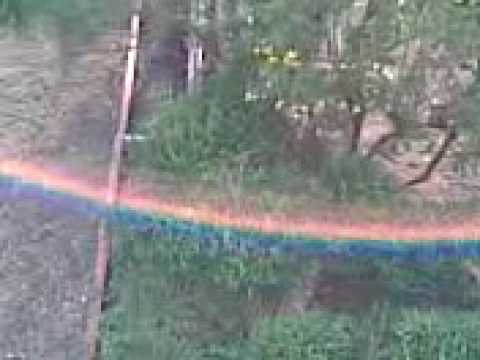
I was browsing some wonderful pictures and videos and one crossed my vision and raised a doubt.
hqdefault.jpg


When I studied optics back in my school, I learned that the red wave stayed in the "outside" part of the rainbow, in the "outside" curvature. Also, I never saw a rainbow so close to the ground.
Is this possible or it's probably graphical working?

Many thanks for the attention.
Best wishes.
 
Science news on Phys.org
Thalles said:
I learned that the red wave stayed in the "outside" part of the rainbow, in the "outside" curvature.
http://hyperphysics.phy-astr.gsu.edu/hbase/atmos/rbowpri.html#c2
see the secondary rainbow, you'll understand the formation of what you saw.
Thalles said:
Also, I never saw a rainbow so close to the ground.
Then it's your first, don't make it your last :)
 
  • Like
Likes   Reactions: Thalles
Thalles said:
I think this is the correct subforum for this question. If I'm wrong, please, forgive me.

Well, to the question.

I was browsing some wonderful pictures and videos and one crossed my vision and raised a doubt.
hqdefault.jpg


When I studied optics back in my school, I learned that the red wave stayed in the "outside" part of the rainbow, in the "outside" curvature. Also, I never saw a rainbow so close to the ground.
Is this possible or it's probably graphical working?

Many thanks for the attention.
Best wishes.

What makes you think this is a rainbow? It could easily be a refraction off a glass or window.

Zz.
 
Because it was from a video and it was outdoors and the people were seeing the rainbow and all.

I've seen this many months ago, so I don't have the page anymore, sorry. I just kept this image from the video.
 
Rainbows seen so close to the ground are rare simply because of the geometry required.

The droplet-laden air must be the right angular distance from the sun (~40 degrees for primary bow, 50 degrees for secondary bow with inverted colours). In order for that to occur below the horizon line, the air must be pretty much at your feet.

This occurs when looking through a sprinkler or other misting apparatus, but rarely occurs in nature because you're usually looking at a volume of air in the distance and in the sky.

rainbow.jpg
 
Last edited by a moderator:
Rainbows are formed with the sun behind the observer and not in front, as that diagram implies. (I wonder where it came from originally as there are hundreds of the correct version if you look on google) There are only a few situations where the Sun is low enough in the sky and the observer high enough to see the invert of the circular bow. I have had spectacular views from an aeroplane of a complete circle and a few good ones in the back garden with a garden hose, getting just the correct angles.

You can get coloured halos around the sun - typically die to ice crystals in the atmosphere.
 
I think this video was filmed in Tibet, which would explain the angle.
 
Thalles said:
I think this video was filmed in Tibet, which would explain the angle.
Quite possibly; looking down into a valley with the Sun quite low in the sky.
You can see, from the lighting on the leaves, that the Sun is actually behind the camera.
 
Can secondary rainbows appear alone?
 
  • #10
Thalles said:
Can secondary rainbows appear alone?
i don't see why not!If the sun is at 51° from the water droplets.
 
  • Like
Likes   Reactions: Thalles
  • #11
Thalles said:
Can secondary rainbows appear alone?
Yes, in theory.

Rainbows require the presence of droplet-laden air in the right place. If there is droplet-laden air 50 degrees away from the sun, but not 40 degrees away from the sun, then the primary bow will not be seen.
 
  • Like
Likes   Reactions: Thalles
  • #12
Thalles said:
Can secondary rainbows appear alone?

The two rainbows have no direct relationship. Neither is caused by the other. They require a number things to appear:

1. A bright, pointlike illumination source
2. A path from that source to the refraction area.
3. A volume of air at the refraction area containing suspended spherical droplets.
4. A path from the refraction area to your eye.

If there is a cloud in the way of the light illuminating the area responsible for the primary rainbow, you don't get the primary rainbow. If there are no droplets in the area responsible for the primary rainbow, you don't get the primary rainbow. If you hold your hand in front of your eye so that you can't see the primary rainbow, you won't see the primary rainbow. In all three cases you may nonetheless be able to see the secondary rainbow.
 
  • Like
Likes   Reactions: Thalles and Suraj M
  • #13
I found another video of the same rainbow. Turns out that this rainbow was considered a holy sign because it appeared during the funeral of one tibetan Lama


Here it is.

It's weird, but I don't think it's impossible.
 
  • #14
Thalles said:
It's weird, but I don't think it's impossible.
No, that is very weird. (Assuming no tampering.)

A secondary bow occurring without a primary isn't hard to do over a short arc, because the pocket of droplet-laden air can be arbitrarily small, or in the wrong place, so only the secondary is formed. But - it forms only in a short arc. [see middle panel in highly technically-accurate simulation below]

But the secondary bow in the video is pretty much fully circular. How can you have a mass of droplet-laden air in a circle 50 degrees from the sun but not at 40 degrees? What? Is it a torus of moist air?

That makes no sense, so there must be another explanation.

rainbow2.jpg


One thing I should point out in the video that I did not simulate: you can see that the bow is visible in front of spectators very nearby, which means the moisture-laden air is not distant and high-in-the-sky; the videographer is in the air mass.
 
Last edited:
  • #15
Looking around the webernets, I see that it is not uncommon afterall.

Googling full circle rainbow, I can find pics of "normal" full circle double rainbows, but also full circle inverted-only rainbows (characterized by having the blue band outside, and red inside).

http://i.dailymail.co.uk/i/pix/2007/08_01/rainbowG0608_468x479.jpg

So I think this is more closely-related to halos or ice-bows, which are due to ice crystals, rather than water-droplets.
Also, they occur at 22 degrees, not at 40 or 50 degrees.

I don't have a complete explanation for the different phenom yet, but I think we're getting closer.
 
  • #16
DaveC426913 said:
So I think this is more closely-related to halos or ice-bows, which are due to ice crystals, rather than water-droplets.
How many crystals/droplets/whatever you think there are between the camera and the monk in the picture below?

tibet_rainbow.png


This looks like a effect created by the cameras optics, or something attached to the camera.
 
  • #17
A.T. said:
How many crystals/droplets/whatever you think there are between the camera and the monk in the picture below?
I know. It's a mystery.

A.T. said:
This looks like a effect created by the cameras optics, or something attached to the camera.
Possibly. I've seen a lot of camera optics effects, but not like this. Not saying I disagree, just that it's a mystery to me.[/QUOTE]
 

Similar threads

  • · Replies 9 ·
Replies
9
Views
8K
  • · Replies 20 ·
Replies
20
Views
4K
  • · Replies 69 ·
3
Replies
69
Views
16K
  • · Replies 5 ·
Replies
5
Views
4K
  • · Replies 7 ·
Replies
7
Views
2K
  • · Replies 24 ·
Replies
24
Views
5K
  • · Replies 2 ·
Replies
2
Views
1K
  • · Replies 13 ·
Replies
13
Views
4K
  • · Replies 40 ·
2
Replies
40
Views
7K
  • · Replies 6 ·
Replies
6
Views
2K