Homework Help Overview
The discussion revolves around the measurement of temperature change in a thermal physics context, specifically questioning the intuitiveness of a rate of 100 K/s as a measure of temperature change.
Discussion Character
- Exploratory, Assumption checking, Conceptual clarification
Approaches and Questions Raised
- Participants discuss the appropriateness of a given approach to the problem, questioning the correctness of results derived from thermal equations. There is an exploration of the implications of a high rate of temperature change and its physical feasibility.
Discussion Status
The discussion is active, with participants raising questions about the validity of results and assumptions made in calculations. Some guidance has been offered regarding the interpretation of units and the implications of the heating rate, but no consensus has been reached.
Contextual Notes
Participants note the significance of units such as kilowatts for power input and kilograms for mass, which are crucial for understanding the calculations involved. There is also mention of potential oversight in computations that could lead to the perceived high rate of temperature change.

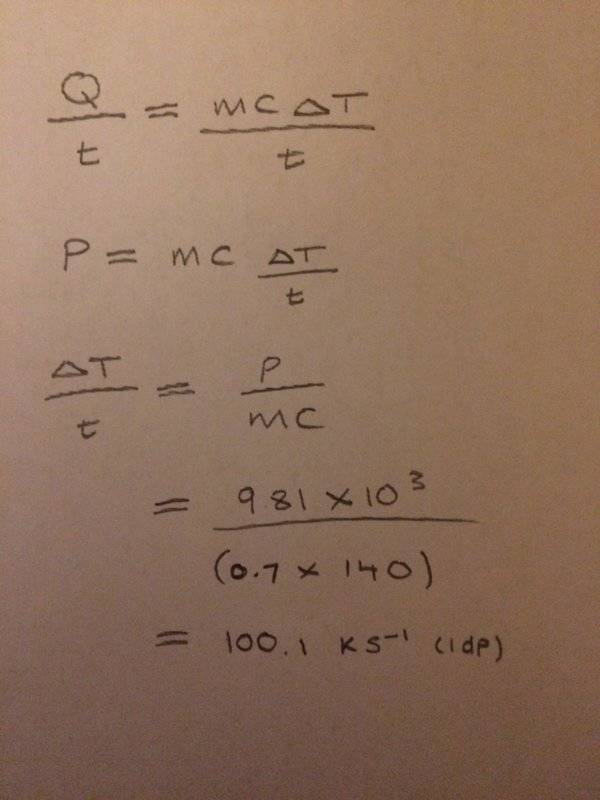
 . Looking at the faint decimal point in "nine point eight one" and figuring he'd missed that in his computation; wasn't paying attention...100K/s? Intuitively offensive, but...