Is arcsec = 1 divided by arccos ? Arcsec = 1/arccos

  • Context: Undergrad 
  • Thread starter Thread starter Vividly
  • Start date Start date
Click For Summary

Discussion Overview

The discussion revolves around the relationship between the arcsecant and arccosine functions, specifically whether arcsec(x) is equal to 1/arccos(x). Participants explore this concept through various mathematical approaches, including the use of triangles and derivatives, while also addressing potential misunderstandings about reciprocal and inverse functions.

Discussion Character

  • Exploratory
  • Technical explanation
  • Debate/contested
  • Mathematical reasoning

Main Points Raised

  • Some participants express confusion about the meaning of 1/arccos and its relationship to arcsec.
  • Others suggest checking values using a calculator to see if arcsec(x) equals 1/arccos(x) for specific angles.
  • There is a discussion about the distinction between reciprocal and inverse functions, with some arguing that they do not equate.
  • One participant proposes that arcsec(1/x) might equal 1/arccos(x), prompting further exploration of this relationship.
  • Concerns are raised about the domains of the functions, with some noting that they do not match, which could imply they are not the same function.
  • Participants discuss the process of finding derivatives of inverse trigonometric functions and the challenges of using triangles to visualize these relationships.
  • There are claims that the derivative of 1/arccos(x) leads to confusion, with some participants suggesting that it results in an incorrect expression.

Areas of Agreement / Disagreement

Participants do not reach a consensus on whether arcsec(x) equals 1/arccos(x). There are multiple competing views, with some asserting they are different functions while others explore potential relationships.

Contextual Notes

Limitations include unresolved mathematical steps regarding the derivatives and the specific conditions under which the functions are defined. Additionally, there is uncertainty about the correct application of trigonometric identities and their implications.
Vividly
Messages
44
Reaction score
0
TL;DR
Im confused about what 1/arccos is equal too.
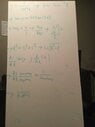
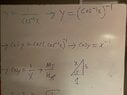
Im not sure what 1/arccos is. I looked online and all I have found is y=arccos(1/x) and I am not sure if that's the same thing. I tried to make a triangle to decipher the answer. However when I looked at the answer when I finished it was incorrect. I got 1/xsqrt(x^2-1) and the answer is 1/(arccos)^2 sqrt(1-x^2)
 

Attachments

  • image.jpg
    image.jpg
    31.5 KB · Views: 189
Mathematics news on Phys.org
You could try putting some angles into a calculator or spreadsheet and checking whether ##arcsec \ x = \frac 1 {\arccos x}##.

Alternatively, if we let ##y = \arccos x## and ##z = arcsec \ x##, then ##\sec z = x## ... Can you finish it from there?
 
You seem to confuse reciprocal and inverse function. Say
y=\frac{1}{\arccos x},
x=\cos(\frac{1}{y})
Say
y=arccos(\frac{1}{x})
x=\frac{1}{\cos y}
 
  • Like
Likes   Reactions: FactChecker
PeroK said:
You could try putting some angles into a calculator or spreadsheet and checking whether ##arcsec \ x = \frac 1 {\arccos x}##.

Alternatively, if we let ##y = \arccos x## and ##z = arcsec \ x##, then ##\sec z = x## ... Can you finish it from there?
I am confused about why you have all those number signs. Is it for a formula in excel? If your say that z=arcsec divided by x is equal to some number or 1/secz=x then x = cosz
 
anuttarasammyak said:
You seem to confuse reciprocal and inverse function. Say
y=\frac{1}{\arccos x},
x=\cos(\frac{1}{y})
Are you saying reciporal and inverse functions do not equate to one another? So 1/arccos(x)≠ arcsec(x) ?
 
Vividly said:
I am confused about why you have all those number signs. Is it for a formula in excel? If your say that z=arcsec divided by x is equal to some number or 1/secz=x then x = cosz
What's a "number sign"? You mean variables ##y, z##?

You do understand that IF ##arcsec \ x = \frac 1 {\arccos x}##, then this is true for any angle ##x##?

That means that:

##arcsec \ 0.1 = \frac 1 {\arccos 0.1}##

##arcsec \ 0.5 = \frac 1 {\arccos 0.5}##

##arcsec \ 1.0 = \frac 1 {\arccos 1.0}##

Etc. Did you try those on a calculator to see whether they really are equal?
 
Vividly said:
If you’re saying that z=arcsec divided by x is equal to some number or 1/secz=x then x = cosz
 
Vividly said:
So 1/arccos(x)≠ arcsec(x) ?
I am not used to arcsec function in RHS. I assume it means
x=\sec y = \frac{1}{\cos y} right ?

LHS function means
x=cos(\frac{1}{y})

They are different functions.
 
Last edited:
PeroK said:
What's a "number sign"? You mean variables ##y, z##?

You do understand that IF ##arcsec \ x = \frac 1 {\arccos x}##, then this is true for any angle ##x##?

That means that:

##arcsec \ 0.1 = \frac 1 {\arccos 0.1}##

##arcsec \ 0.5 = \frac 1 {\arccos 0.5}##

##arcsec \ 1.0 = \frac 1 {\arccos 1.0}##

Etc. Did you try those on a calculator to see whether they really are equal?
Arcsec(0.1) =error
I/arccos(0.1)=.6799811946

with that being said they’re not the same. So inverse trig functions have no relation, well at least in this regard. So how can I solve the problem? I don’t understand how to make it possible. I can try the quotient rule but not sure if that will work.
 
  • #10
Vividly said:
Arcsec(0.1) =error
I/arccos(0.1)=.6799811946
So, they don't even have the same domain. Not much chance of being the same function then.
 
  • #11
What about? $$arcsec(\frac 1 x) = \frac{1} {\arccos x}$$Does that look better?
 
  • Like
Likes   Reactions: Vividly
  • #12
Vividly said:
Arcsec(0.1) =error
I/arccos(0.1)=.6799811946
PeroK said:
What about? $$arcsec(\frac 1 x) = \frac{1} {\arccos x}$$Does that look better?
They both show up as errors. So what would make them show up as actual numbers?
 
  • #13
Vividly said:
They both show up as errors. So what would make them show up as actual numbers?
They shouldn't have. Let's try to prove this anyway:

Let ##z = arcsec(\frac 1 x)##, then ##\sec z = \frac 1 x##, and ##\cos z = \frac 1 {\sec z} = x## and ##z = \arccos x##.

So, it seems that we what really want is: $$\arccos x = arcsec(\frac 1 x)$$
 
  • Like
Likes   Reactions: anuttarasammyak
  • #14
PeroK said:
They shouldn't have. Let's try to prove this anyway:

Let ##z = arcsec(\frac 1 x)##, then ##\sec z = \frac 1 x##, and ##\cos z = \frac 1 {\sec z} = x## and ##z = \arccos x##.

So, it seems that we what really want is: $$\arccos x = arcsec(\frac 1 x)$$
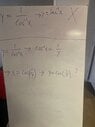
I guess what I am asking is how to find the derivative of y=1/arccos with a triangle. I am not sure how to put x=cos(1/y) on a right triangle to find the Hypotenuse, Opposite and Adjacent like I did for this problem.
 

Attachments

  • image.jpg
    image.jpg
    26.2 KB · Views: 196
  • #15
Vividly said:
I guess what I am asking is how to find the derivative of y=1/arccos with a triangle. I am not sure how to put x=cos(1/y) on a right triangle to find the Hypotenuse, Opposite and Adjacent like I did for this problem.
An interesting idea. If you differentiate ##y = \frac 1 {\arccos x}##, you must get an ##\arccos^2 x## term in the denominator. It's not going to come out as a polynomial in ##x##.
 
  • #16
PeroK said:
An interesting idea. If you differentiate ##y = \frac 1 {\arccos x}##, you must get an ##\arccos^2 x## term in the denominator. It's not going to come out as a polynomial in ##x##.
Yes, that's what I don’t understand how that came to be. The answer I get is 1/xsqrt(x^2-1). Did you do the quotient rule or did you do the power rule and bring arccos to the top then take the derivative?
 
  • #17
Vividly said:
The answer I get is 1/xsqrt(x^2-1).
That can't be right. That's the derivative of ##\arctan(\sqrt{x^2 - 1})##.
 
  • #18
Vividly said:
I am confused about why you have all those number signs.
This sounds like you are seeing the LaTeX code rather than the resulting equations that are rendered. Refreshing the screen may help. Those do not always render properly -- though they showed up well for me.

Also, if you are responding to a post, the LaTeX code is helpfully presented in code form, rather than rendered form. This allows you to see how @PeroK composed the equations so that you can retrieve that quoted code and modify it to use in your response. See the LaTeX Guide below the editing window.
 
  • Like
Likes   Reactions: Vividly
  • #19
PeroK said:
That can't be right. That's the derivative of ##\arctan(\sqrt{x^2 - 1})##.
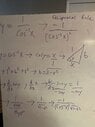
Yes, I made a mistake because supposedly 1/arccosx ≠arcsec. I will try to write out my thoughts again and show you
 

Attachments

  • AA121692-0F46-4582-A463-46CD97CCB821.jpeg
    AA121692-0F46-4582-A463-46CD97CCB821.jpeg
    27.2 KB · Views: 199
  • image.jpg
    image.jpg
    24.5 KB · Views: 196
  • #20
Vividly said:
Yes, I made a mistake because supposedly 1/arccosx ≠arcsec.
There's no supposedly about it. They are definitely not the same thing.
 
  • #21
PeroK said:
There's no supposedly about it. They are definitely not the same thing.
Well with that being said, I am trying to figure out how to make it into a triangle so I can know how to solve it from scratch without memorizing. Did you do the quotient rule or reciprocal rule to solve it? I am want to figure out how to get the polynomial under the square root.
 
  • #22
Vividly said:
Well with that being said, I am trying to figure out how to make it into a triangle so I can know how to solve it from scratch without memorizing.
There's nothing to memorise to get inverse trig derivatives. You just use the chain rule: $$f^{-1}(f(x)) = x \ \Rightarrow \ (f^{-1})'(f(x))f'(x) = 1 \ \Rightarrow \ (f^{-1})'(f(x)) = \frac 1 {f'(x)}$$ For example:$$f(x) = \tan x \ \Rightarrow \ f'(x) = \sec^2 x = \tan^2 x + 1 \ \Rightarrow \ (\tan^{-1})'(\tan x) = \frac 1 {\tan^2 x + 1}$$$$\Rightarrow \ (\tan^{-1})'(x) = \frac 1 {x^2 + 1}$$
 
  • #23
PeroK said:
There's nothing to memorise to get inverse trig derivatives. You just use the chain rule: $$f^{-1}(f(x)) = x \ \Rightarrow \ (f^{-1})'(f(x))f'(x) = 1 \ \Rightarrow \ (f^{-1})'(f(x)) = \frac 1 {f'(x)}$$ For example:$$f(x) = \tan x \ \Rightarrow \ f'(x) = \sec^2 x = \tan^2 x + 1 \ \Rightarrow \ (\tan^{-1})'(\tan x) = \frac 1 {\tan^2 x + 1}$$$$\Rightarrow \ (\tan^{-1})'(x) = \frac 1 {x^2 + 1}$$
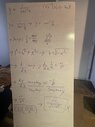
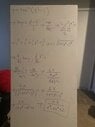
I figured it out
 

Attachments

  • image.jpg
    image.jpg
    30.5 KB · Views: 249
  • #24
You have the wrong sign there. The derivative should be positive.
 
  • #25
PeroK said:
You have the wrong sign there. The derivative should be positive.
Yes the negative on top and the one at the bottom cancel. I just didn’t show it canceling. Thank you for the help.
 
  • #26
PeroK said:
They shouldn't have. Let's try to prove this anyway:

Let ##z = arcsec(\frac 1 x)##, then ##\sec z = \frac 1 x##, and ##\cos z = \frac 1 {\sec z} = x## and ##z = \arccos x##.

So, it seems that we what really want is: $$\arccos x = arcsec(\frac 1 x)$$
What do you get when you put it in a calculator? I tried to resolve the problem but with arcsec(1/x) and got a different answer than the derivative of 1/arccosx
 
  • #27
Say
y=\frac{1}{\arccos x}
, calculation of its derivative is :
x=\cos\frac{1}{y}
dx=-\sin(\frac{1}{y})\ \ (-\frac{dy}{y^2})
\frac{dy}{dx}=\frac{y^2}{\sin\frac{1}{y}}=\frac{(\arccos x)^{-2}}{\sin(\arccos x)}=\frac{(\arccos x)^{-2}}{\pm\sqrt{1-x^2}}
arccos function is a multi-value function so we should be careful.
スライド1.JPG
 
Last edited:
  • #28
Vividly said:
What do you get when you put it in a calculator? I tried to resolve the problem but with arcsec(1/x) and got a different answer than the derivative of 1/arccosx
What calculation did you do?
 
  • #29
anuttarasammyak said:
\frac{dy}{dx}=\frac{y^2}{\sin\frac{1}{y}}=\frac{(\arccos x)^{-2}}{\sin(\arccos x)}=\frac{(\arccos x)^{-2}}{\pm\sqrt{1-x^2}}
arccos function is a multi-value function so we should be careful.
For all ##x \in [-1, 1]## we have:$$\cos (\arccos x) = x$$$$\sin(\arccos x) = \sqrt{1-x^2}$$And, for ##x \in [0, \pi]##$$\arccos(\cos x) = x$$But, for ##x \in (\pi, 2\pi]##$$\arccos(\cos x) = 2\pi - x$$
 
  • #30
PeroK said:
What calculation did you do?
Its completely different. Not sure what I am doing wrong. Unless arccos(x) ≠arcsec(1/x) like I stated at the top right of the board.
 

Attachments

  • image.jpg
    image.jpg
    32.6 KB · Views: 190

Similar threads

  • · Replies 7 ·
Replies
7
Views
2K
  • · Replies 2 ·
Replies
2
Views
3K
  • · Replies 12 ·
Replies
12
Views
3K
  • · Replies 6 ·
Replies
6
Views
2K
  • · Replies 25 ·
Replies
25
Views
1K
  • · Replies 13 ·
Replies
13
Views
1K
  • · Replies 2 ·
Replies
2
Views
2K
  • · Replies 6 ·
Replies
6
Views
2K
  • · Replies 7 ·
Replies
7
Views
1K
  • · Replies 34 ·
2
Replies
34
Views
3K