Is Earth a Viable Substitute for the Neutral Wire in Electrical Systems?

  • Thread starter Thread starter Chris Toffer
  • Start date Start date
  • Tags Tags
    Earth Neutral
Click For Summary
SUMMARY

The discussion centers on the feasibility of using Earth as a neutral wire in electrical systems, particularly in Single Wire Earth Return (SWER) systems. Participants confirm that while current can flow through the Earth, doing so poses significant safety risks, especially if the system is not designed for it. The consensus emphasizes that using Earth as a neutral can lead to dangerous conditions, such as creating a potential difference that could electrify metalwork in fault scenarios. Proper grounding and separation of neutral and ground are essential for safety in electrical installations.

PREREQUISITES
  • Understanding of Single Wire Earth Return (SWER) systems
  • Knowledge of electrical grounding and neutral wire functions
  • Familiarity with Ohm's Law and electrical resistance concepts
  • Basic principles of alternating current (AC) behavior
NEXT STEPS
  • Research the design and safety standards for Single Wire Earth Return (SWER) systems
  • Study the implications of grounding and neutral separation in electrical systems
  • Learn about fault conditions and their impact on electrical safety
  • Explore the principles of current flow and resistance in complex circuits
USEFUL FOR

Electrical apprentices, engineers, and safety professionals seeking to understand the implications of using Earth as a neutral wire and the associated risks in electrical systems.

Chris Toffer
Messages
3
Reaction score
0
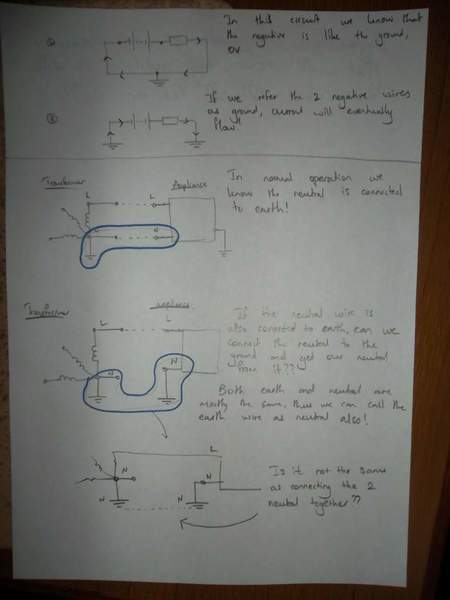
In a power station, the transformer's neutral wire is the same which is connected to earth. My question is if the neutral and the Earth is basically the same wire, can we use the Earth as our neutral point? i mean will it be a closed circuit where current will flow if we connect our neutral wire to earth??

SAM_0414.jpg


Regardless any danger that will occur, i just want to know if the current will flow through the ground or not...
 
Engineering news on Phys.org
Chris Toffer said:
My question is if the neutral and the Earth is basically the same wire, can we use the Earth as our neutral point? i mean will it be a closed circuit where current will flow if we connect our neutral wire to earth??
Yes. In rural areas with long runs of wire, costs can be lowered by using a single high voltage conductor and the Earth as the current return path.


Swer.gif


Single wire Earth return (SWER)
 
The "quality" of your voltage depends on how the transformer is grounded. In a floating neutral point or delta connected secondary a phase-ground connection would not give the same function as a phase-phase connection. But it would still be a potential difference between one phase and ground! That is a fascinating fact! Do you know why?
 
thanks for ur reply, my problem is solved
 
nope why is it fascinating??
 
May I interject here ... in theory yes you can use the Earth path as a neutral but in reality doing so if the system isn't specifically designed as such then strapping the return neutral path to Earth can be very dangerous...
Consider a fault condition where the neutral was lost then the Earth will become the return path and this could make all Earth metal work at mains potential if a incomplete circuit ... lethal to the next joe blogs who might put his hand on the radiator
 
  • Like
Likes   Reactions: 1 person
Yes, current will flow.

We obviously go to great lengths to separate ground and neutral in our everyday wiring.
You might ask the question, will the circuit work if I don't ground it. Yes, it will.
You might ask the question, what if I just use the ground wire for my nuetral...will it work...yes it will.

All those conditions will work, just they all break code and can kill in short circuit situations and what not.

And just because a transformer has it's neutral grounded, that is not an invite to use the ground as neutral. Two return paths is always ideal.

If you have an ohmeter, stick in it the dirt outside your house. Keep the prongs like 5 feet about. You will probably read a few ohms give or take according to the moisture in your soil. V=IR...so you can guess your voltage drop.
 
  • Like
Likes   Reactions: 1 person
Hi,

I am an electrical apprentice currently undergoing studies and we touched on the SWER system today. My question is in regards to how the electrons actually travel back to the distribution source/transformer and not just flow off in another direction. To my knowledge they will follow the path of the least resistance so if no infrastructure or conductive aid is installed to ensure their return what's stopping them from traveling wherever they want? Thanks for your time.

Regards,

Kieran.
 
They will take the easiest, laziest path back to their source which is typically the secondary of THEIR nearest transformer.
 
  • #10
Doesn't KCL tell us that charge MUST get back to where it started from?

What would happen to the transformer winding if its charge flowing out one end didn't come back into the other ?

"Ground" is widely misunderstood. It's best thought of as "just another wire" , one that goes everyplace on earth.
 
  • Like
Likes   Reactions: NascentOxygen
  • #11
Kieran Hart said:
Hi,

I am an electrical apprentice currently undergoing studies and we touched on the SWER system today. My question is in regards to how the electrons actually travel back to the distribution source/transformer and not just flow off in another direction. To my knowledge they will follow the path of the least resistance so if no infrastructure or conductive aid is installed to ensure their return what's stopping them from traveling wherever they want? Thanks for your time.

Regards,

Kieran.
I really don't think bringing electrons into this is of any help to understanding. For a start, with AC, there is no net flow (i.e. they all end up where they started at the end of every cycle) and also, you must know that the average drift speed is in the order of mm per second. Stick to Current, as all good Engineers do and save yourself from a further level of complication.

Also, charges do not just take 'the easiest route'. The current is shared according to the resistances of all possible paths. In a simple circuit, this may only involve one significant path but in cases like this, it's anyone's guess, without more information.
 
  • #12
Kieran Hart said:
My question is in regards to how the electrons actually travel back to the distribution source/transformer and not just flow off in another direction.

Electrons don't move very fast in a wire even though lots of energy is being transferred.

micohm.gif


http://hyperphysics.phy-astr.gsu.edu/hbase/electric/ohmmic.html
 

Similar threads

Replies
12
Views
659
  • · Replies 7 ·
Replies
7
Views
2K
  • · Replies 83 ·
3
Replies
83
Views
7K
  • · Replies 12 ·
Replies
12
Views
4K
  • · Replies 32 ·
2
Replies
32
Views
4K
  • · Replies 16 ·
Replies
16
Views
5K
  • · Replies 9 ·
Replies
9
Views
2K
  • · Replies 3 ·
Replies
3
Views
2K
Replies
16
Views
4K
Replies
4
Views
10K