Is it Possible to Create a Large but Low-Powered Electromagnet?

Click For Summary

Discussion Overview

The discussion revolves around the feasibility of creating a large but low-powered electromagnet for a university project, specifically designed to hold ferromagnetic discs in place on a chessboard. Participants explore various aspects of electromagnet design, including dimensions, strength, and operational requirements.

Discussion Character

  • Exploratory
  • Technical explanation
  • Debate/contested
  • Conceptual clarification

Main Points Raised

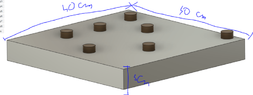
  • Marcello seeks to create an electromagnet measuring 40cm by 40cm with a height of 3 to 5 cm to hold pieces of metal weighing 20 to 40 grams.
  • Some participants emphasize the need for clarity on the strength of the electromagnet and the characteristics of the materials being used, noting that not all metals are magnetic.
  • There is a suggestion to consider the use of permanent magnets instead of electromagnets for the application, as they can be turned on and off with a lever or knob.
  • Participants discuss the importance of defining the magnetic field's orientation and strength, with some questioning the feasibility of achieving exactly perpendicular field lines.
  • One participant proposes the idea of using multiple electromagnets under each square of the chessboard to better manage the forces acting on the pieces.
  • Marcello expresses uncertainty about the required vertical and lateral forces needed to hold the pieces in place, indicating a need for further specification.
  • There are discussions about the potential complexity of controlling multiple electromagnets versus a single unit, and the energy source required for operation.
  • Some participants share personal experiences related to similar projects, highlighting the learning opportunities and challenges faced.

Areas of Agreement / Disagreement

Participants do not reach a consensus on the best approach to achieve the desired functionality. There are competing views on whether to use an electromagnet or a permanent magnet, and uncertainty remains regarding the specific design parameters needed for the project.

Contextual Notes

Participants note the importance of defining the range of disc diameters and thicknesses, as well as the required forces for the design. The discussion highlights the need for clarity on operational constraints and design specifications before proceeding.

MarcelloP
Messages
5
Reaction score
0
Hi to everyone!

I'm currently working on a University project and one of my crazy ideas needs me to get my hands on a pretty strange electromagnet. the measurements are 40cm by 40cm with a height of 3 to 5 cm (doesnt matter a lot) i don't need this magnet to be very powerful (just enough to keep locked on his area pieces of metal of about 20 to 40 grams), but i can't find anythind on the internet, the only electromagnets i can find with this large of an area are way too powerful and expensive, so i started wondering if it's actually phisically doable. Is it?.

thanks a lot for your answers,

Marcello.
 
Physics news on Phys.org
MarcelloP said:
Summary:: I need to buy/build a mildly powerful electromagnet of 40cmx40cm with a 3 to 5cm height and I'm wondering if its actually doable.

i started wondering if it's actually phisically doable. Is it?.

Build, no.

You need to define the magnet better. You have specified the size, but not the strength. "keep locked on his area pieces of metal of about 20 to 40 grams" doesn't tell us much. Among other things, some metals won't be picked up by a magnet at all!

To know if you can build it, you need to know the field strength and where the field lines are supposed to go. If you don't know those things, you can't design it.

Buy, maybe.

There may well be magnets out there that do what you want. but if you can't look through a catalog and determine if a given magnet will work or not, you have the exact same problem.
 
  • Like
Likes   Reactions: MarcelloP
Hi thanks for your answer,
the field lines need to be perpendicoular to the large 40x40 area, as for the strenght I'm not really sure, the usecase is to be able to put ferromagnetic discs on the large surface of the electromagnet and lock them in place hard enough to be touched by a hand without moving.
thanks a lot for you time,
Marcello
 
Perhaps you could sketch the magnet to show us where the magnetic poles will be and what polarity they will have. We also need to know the thickness of the discs that will be stuck to the magnet, as it determines the pole separation on the magnet.

Why must it be an electromagnet? Permanent magnets can be used for magnetic chucks that can be turned on / off with a lever or knob.
https://www.ebay.com.au/itm/282969231136
 
  • Like
Likes   Reactions: Vanadium 50
MarcelloP said:
the field lines need to be perpendicoular to the large 40x40 area

Exactly perpendicular? Then no...no magnet will do that.
 
Baluncore said:
Perhaps you could sketch the magnet to show us where the magnetic poles will be and what polarity they will have. We also need to know the thickness of the discs that will be stuck to the magnet, as it determines the pole separation on the magnet.

Why must it be an electromagnet? Permanent magnets can be used for magnetic chucks that can be turned on / off with a lever or knob.
https://www.ebay.com.au/itm/282969231136
I need it to be an electromagnet in order to be able to switch it on and off with a microcontroller, the thickness of the discs is not a design concern so wathever height works best is fine for me,
i'm also attaching a sketch of what i have in mind,
thanks for your answer,
Marcello
 

Attachments

  • Capture.PNG
    Capture.PNG
    21.3 KB · Views: 162
Vanadium 50 said:
Exactly perpendicular? Then no...no magnet will do that.
you are right,
not exactly but enough to keep the discs in place,
thanks,
Marcello
 
I have a travel chess set - the pieces have magnets in their bases and the board is some magnetic sheet. The pieces stick well enough that they don't go flying when your train goes over the points but not so hard that you can't move them. I have the impression you are trying to build something similar, but with the board being the magnet, and possible to turn off and on the stickyness.

I think that the questions you need to answer before we can help is how much vertical force do you need, how much variation in the vertical force is acceptable, and how much lateral force is acceptable. When you have ball park figures for these things you can develop an idea of how much variation in the magnetic field you can tolerate and start thinking about electromagnet design. Until then you don't really understand the constraints on the design.
 
  • Like
Likes   Reactions: russ_watters and Vanadium 50
Ibix said:
I have a travel chess set - the pieces have magnets in their bases and the board is some magnetic sheet. The pieces stick well enough that they don't go flying when your train goes over the points but not so hard that you can't move them. I have the impression you are trying to build something similar, but with the board being the magnet, and possible to turn off and on the stickyness.

I think that the questions you need to answer before we can help is how much vertical force do you need, how much variation in the vertical force is acceptable, and how much lateral force is acceptable. When you have ball park figures for these things you can develop an idea of how much variation in the magnetic field you can tolerate and start thinking about electromagnet design. Until then you don't really understand the constraints on the design.
yeah I'm trying to build a smart chessboard where i can turn on and off the stickyness, so for the forces i don't really know, i think that as long as they can withstand some light touching and the lateral forces it would be good.
thank you for you reply,
Marcello
 
  • #10
Don't know about cost, but might it be easier to have an electromagnet under each square? It positively locks the pieces in squares and you don't need to worry so much about lateral forces.
 
  • Like
Likes   Reactions: MarcelloP
  • #11
So you need 64 electromagnets on an 8x8 array under the chessboard. You would want to address them with 8+8 lines x-y and provide a means for unlatching the piece in play at the moment.
 
  • Like
Likes   Reactions: MarcelloP
  • #12
MarcelloP said:
the thickness of the discs is not a design concern so wathever height works best is fine for me,
i'm also attaching a sketch of what i have in mind,
You need to specify the range of disc diameters and the range of relative disc thickness before a magnet pole pattern can be selected.

Do you need independent control over 64 individual squares or one master control for the whole board?

What is the source of electric energy that keeps the magnet(s) turned on?
 
  • #13
MarcelloP said:
yeah I'm trying to build a smart chessboard where i can turn on and off the stickyness, so for the forces i don't really know, i think that as long as they can withstand some light touching and the lateral forces it would be good.
thank you for you reply,
Marcello
Why not just use the traditional design that @Ibix described? I don't see any advantage to electromagnets at each position. You could still put sensing coils at each square to tell when a piece is moved, but so far I don't see a reason to use electrical energy to hold down the pieces.
 
  • Like
Likes   Reactions: Vanadium 50
  • #14
One of my first "hobby" projects at the time of the first PC's (I was unemployed unexpectedly) was to build a rotating robot arm with hand to move chess pieces on a standard board. It worked slowly, painfully, and humorously but I learned a lot and spent about $300. And it did in fact work. Also I wrote software that kept track of where everybody was on the board etc. Kept me sane (nearly) and actually taught me an extraordinary amount (this was circa 1985) about small computing and interfacing.
So the sky is the limit here, but the magnets are easy!
 

Similar threads

Replies
3
Views
3K
  • · Replies 12 ·
Replies
12
Views
7K
  • · Replies 6 ·
Replies
6
Views
3K
Replies
3
Views
2K
  • · Replies 13 ·
Replies
13
Views
4K
Replies
12
Views
4K
  • · Replies 3 ·
Replies
3
Views
9K
Replies
5
Views
3K
  • · Replies 15 ·
Replies
15
Views
6K
  • · Replies 3 ·
Replies
3
Views
5K