Tosh5457
- 130
- 28
Is it? If so, can you show how? Thanks 
Last edited:
The discussion revolves around the possibility of deriving the Divergence Theorem from Stokes' Theorem, specifically examining the relationship between these two theorems in the context of vector calculus and differential forms. Participants explore various approaches and mathematical identities relevant to this derivation.
Participants do not reach a consensus on the derivation process, with multiple competing views and approaches presented. Uncertainty remains regarding the specific theorems being referenced and the feasibility of deriving one from the other.
Some participants note limitations in their mathematical training, which may affect their ability to engage with the theoretical aspects of the discussion. The discussion also highlights the dependence on definitions and the complexity of the mathematical steps involved in the derivations.
deluks917 said:It is possible, what have you attempted?
Tosh5457 said:I don't know where to start, unfortunately the mathematics disciplines in physics, in my university, are a bit superficial, with no theoretical exercises (only exercises to apply the theory). So I'm not trained for this, I want to see someone doing it so I can learn![]()
Tosh5457 said:I'm referring to the Kelvin-Stokes theorem
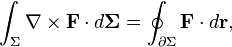
![]()