Is Pressure Constant in U-Tube Arms with Different Density Liquids?

Click For Summary
SUMMARY

The discussion clarifies that pressure in a U-tube with different density liquids does not remain constant at the same depth. When two immiscible liquids are present, the pressure at the same height in each liquid varies due to differences in density. The principle of equal pressure at equal depths applies only under specific conditions: constant fluid density, a connected path, and a motionless fluid in equilibrium. When these conditions are not met, as with liquids of differing densities, the pressure at the same depth will differ, confirming that the pressure gradient is influenced by the density of the liquids involved.

PREREQUISITES
  • Understanding of hydrostatic pressure principles
  • Knowledge of fluid density and its impact on pressure
  • Familiarity with the concept of equilibrium in fluid mechanics
  • Basic grasp of vector calculus and path integrals
NEXT STEPS
  • Study the hydrostatic pressure equation: p = ρgh
  • Explore the effects of fluid density variations on pressure in static fluids
  • Learn about the conditions for hydrostatic equilibrium in fluid systems
  • Investigate the application of path integrals in fluid mechanics
USEFUL FOR

Students and professionals in physics, engineering, and fluid mechanics who seek to deepen their understanding of pressure behavior in multi-liquid systems and the principles governing hydrostatic equilibrium.

Nikhil Rajagopalan
Messages
72
Reaction score
5
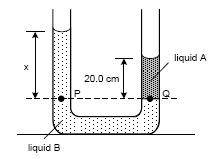
A liquid in a U-tube maintains the same level in both the arms. When another liquid which does not mix with the first one is poured in it, the air interface with either of the liquids in both the arms will be at different levels.
untitled-jpg.jpg

Considering a point at the top surface of liquid A, the pressure there should be atmospheric pressure. Another point in liquid B taken at the same level will have a pressure that amounts to atmospheric pressure plus the pressure due to the column of liquid B over it. These cannot be same. So how is the pressure at the same depth not being equal when we use that principle to solve many problems.
 

Attachments

  • untitled-jpg.jpg
    untitled-jpg.jpg
    5.4 KB · Views: 2,653
Physics news on Phys.org
Nikhil Rajagopalan said:
A liquid in a U-tube maintains the same level in both the arms. When another liquid which does not mix with the first one is poured in it, the air interface with either of the liquids in both the arms will be at different levels.
View attachment 216053
Considering a point at the top surface of liquid A, the pressure there should be atmospheric pressure. Another point in liquid B taken at the same level will have a pressure that amounts to atmospheric pressure plus the pressure due to the column of liquid B over it. These cannot be same. So how is the pressure at the same depth not being equal when we use that principle to solve many problems.
You have correctly reasoned that the pressures 20 cm above P and Q in the two tubes will not be the same.

Often we deal with tanks in which there is only one fluid and that fluid's density is constant. In these tanks we often take it for granted that there is a path through the fluid from any point to any other point. And finally, these situations are often static -- the fluid has been allowed to settle down into an equilibrium with no waves, no flow and no sloshing from side to side. In such circumstances, the pressure within the fluid is a simple function of depth: ##p=\rho g h## where ##\rho## is the fluid density, g is the local acceleration of gravity and h is the depth below the reference height. ["Gauge" pressure is taken to be zero at the reference height].

Clearly, in such circumstances, this means that the pressure at two points at the same depth will be identical. Break anyone of the three conditions (same fluid density, connected path, motionless fluid) and the guarantee no longer holds. [Technically, a fourth condition is also required -- gravity must be uniform across the area of interest]

But let us discard the ##p = \rho g h## and try to derive the equal pressure guarantee from first principles. Suppose that you are at point A somewhere in the fluid. The pressure there is P. Now you trace a path through the fluid to point B.

[Note that here we used the "connected" condition]

As you trace the path, every time the path goes downward by an increment of ##d h##, you will add ##\rho g\ dh## to the pressure. If this pressure increase were not present, the tiny volume of fluid at this point on the path would be subject to an unbalanced net force. It would accelerate. But we have assumed that the fluid is in equilibrium. Similarly, ever time the path goes upward by an increment of ##dh## you will subtract ##\rho g\ dh## from the pressure.

The concept of tracing the path and adding up little contributions from incremental path segments is known in vector calculus: a "path integral".

[Note that here we used the "motionless at equilibrium" condition]

If the start and end points are at the same height then when you finish tracing the path, the sum of ##d h## values must be zero. If the fluid has constant density and if gravity is constant then this means that the sum of the ##\rho g\ dh## must also be zero.

[Note that here we used the "fluid of constant density" condition]

To summarize: There are conditions that must hold before the "equal pressure at equal depths" principle can be known to be true.
 
  • Like
Likes   Reactions: Richard Spiteri and Nikhil Rajagopalan
You assume that in the two columns the pressure gradient must be identical at each height. This statement only applies, if the two liquids have the same density. Start from the level P-Q. Since in both arms, up to this level, the liquid has the same density, your approach is correct - the pressure is identical. Liquid A now has a higher density, therefore the pressure to up to its free surface must decrease faster than in the liquid B (##\rho g \Delta h = \Delta p##). The pressure at the free surface must have the atmosphere's value.

If you demand the same pressure profile in the two arms, you deny the existence of liquids with different densities.
 
  • Like
Likes   Reactions: Richard Spiteri and Nikhil Rajagopalan

Similar threads

  • · Replies 12 ·
Replies
12
Views
2K
  • · Replies 17 ·
Replies
17
Views
2K
  • · Replies 15 ·
Replies
15
Views
2K
  • · Replies 48 ·
2
Replies
48
Views
6K
  • · Replies 17 ·
Replies
17
Views
5K
  • · Replies 5 ·
Replies
5
Views
2K
  • · Replies 32 ·
2
Replies
32
Views
10K
  • · Replies 8 ·
Replies
8
Views
5K
  • · Replies 11 ·
Replies
11
Views
7K
  • · Replies 9 ·
Replies
9
Views
4K