Is Snell's law incompatible with interface conditions? What went wrong?

Click For Summary
SUMMARY

The discussion centers on the apparent incompatibility of Snell's law with electromagnetic interface conditions when transitioning from vacuum (n1 = 1) to a medium with εr = μr = 10 (n2 = 10). The calculated angles of propagation yield a ratio of sin(theta2) / sin(theta1) = 1.65, which contradicts the expected ratio of n1/n2 = 0.1. Participants analyze the derivation of electric field vectors E2 and magnetic field vector H2, identifying errors in the application of boundary conditions and the calculation of refractive indices. The conversation emphasizes the importance of correctly applying Maxwell's equations and continuity conditions in electromagnetic theory.

PREREQUISITES
  • Understanding of Snell's Law in optics
  • Familiarity with electromagnetic wave propagation
  • Knowledge of Maxwell's equations
  • Concepts of boundary conditions in electromagnetism
NEXT STEPS
  • Study the derivation of Snell's Law from Maxwell's equations
  • Learn about electromagnetic wave propagation in different media
  • Explore the implications of boundary conditions on wave behavior
  • Investigate the role of reflected waves in electromagnetic theory
USEFUL FOR

Students and professionals in physics, particularly those specializing in electromagnetism, optics, and materials science, will benefit from this discussion. It provides insights into the complexities of wave behavior at material interfaces and the application of theoretical principles.

Ngineer
Messages
62
Reaction score
1
Hi everyone,

Someone posted this hypothetical problem on a facebook group and I am wondering what your thoughts are.

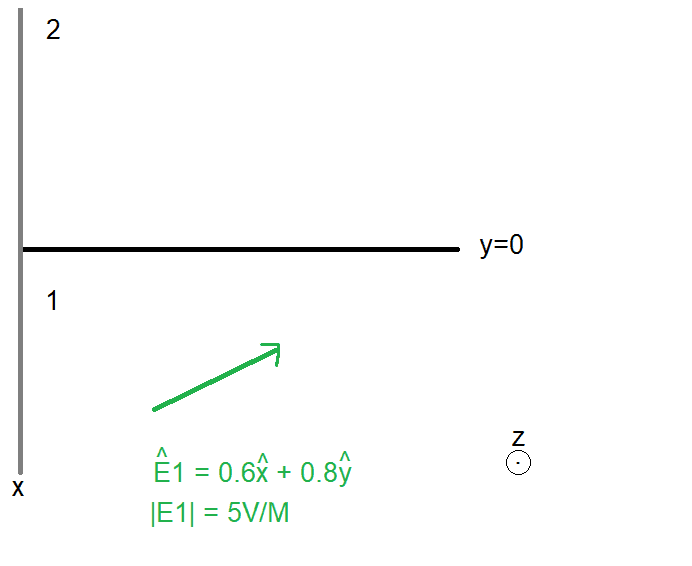
The issue is that Snell's law does not seem to hold when applied to the transmitted wave (calculated using the electromagnetic interface conditions.) Here is an example:

Suppose we have an interface at y=0 between vacuum (medium 1; n1 = 1) and a material of εr = μr = 10 (medium 2; n2 = 10).
246059

For a plane electromagnetic wave whose electric field is given by the green arrow, we subsequently have:

246061

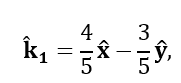
And a propagation direction along E1xH1:
246062


which corresponds to an angle of 36.87 degrees.

Using the interface conditions, we find that in the second medium, E2 has a unit vector of (x+ 0.132y), and that H2 is in a direction identical to H1 (i.e. z).
This gives rise to a propagation direction of
k2 = -0.132x + y

Which corresponds to an angle of 82.47 degrees.

Now the problematic issue is:
sin(theta2) / sin(theta1) = sin(82.47)/sin(36.87) = 1.65
Whereas
n1/n2 = 1/10 = 0.1.

Doesn't Snell's law stipulate that they're equal? What went wrong?
 

Attachments

  • 1562145031575.png
    1562145031575.png
    2.9 KB · Views: 342
  • 1562147264538.png
    1562147264538.png
    958 bytes · Views: 321
Science news on Phys.org
I don't understand how you determined E2 and H2: "Using the interface conditions, we find that in the second medium, E2 has a unit vector of (x+ 0.132y), and that H2 is in a direction identical to H1 (i.e. z). "
 
Hi Andy,
E1 = 5V/M * [0.6,0.8] = [3,4,0] V/M
Using the conditions for continuity at the interface:
E2x = E1y = 3
E2y = E1y * (epsilon1/epsilon2) = 4 * 1/10 = 0.4
So E2 = [3, 0.4, 0] V/M
= 3.02 V/M * [ 0.991, 0.1321, 0 ]
For H2,
H1 = [0,0,5/377] A/M Hence H2z = H1z * meu1/meu2 = 0.5/377 A/M

(This got me even wondering, how does the continuity stipulate that H1z = H2z = 5/377 A/M, when due to propagation we require H2z = 3.02/377 A/M!)
 
Last edited:
One error: n = √(ε_r μ_r), so if n = 10 and μ_r = 1 (valid for dielectrics), then ε_r = 100.
 
Andy Resnick said:
One error: n = √(ε_r μ_r), so if n = 10 and μ_r = 1 (valid for dielectrics), then ε_r = 100.
For the second medium, εr = μr = 10
 
ZapperZ said:
The claim of this thread is very odd, considering that one of things that a student in an E&M course often do is to DERIVE Snell's law using Maxwell equations and the boundary conditions, such as this:

https://ocw.mit.edu/courses/materia...-2013/lecture-notes/MIT3_024S13_2012lec22.pdf
Zz.
I'm not making a claim, I'm asking what went wrong in this particular derivation because I can't figure it out.
 
Did you consider the reflected wave?
 
DrDu said:
Did you consider the reflected wave?
Thanks! that was probably it!
 

Similar threads

  • · Replies 6 ·
Replies
6
Views
4K
  • · Replies 6 ·
Replies
6
Views
2K
  • · Replies 1 ·
Replies
1
Views
4K
  • · Replies 3 ·
Replies
3
Views
3K
  • · Replies 11 ·
Replies
11
Views
8K
  • · Replies 1 ·
Replies
1
Views
2K
  • · Replies 3 ·
Replies
3
Views
5K
  • · Replies 2 ·
Replies
2
Views
8K
  • · Replies 6 ·
Replies
6
Views
3K
  • · Replies 4 ·
Replies
4
Views
3K