Plane wave angle of incidence calculation

Click For Summary

Discussion Overview

The discussion revolves around calculating the angle of incidence for a plane wave using Snell's law. Participants explore the implications of wave propagation, polarization, and the mathematical relationships involved in the problem, which appears to be related to a homework assignment.

Discussion Character

  • Homework-related
  • Technical explanation
  • Debate/contested

Main Points Raised

  • One participant expresses confusion about the missing information needed to calculate the angle of incidence, noting the use of Snell's law.
  • Another participant questions the nature of the transmitted wave's magnetic field orientation and its implications for wave propagation direction, suggesting the problem may be misstated.
  • A participant proposes a method to calculate the angle of incidence based on their interpretation of the propagation vector, leading to a calculated angle of 45 degrees.
  • Another participant echoes the previous question about the propagation vector and expresses uncertainty about the problem's setup, suggesting it may contain a flaw.
  • Some participants inquire about using the relationship tan(Θi) = n2/n1 as a potential approach to the problem, indicating their own confusion.
  • One participant notes that such problems typically specify incident and transmitted wave vectors and may involve solving for reflected vectors, hinting at the complexity of the problem.

Areas of Agreement / Disagreement

Participants express uncertainty and confusion regarding the problem setup and the calculations involved. There is no consensus on the correct approach or solution, and multiple competing views about the problem's clarity and correctness are present.

Contextual Notes

Participants highlight potential ambiguities in the problem statement, particularly regarding the orientation of the magnetic field and the definition of the propagation vector. There are unresolved assumptions about the problem's parameters and setup.

quantumguy45
Good afternoon! Please help me figure out the mathematics of this simple plane wave question!

1. Homework Statement
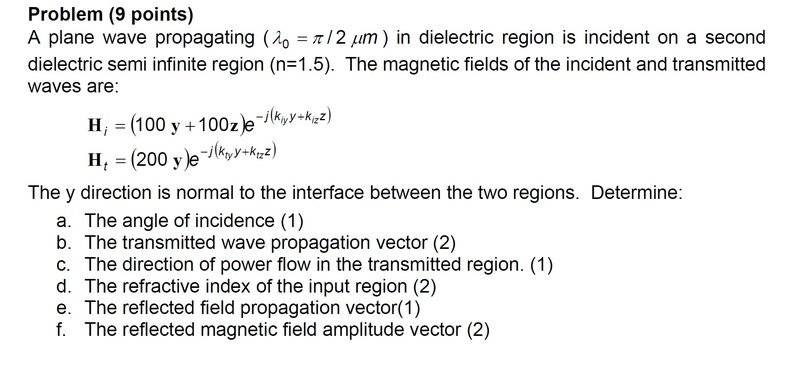
q1.jpg


2. Homework Equations

n1*sin(theta1)=n2*sin(theta2)

The Attempt at a Solution


I need help calculating the angle of incidence.
I found the propagation vector for incidence: ki=2*pi / lambda0 = 4 um
n1= 1 since we are given lambda0
I have n2 = 1.5
I know Snell's law is n1*sin(theta1)=n2*sin(theta2)
What vital information am I missing to solve this? I feel like its staring me in the face yet I'm unable to grasp it.

Thanks so much!
 
Last edited by a moderator:
Physics news on Phys.org
I'm assuming it is a transverse electromagnetic wave with some kind of linear polarization. I'm puzzled as to how the transmitted wave could have its magnetic field pointing only in the y direction perpendicular to the interface. That should mean that the transmitted wave must be propagating parallel to the interface. I'm stuck. Perhaps someone else can give an input. It doesn't look like a simple problem. I question whether the problem may have been misstated, but I could be missing something.
 
Charles Link said:
I'm assuming it is a transverse electromagnetic wave with some kind of linear polarization. I'm puzzled as to how the transmitted wave could have its magnetic field pointing only in the y direction perpendicular to the interface. That should mean that the transmitted wave must be propagating parallel to the interface. I'm stuck. Perhaps someone else can give an input. It doesn't look like a simple problem. I question whether the problem may have been misstated, but I could be missing something.

I have a question, since I found k_i= 4um, can I just say the propagation vector for the incident wave is (4y+4z) therefore the angle of incidence would be arctan(4/4) = 45 degrees? Using this then:
1*sin 45=1.5 sin*(theta_t)
theta_t= 28 degrees?
 
quantumguy45 said:
I have a question, since I found k_i= 4um, can I just say the propagation vector for the incident wave is (4y+4z) therefore the angle of incidence would be arctan(4/4) = 45 degrees? Using this then:
1*sin 45=1.5 sin*(theta_t)
theta_t= 28 degrees?
I don't see a solution. Usually the z direction is taken as perpendicular to the interface in optics problems. Perhaps it is a typo, or perhaps I am missing the obvious, but I don't see a solution. @vanhees71 Could you take a look at this please. Am I missing something? I believe it is a flawed problem, but perhaps you can see a solution.
 
Last edited:
Can I use tanΘi= n2/n1? I'm probably more lost than you are so I'm just looking for a spark to figure this out!
 
quantumguy45 said:
Can I use tanΘi= n2/n1? I'm probably more lost than you are so I'm just looking for a spark to figure this out!
See my edited post above. I've requested another fellow who has considerable expertise to take a look at it. I'm stuck.
 
  • Like
Likes   Reactions: quantumguy45
Just an additional note: Usually problems like this specify the incident and/or transmitted ## \vec{k} ## vector, and they might ask you to solve for the reflected ## \vec{k} ##. They take a little bit of work, but they are interesting problems in vector algebra.
 
  • Like
Likes   Reactions: quantumguy45

Similar threads

  • · Replies 1 ·
Replies
1
Views
2K
  • · Replies 8 ·
Replies
8
Views
2K
  • · Replies 6 ·
Replies
6
Views
5K
  • · Replies 3 ·
Replies
3
Views
11K
  • · Replies 5 ·
Replies
5
Views
2K
  • · Replies 1 ·
Replies
1
Views
2K
Replies
6
Views
2K
Replies
6
Views
2K
Replies
4
Views
2K
  • · Replies 5 ·
Replies
5
Views
10K