SUMMARY
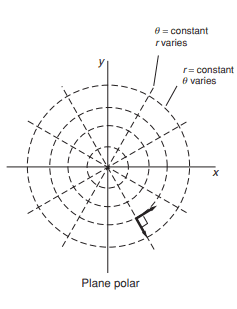
The discussion centers on the relationship between the polar coordinate variables \( r \) and \( \theta \). It establishes that while the unit vectors \( \hat{r}(\theta) \) and \( \hat{\theta}(\theta) \) are functions of the angle \( \theta \), the radial distance \( r \) is not inherently a function of \( \theta \) unless explicitly defined as such, for example, in the case of a spiral where \( r = a\theta \). The distinction between the coordinates \( r, \theta \) and the basis vectors \( \hat{r}, \hat{\theta} \) is crucial, as the latter depend on the angle while the former can remain independent. This subtlety often leads to confusion among students learning polar coordinates.
PREREQUISITES
- Understanding of polar coordinates and their representation
- Familiarity with vector notation and unit vectors
- Knowledge of Cartesian coordinates for comparison
- Basic calculus concepts related to functions and derivatives
NEXT STEPS
- Explore the relationship between polar coordinates and Cartesian coordinates
- Study the derivation of velocity and acceleration in polar coordinates
- Investigate the implications of \( r \) being a function of \( \theta \) in different contexts
- Learn about the applications of polar coordinates in physics and engineering
USEFUL FOR
Students and educators in mathematics and physics, particularly those focusing on coordinate systems, vector calculus, and applications of polar coordinates in various fields.