How to find the length of a vector expressed in polar coordinates?

Click For Summary

Discussion Overview

The discussion revolves around finding the length of a vector expressed in polar coordinates, particularly in the context of velocity vectors. Participants explore the mathematical properties of polar coordinate systems, including the relationships between the components of vectors in polar and Cartesian coordinates.

Discussion Character

  • Technical explanation
  • Mathematical reasoning
  • Debate/contested

Main Points Raised

  • One participant questions whether the length of a vector in polar coordinates can still be computed as the square of its components, given that the basis vectors are not fixed and change with position.
  • Another participant suggests using the orthonormality of the basis vectors or converting to Cartesian coordinates for verification.
  • Several participants discuss the scalar products of the basis vectors, noting that ##\hat{e}_r \cdot \hat{e}_r = 1##, ##\hat{e}_\theta \cdot \hat{e}_\theta = 1##, and ##\hat{e}_r \cdot \hat{e}_\theta = 0##.
  • There is a suggestion that the dot product of the velocity vector will yield the square of its components, leading to the expression for the vector's length.
  • Participants also discuss the implications of using orthonormal bases for vector operations, including the cross product, and the importance of right-handedness in basis vectors.
  • A detailed explanation is provided about the derivation of the components of a velocity vector in polar coordinates and how they relate to the Cartesian basis.

Areas of Agreement / Disagreement

Participants express varying viewpoints on the computation of vector lengths in polar coordinates and the implications of using different bases. While some agree on the orthonormality of the basis vectors, others raise questions about the application of these concepts in different contexts, indicating that multiple competing views remain.

Contextual Notes

Participants highlight the need to consider the changing nature of basis vectors in polar coordinates and the importance of understanding scalar and vector products in different bases. There are unresolved aspects regarding the application of these concepts to specific problems, such as the cross product in spherical coordinates.

Tony Hau
Messages
107
Reaction score
30
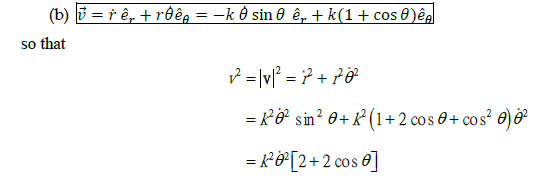
The velocity of a particle below is expressed in polar coordinates, with bases e r and e theta. I know that the length of a vector expressed in i,j,k is the square of its components. But here er and e theta are not i,j,k. Plus they are changing as well. Can someone help convince me that the length of v is still the square of its components?

1585748679302.png
 
Science news on Phys.org
Either use the orthonormality of ##\hat r, \hat \theta##. Or, convert the vector to Cartesian coordinates to double check.
 
  • Like
Likes   Reactions: Tony Hau and vanhees71
Well, first of all answer this question, what are the scalar products of
$$\hat{e}_r\cdot\hat{e}_r, \qquad \hat{e}_r\cdot\hat{e}_\theta, \qquad \hat{e}_\theta\cdot\hat{e}_\theta$$
 
  • Like
Likes   Reactions: vanhees71
Gaussian97 said:
Well, first of all answer this question, what are the scalar products of
$$\hat{e}_r\cdot\hat{e}_r, \qquad \hat{e}_r\cdot\hat{e}_\theta, \qquad \hat{e}_\theta\cdot\hat{e}_\theta$$
e r dot e r is (e r)^2
e r dot e theta is 0
e theta dot e theta is (e theta)^2
 
And what are the values of ##\hat{e}_r^2## and ##\hat{e}_\theta^2##?
 
Gaussian97 said:
And what are the values of ##\hat{e}_r^2## and ##\hat{e}_\theta^2##?
Both are 1?
 
Exact! Now you can compute directly what is the product
$$v^2 = \vec{v}\cdot \vec{v}$$
 
  • Like
Likes   Reactions: Tony Hau
My guess is like this. The dot product of v itself will make both bases vanish. So the dot product is just the square of its components.
 
  • Like
Likes   Reactions: vanhees71
Yes, essentially is this, although it's good to make the computation once in your life :)
 
  • Like
Likes   Reactions: PeroK and Tony Hau
  • #10
PeroK said:
Either use the orthonormality of ##\hat r, \hat \theta##. Or, convert the vector to Cartesian coordinates to double check.
May I confirm that if a vector is expressed in orthonormal bases, they will have the same operation as if they are expressed in the standard bases? It is because I got another HW question asking the cross product of two vectors expressed in spherical coordinates.
 
  • #11
Tony Hau said:
May I confirm that if a vector is expressed in orthonormal bases, they will have the same operation as if they are expressed in the standard bases? It is because I got another HW question asking the cross product of two vectors expressed in spherical coordinates.
For the cross product you also have to think about the right-handedness of your basis vectors. Not just the orthonormality.
 
  • Like
Likes   Reactions: vanhees71
  • #12
PeroK said:
For the cross product you also have to think about the right-handedness of your basis vectors. Not just the orthonormality.
Sorry I only learned how to determine the right-hanedness of standard bases. How can you determine the right-handedness of other basis vectors?
 
  • #13
Tony Hau said:
Sorry I only learned how to determine the right-hanedness of standard bases. How can you determine the right-handedness of other basis vectors?

With your right hand! It's the same idea.
 
  • Like
Likes   Reactions: Tony Hau
  • #14
Tony Hau said:
Sorry I only learned how to determine the right-hanedness of standard bases. How can you determine the right-handedness of other basis vectors?
It's the same idea as the scalar product. To compute the scalar product in one base you need to know the scalar product of the basis vectors ##\hat{e}_i\cdot\hat{e}_j##. Then to compute the vector product of a vector you need to know first the vector product ##\hat{e}_i\times\hat{e}_j##. To be right-handed simply means ##\hat{e}_i\times\hat{e}_j = \varepsilon_{ijk}\hat{e}_k##
 
  • Like
Likes   Reactions: PeroK
  • #15
Gaussian97 said:
It's the same idea as the scalar product. To compute the scalar product in one base you need to know the scalar product of the basis vectors ##\hat{e}_i\cdot\hat{e}_j##. Then to compute the vector product of a vector you need to know first the vector product ##\hat{e}_i\times\hat{e}_j##. To be right-handed simply means ##\hat{e}_i\times\hat{e}_j = \varepsilon_{ijk}\hat{e}_k##
Thanks for your reply
 
  • #16
Let's go through the logic of polar coordinates to summarize what has been achieved nicely above:

It's a simple example for curvilinear orthogonal coordinates. You start from a cartesian basis ##\vec{e}_1## and ##\vec{e}_2##. Then you define polar coordinates ##(r,\theta)## with ##r \in \mathbb{R}_{>0}## and ##\theta \in ]-\pi,\pi]## (of course you can define the angle to be in any semi-open interval of length ##2 \pi##) as
$$\vec{r}=x \vec{e}_1+ y \vec{e}_2=r \cos \theta \vec{e}_1 + r \sin \theta \vec{e}_2.$$
Then it's also convenient to define, at each point, a basis system given by the tangent vectors of the coordinate lines, i.e., the lines given by holding one of the two polar coordinates constant:
$$\vec{b}_r=\partial_r \vec{r}=\cos \theta \vec{e}_1 + \sin \theta \vec{e}_2, \quad \vec{b}_{\theta}=\partial_{\theta} \vec{r}=-r \sin \theta \vec{e}_1 + r \cos \theta \vec{e}_2.$$
It's easy to see that
$$\vec{b}_r \cdot \vec{b}_{\theta}=0,$$
i.e., that the two tangent vectors on the coordinate lines at any point are orthogonal to each other. In this case, usually one chooses the basis for the curvilinear coordinates as normalized. Now ##\vec{b}_r^2=1## and ##\vec{b}_{\theta}^2=r^2##. Thus we define
$$\vec{e}_r=\vec{b}_r = \cos \theta \vec{e}_1 + \sin \theta \vec{e}_2, \quad \vec{e}_{\theta}=\frac{1}{r} \vec{b}_{\theta} = -\sin \theta \vec{e}_1 + \cos \theta \vec{e}_2.$$
Now you have at any point a orthonormal basis system since
$$\vec{e}_{r}^2=\vec{e}_{\theta}^2=1, \quad \vec{e}_r \cdot \vec{e}_{\theta}=0.$$
Now as with any basis you can define vector components with respect to this "curvilinear bases". In your case this was done for the velocity vector. To that end just use the original Cartesian coordinates first and then express the resulting vectors in terms of the new basis vectors:
$$\vec{v}=\dot{\vec{r}}=\mathrm{d}_t (r \cos \theta \vec{e}_1 + r \sin \theta \vec{e}_2) = \dot{r} \vec{e}_r + r \dot{\theta} \vec{e}_{\theta}.$$
Thus you have the components
$$v_r=\dot{r}, \quad v_{\theta}=r \dot{\theta}.$$
Now, since these are components with respect to an orthronormal basis, you get
$$\vec{v}^2=(v_r \vec{e}_r + v_{\theta} \vec{e}_{\theta})^2=v_r^2 \vec{e}_r^2 + v_{\theta}^2 \vec{e}_{\theta}^2 + 2 v_r v_{\theta} \vec{e}_r \cdot \vec{e}_{\theta}=v_r^2 + v_{\theta}^2 = \dot{r}^2 + r^2 \dot{\theta}^2.$$
 
  • Like
Likes   Reactions: Tony Hau

Similar threads

  • · Replies 2 ·
Replies
2
Views
1K
  • · Replies 7 ·
Replies
7
Views
3K
  • · Replies 8 ·
Replies
8
Views
2K
  • · Replies 3 ·
Replies
3
Views
1K
  • · Replies 27 ·
Replies
27
Views
2K
  • · Replies 3 ·
Replies
3
Views
6K
  • · Replies 3 ·
Replies
3
Views
2K
  • · Replies 3 ·
Replies
3
Views
2K
  • · Replies 6 ·
Replies
6
Views
8K
  • · Replies 7 ·
Replies
7
Views
5K