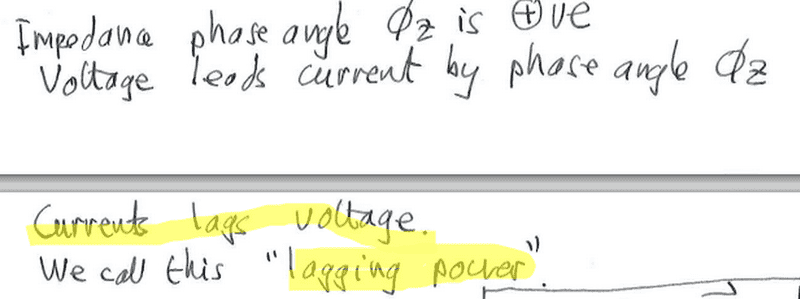
You can play with a few numbers to confirm or refute the statements. Here's how.
Suppose you assume a source voltage of E = 2V RMS. Set your impedance to a convenient value like Z = 1 + 1j Ω for an RL load, or to Z = 1 - 1j Ω for an RC load.
Now, a very handy formula to know is that the complex power is given by S = EI*, where I* is the complex conjugate of the current I (the sign of the imaginary term is reversed). You can determine the current for your sample values as I = E/Z. Plug in the values and see how the various signs and angles turn out.