Casio1
- 86
- 0
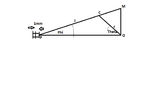
With reference to the Force Diagram, which represents a single piston cylinder rotating and producing 26NM of torque.
The technical data given is;
I = 70mm
r = 18mm
T = 26Nm
Theta = 17.13 degress
Phi = 4.34 degress
Using the diagram calculate the force on the piston Fp at 1mm before TDC.
Interestingly I can't solve this using the above data, but using trig in conjunction with the above I calculated the following angles;
Triangle OMC
M = 85.66 degress
O = 72.87 degrees
C = 21.47 degress
I worked it out like this;
PC = 18(sin 17.13) / (sin 4.34) = PM = I = 70.06 mm
The length (I) has now been proven.
Using the sine rule;
OM = 18(sin 21.47) / (sin 85.66) = 6.61
Force on piston Fp = 26 / 6.61 x 1000 = 3933 N
Once you follow it through you will see that I have not used much of the original data to solve the problem, but I am thinking there is an alternative method because I am to believe that the actual solution is
Fp = 3935 N
Although it is only two Newtons difference I could be using the wrong techniques?
The technical data given is;
I = 70mm
r = 18mm
T = 26Nm
Theta = 17.13 degress
Phi = 4.34 degress
Using the diagram calculate the force on the piston Fp at 1mm before TDC.
Interestingly I can't solve this using the above data, but using trig in conjunction with the above I calculated the following angles;
Triangle OMC
M = 85.66 degress
O = 72.87 degrees
C = 21.47 degress
I worked it out like this;
PC = 18(sin 17.13) / (sin 4.34) = PM = I = 70.06 mm
The length (I) has now been proven.
Using the sine rule;
OM = 18(sin 21.47) / (sin 85.66) = 6.61
Force on piston Fp = 26 / 6.61 x 1000 = 3933 N
Once you follow it through you will see that I have not used much of the original data to solve the problem, but I am thinking there is an alternative method because I am to believe that the actual solution is
Fp = 3935 N
Although it is only two Newtons difference I could be using the wrong techniques?