Is This a Series or Parallel Circuit?

Click For Summary
SUMMARY

The discussion centers on the analysis of a circuit using Kirchhoff's loop and junction rules, leading to the conclusion that the circuit behaves as a parallel circuit despite initial assumptions of series behavior. The correct current through the circuit is calculated to be approximately 1.3A, derived from the combined resistance of R1 and R2 in parallel with R3. The participants clarify the significance of units, confirming that Coulombs per second (C/s) is equivalent to amperes (A), and discuss the implications of circuit configuration on current flow.

PREREQUISITES
  • Understanding of Kirchhoff's loop and junction rules
  • Basic knowledge of series and parallel circuit configurations
  • Familiarity with electrical units, specifically amperes and coulombs
  • Ability to perform circuit calculations involving resistance and current
NEXT STEPS
  • Study Kirchhoff's laws in depth to enhance circuit analysis skills
  • Learn about the implications of series vs. parallel circuits on current distribution
  • Explore the concept of equivalent resistance in parallel circuits
  • Review the SI units of measurement, focusing on the definitions of ampere and coulomb
USEFUL FOR

Electrical engineering students, circuit designers, and anyone involved in analyzing or designing electrical circuits will benefit from this discussion.

bmarc92
Messages
8
Reaction score
0
Thread moved from the technical forums to the schoolwork forums
Homework Statement
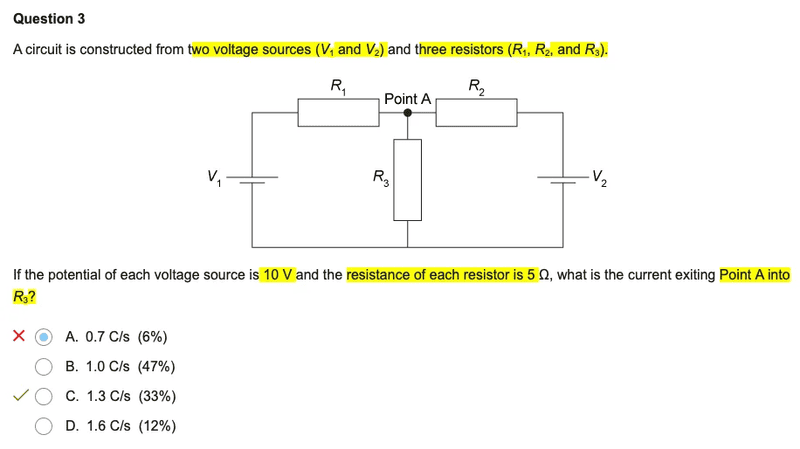
If the potential from each voltage source is 10V and the resistance of each resistor is 5Ohms, what is the current exiting point A into R3?
Relevant Equations
Loop rule: \oint {\vec{E}} \cdot \left{\vec{dl}} = 0

Junction rule: \sum{I_{in}} = \sum{I_{out}}
Consider the problem below
1716149859420.png


I used Kirchoff's loop/junction rules to correctly arrive at answer C (1.3A). Before using Kirchoff's rules I tried to get ##V_3## by treating this as a Fermi problem using the following lines of logic, but there is a flaw somewhere, can someone identify the flaw?


(a) If ##V_1 = V_2##, we can assume no current from either power source branches at junction A and everything exits through ##R_3##.

(b) If there is no current branching, we can treat each loop independently as a series circuit.

(c) If I can treat each loop independently as a series circuit,

$$I_I = \frac{V_1=10}{(R_1=5) + (R_3=5)}$$
$$I_2 = \frac{V_2=10}{(R_2=5) + (R_3=5)}$$

(d) ##I_3 = I_1 + I_2##

(e) ##I_3 = 2##


(c) & (d) & (e) follows from (b), implying each loop cannot be treated independently. But why must this circuit be treated as parallel if there is no current branching?
 
Last edited:
Physics news on Phys.org
The question asks for the current, not the voltage.

If the two voltage sources are identical, and share the same common node, then they can be joined in parallel, and one eliminated.
Then R1 and R2 are in parallel, and in series with R3.
The resistance of the circuit is then known, (5/2 + 5) and so is the current.
 
bmarc92 said:
(b) If there is no current branching, we can treat each loop independently as a series circuit.
No, because the conductive capacity of ##R_3## is shared in some way between those two loops. Given the symmetry, it is shared equally, so in each loop it provides resistance ##2R_3##.
 
If the correct answer is; (c). 1.3 C/s (33%)
What does 1.3 C/s mean?
What does (33%) mean?
 
bmarc92 said:
But why must this circuit be treated as parallel if there is no current branching?
Why is branching the criterion you're using? The currents "join" at point A. Isn't that just branching in reverse?
 
Baluncore said:
What does (33%) mean?
The fraction of responders who chose that answer?
 
Mister T said:
The fraction of responders who chose that answer?
Then 2% did not tick any box.
 
Baluncore said:
What does 1.3 C/s mean?
Coulombs/sec?
 
haruspex said:
Coulombs/sec?
Coulombs/sec = amp.
That seems likely, but the answer is still a little bit wrong.
R = 5/2 + 5 = 15/2 ohms.
I = 10 * 2/15 = 20/15 = 4/3 amp ≠ 1.3 amp
 
  • #10
Baluncore said:
Then 2% did not tick any box.
Not surprising. I guess "responder" means student that started the assignment.
 
  • #11
Baluncore said:
Coulombs/sec = amp.
That seems likely, but the answer is still a little bit wrong.
R = 5/2 + 5 = 15/2 ohms.
I = 10 * 2/15 = 20/15 = 4/3 amp ≠ 1.3 amp
I thought you were asking the OP so you could verify that he understood the units are not volts.

C/s is the correct combination of symbols according to the SI.

##4/3 \approx 1.3##, correct to 2 sig figs.

Edit: Or rounded to one decimal place.
 
  • #12
Mister T said:
C/s is the correct combination of symbols according to the SI.
The ampere was a base unit in the SI.
The coulomb was a derived unit. C =A⋅s
C/s = A⋅s / s = A
When did things change?
 
  • #14
Baluncore said:
The ampere was a base unit in the SI.
The coulomb was a derived unit. C =A⋅s
C/s = A⋅s / s = A
When did things change?
They didn't. I should have C/s is a correct combination of SI symbols. The symbol A is also correct.
 

Similar threads

  • · Replies 6 ·
Replies
6
Views
3K
  • · Replies 16 ·
Replies
16
Views
2K
  • · Replies 17 ·
Replies
17
Views
2K
  • · Replies 16 ·
Replies
16
Views
2K
Replies
7
Views
1K
  • · Replies 6 ·
Replies
6
Views
2K
Replies
2
Views
2K
Replies
5
Views
2K
  • · Replies 13 ·
Replies
13
Views
1K
Replies
1
Views
1K