Is This Electromagnetic Theory Solution Correct?

Click For Summary

Homework Help Overview

The discussion revolves around a problem in electromagnetic theory, specifically involving forces between charged masses and their equilibrium conditions. Participants are examining the correctness of a solution and the underlying equations related to forces, angles, and distances in the context of the problem.

Discussion Character

  • Exploratory, Assumption checking, Mathematical reasoning

Approaches and Questions Raised

  • Participants are checking the validity of equations and assumptions related to forces acting on charged masses. There are discussions about the correct use of variables, the significance of certain terms, and the implications of limits in the context of the problem. Some participants are attempting to clarify relationships between angles and distances in their equations.

Discussion Status

The discussion is ongoing, with participants providing feedback on each other's equations and reasoning. Some have offered corrections and suggestions for improvement, while others are exploring different interpretations of the problem. There is a collaborative effort to refine the understanding of the relationships involved.

Contextual Notes

Participants note the importance of expressing answers in terms of given quantities, such as the length of the string, rather than unknown variables. There are also mentions of issues with formatting equations and the need for clearer diagrams to represent the problem accurately.
Usiia
Messages
29
Reaction score
4
Homework Statement
Two Particles, each of mass m and having charges q and 2q respectively, are suspended from strings of length l from a common point. Find the angle θ that each string makes with the vertical.
Relevant Equations
Coulomb force definition with permittivity variable present.
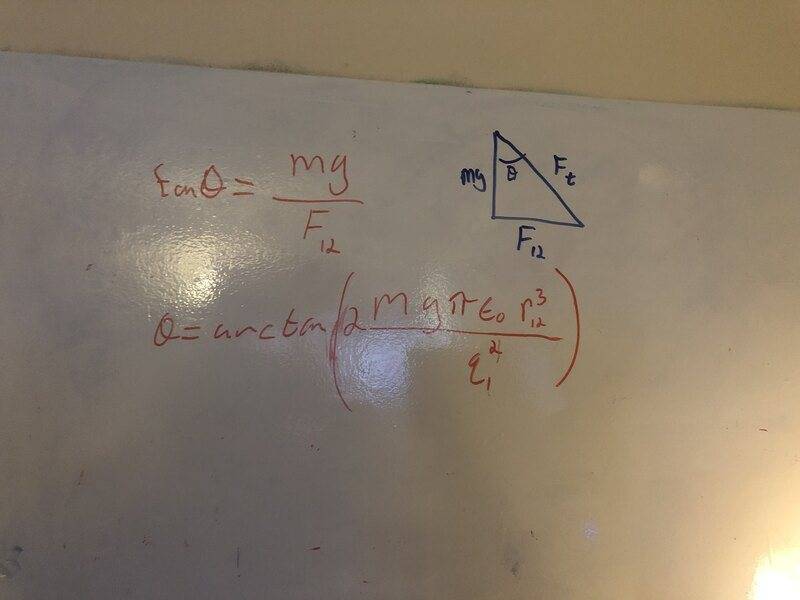
I'd like someone to check that this solution is right, and if not, give me the point of failure and not the answer.

Thanks!
IMG_0510.jpg
 
Physics news on Phys.org
Error in your first equation. Otherwise, all the components are there and looks good
 
  • Like
Likes   Reactions: Usiia
Thanks! Will take another look and report back!
 
Ok, second try:
DB893DBC-5FA1-4791-B02A-9D263F091EB2.jpg
 
Attachment disappeared !
 
needed a correction, making that now, having camera/file issues.

EDIT: No, I the right one I meant to upload was wrong. One sec.

ok, try number 4:

AD857713-6CB1-45BE-9841-010C53691929.jpg
 
Picture OK now (well, a bit of ##LaTeX## would be a lot better :rolleyes: ) . What about ##r_{12}## ?
 
  • Like
Likes   Reactions: PhDeezNutz and Usiia
Tried using latex, mathjax wouldn't work
 
Also, I'm incredibly good at LaTeX as well as a CS person, but I don't like it for HW type problems. I just get caught up making it prefect looking instead of right.

If it's a space thing, I'll try harder :)
 
  • #10
So, I left out r_1,2 normalized in this because it wasn't necessary to figure out magnitudes of the force, the direction laterally didn't seem important.
 
  • #11
Usiia said:
needed a correction, making that now, having camera/file issues.

EDIT: No, I the right one I meant to upload was wrong. One sec.

ok, try number 4:

View attachment 294532

Looks good to me. Yes, it was your rearrangement of ##F=mg\tan \theta## that was the issue. Everything else seems good
 
  • Like
Likes   Reactions: Usiia
  • #12
Thank you so much! I'll work on getting the LaTeX working for presenting my answers better and preserving the server storage!
 
  • Like
Likes   Reactions: berkeman
  • #13
Usiia said:
Thank you so much! I'll work on getting the LaTeX working for presenting my answers better and preserving the server storage!
There is a thread on the use of Latex for PF if needed.
 
  • Like
Likes   Reactions: Usiia
  • #14
I'm going to work on this a little more because I feel some identities could simplify this result.
 
  • #15
So I am using an arctan identity

arctan(2mg*pi*permit*r^2/q^2)= -pi/2 - arctan(2mg*pi*permit*r^2/q^2)

and so

-pi/2 - arctan(2mg*pi*permit*r^2/q^2)

EDITED: So, if we took the limit m->0, g->0 or we'd get that this system wants to be at no angle with no force (which is right) and otherwise, q->inf, it's going to be some amount less than 180 degrees.That interpretation is correct right?
 
Last edited:
  • #16
So arctan(x) = -π/2 - arctan(x)?
Did you mean arctan(x) = π/2 - arctan(1/x)?
You are being very sloppy, as is shown by missing terms out in some of the equations you have posted. This is not the way to get right answers.
Usiia said:
EDITED: So, if we took the limit m->0, g->0 or we'd get that this system wants to be at no angle with no force (which is right)
Which is wrong. If m or g = 0, there is no vertical force, so θ = 90°, where the particles are as far apart as possible.

What about r? You are not given r, but you are given l, the length of the string. What is r in terms of l and θ? (This makes things more complicated!)
 
  • #17
Thank you for your reply.

The identity I found had - π/2 and I had inverted the internal expression.

I believed that this was correct with my choice of origin. Also, -π/2 is 0 degrees in the orientation I choose where g points down.

I apologize if I had been sloppy. I am just getting back into this work. I will work on my presentation and draft better.
 
  • #18
mjc123 said:
What about r? You are not given r, but you are given l, the length of the string. What is r in terms of l and θ? (This makes things more complicated!)

Figured out the block quote, so yes, I agree and will work on that as well. Thank you!
 
  • #19
Good. Kudos to you for liking my post though it criticised you; that's the way to learn! Good luck.
 
  • Like
Likes   Reactions: Usiia
  • #20
mjc123 said:
Good. Kudos to you for liking my post though it criticised you; that's the way to learn! Good luck.
I'm sadly aware of how far I've slipped.
 
  • #21
The problem gives you the length of the string ##l## not the separation between the masses. Therefore your answer must be in terms of ##l##, i.e. given ##l## in meters and ##q## in Coulombs, find ##\theta## in radians. @BvU pointed that out in post #7.
 
  • Like
Likes   Reactions: Usiia
  • #22
kuruman said:
The problem gives you the length of the string ##l## not the separation between the masses. Therefore your answer must be in terms of ##l##, i.e. given ##l## in meters and ##q## in Coulombs, find ##\theta## in radians. @BvU pointed that out in post #7.
Yes, I see and realize that now. Thank you.
 
Last edited:
  • #23
So, to start I have two related triangles. One of the forces and one of the lengths.

IMG_0518.jpg

$$ F_{1,2} \cos \theta - mg \sin \theta = 0 $$
$$ r_{1,2} = l \cos \theta$$
$$ F_{1,2} = \dfrac {1}{4 \pi \epsilon_0} \dfrac {2q^2}{r_{1,2}^2} $$

And then
$$ \dfrac{q^2 \cos \theta}{2 \pi \epsilon_0 ( l \cos \theta )^2 } = mgl \sin \theta$$

$$ \dfrac{q^2 }{2 \pi \epsilon_0 (\cos \theta l) ^2 } = mgl \sin \theta$$

Is this right so far or should I be treating this like a related rates problem?
 
Last edited:
  • #24
I must admit I don't understand your diagram or your equations. Why not use ##T## for the tension in the string; ##F## for the electrostatic force; and, ##r## for the distance between the masses?

I suggest you show both masses on the diagram, so you can see how ##r## relates to ##\cos \theta## (or, should that be ##\sin \theta##?)
 
  • Like
Likes   Reactions: Usiia
  • #25
PeroK said:
I must admit I don't understand your diagram or your equations. Why not use ##T## for the tension in the string; ##F## for the electrostatic force; and, ##r## for the distance between the masses?

I suggest you show both masses on the diagram, so you can see how ##r## relates to ##\cos \theta## (or, should that be ##\sin \theta##?)
I will draw out the masses and take another look at the trig functions, thanks!
 
  • #26
Usiia said:
I will draw out the masses and take another look at the trig functions, thanks!
Ok, here's a more complete diagram.

7119458B-0E68-4B23-92FD-F1821AB30001.jpg
ignore the wrong note on tan to the right.
 
  • #27
That doesn't look right. The gravitational force on each mass is simply ##mg##. The same force ##F## acts on each particle (hence the symmetry).
 
  • #28
You're right. I got caught up in finding out where to place that sin.
 
  • Like
Likes   Reactions: PeroK
  • #29
Is this more accurate?

B8693439-172E-4F73-B562-E880CE93B982.jpg
 
  • #30
Just to say that I'm getting an "unsolvable" cubic equation in ##\tan \theta##. Does the question expect an exact solution?
 
  • Like
Likes   Reactions: Usiia

Similar threads

  • · Replies 3 ·
Replies
3
Views
2K
  • · Replies 5 ·
Replies
5
Views
2K
  • · Replies 13 ·
Replies
13
Views
1K
  • · Replies 8 ·
Replies
8
Views
2K
  • · Replies 26 ·
Replies
26
Views
4K
  • · Replies 11 ·
Replies
11
Views
2K
Replies
13
Views
2K
Replies
13
Views
2K
  • · Replies 15 ·
Replies
15
Views
3K
  • · Replies 14 ·
Replies
14
Views
2K