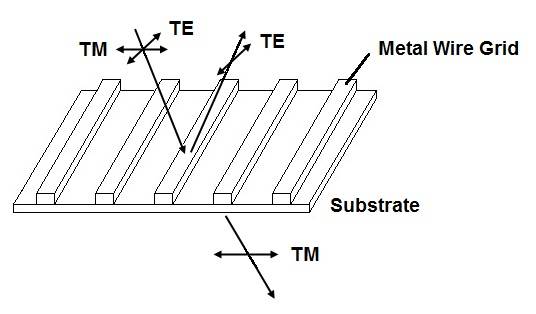
Is this image of a polarizer misleading?

Click For Summary
SUMMARY

The discussion confirms that the wire grid polarizer depicted in the image is accurate, with wires narrower than one wavelength of incoming radiation. Specular reflection can occur from a single wire, but multiple wires are necessary to achieve diffuse reflections due to the Huygens principle. Eddy currents generated from the transverse electric (TE) mode assist in canceling the transmitted TE signal. While polarizers can be effectively constructed for microwave applications, the degree of polarization will not reach 100%.

PREREQUISITES
  • Understanding of wire grid polarizers
  • Knowledge of Huygens principle
  • Familiarity with transverse electric (TE) mode
  • Basic concepts of microwave engineering
NEXT STEPS
  • Research the construction of microwave wire grid polarizers
  • Study the effects of eddy currents in electromagnetic applications
  • Learn about the principles of polarization in electromagnetic waves
  • Explore advanced applications of Huygens principle in optics
USEFUL FOR

Physicists, electrical engineers, and students in optics or microwave engineering who are interested in the principles and applications of polarizers.

Christofer Br
Messages
51
Reaction score
0
On this wire grid polarizer the wires are less
wide than one wavelength of the incoming radiation. Is it possible to achieve a specular reflection from a single wire as shown on the image? What about reflection in the plane of length of the wire and the plane perpendicular to it (as shown)? Or does it require multiple wires so that diffuse reflections from each of them add up due to delay between reemissions (huygens principle)?
wire_grid.jpg
 

Attachments

  • wire_grid.jpg
    wire_grid.jpg
    19.5 KB · Views: 671
Last edited:
Science news on Phys.org
The diagram is correct, and apparently eddy currents that arise from the TE mode help cancel the transmitted TE signal. Perhaps someone with some rf experience can explain this in more detail, but the result is correct. Such polarizers can be readily constructed for microwaves, and I have used them in a laboratory class at the university many years ago. It should be noted the degree of polarization achieved will never be 100%, but in general, the diagram is correct.
 

Similar threads

Replies
8
Views
2K
  • · Replies 7 ·
Replies
7
Views
3K
  • · Replies 1 ·
Replies
1
Views
2K
  • · Replies 6 ·
Replies
6
Views
3K
  • · Replies 4 ·
Replies
4
Views
2K
  • · Replies 4 ·
Replies
4
Views
2K
  • · Replies 4 ·
Replies
4
Views
2K
  • · Replies 16 ·
Replies
16
Views
9K
  • · Replies 2 ·
Replies
2
Views
3K
  • · Replies 1 ·
Replies
1
Views
2K