Is today's exam question unsolvable? - Proton Motion in a Magnetic Field

Click For Summary
SUMMARY

The forum discussion centers around the perceived unsolvability of an electromagnetism exam question regarding a proton's motion in a uniform magnetic field. The key equation discussed is the Lorentz force, F = qvB, which leads to the centripetal force equation, qvB = mv/r. Participants highlight the lack of information regarding the time the proton spends in the magnetic field, making it impossible to calculate the total distance traveled without additional context. Ultimately, a professor suggested assuming the proton travels half a circle before hitting a wall, but the clarity of the question remains in question.

PREREQUISITES
  • Understanding of electromagnetism principles, specifically the Lorentz force.
  • Familiarity with centripetal motion and related equations.
  • Knowledge of momentum and its relation to mass and velocity.
  • Ability to interpret diagrams and figures in physics problems.
NEXT STEPS
  • Study the Lorentz force and its applications in charged particle motion.
  • Learn about centripetal force and its role in circular motion.
  • Explore how to interpret and analyze physics exam questions effectively.
  • Review problem-solving strategies for electromagnetism scenarios.
USEFUL FOR

Students preparing for physics exams, educators designing exam questions, and anyone interested in the principles of electromagnetism and particle motion.

APUGYael
Messages
41
Reaction score
1
<Moderator's note: Moved from a technical forum and thus no template.>

Hello all,

Earlier today I had an electromagnetism exam, and it seems to me that this problem is unsolvable.
There's just too little information given.

A proton enters an uniform magnetic field. It's initial speed v is perpendicular to the magnetic field.
The strength of the magnetic field is B. You also know the direction of the magnetic field (see: https://imgur.com/a/HSTT7Qh).
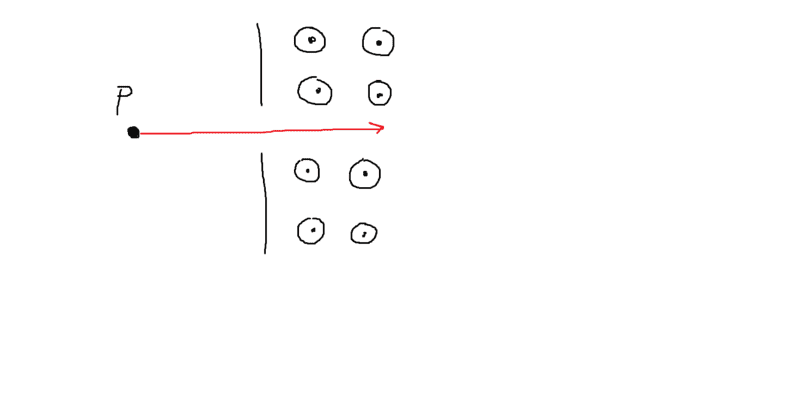
upload_2018-6-28_10-44-56.png


Calculate the total distance the proton travels.


So let's say that, because it's initial speed is perpendicular, the force acting on the proton equals:
F = qvB
q = charge
v = speed
B = magnetic field strength

This force is the centripetal force:
qvB = pv/r

p = momentum (mv)
r = radius circle

So.. Let's solve for r.
r = p/qB

But that doesn't help much.

See: you don't know how long the proton is present in the magnetic field. You could calculate the circumference of a circle with radius r, you could calculate the time it takes the proton to travel 2πr but you still wouldn't be able to calculate the total distance traveled without a given time.

Anyway, my girlfriend is convinced this is solvable. Am I overlooking something?
 

Attachments

  • upload_2018-6-28_10-44-56.png
    upload_2018-6-28_10-44-56.png
    3 KB · Views: 637
Last edited by a moderator:
Physics news on Phys.org
APUGYael said:
Calculate the total distance the proton travels.
You need some additional qualifying information that determines what the start and end conditions are, i.e., what is the distance traveled by the proton between A and B, where A and B are somehow identified. Without access to your exam, it is impossible to say whether or not this information was suitably identifiable, e.g., through a figure.
 
Orodruin said:
You need some additional qualifying information that determines what the start and end conditions are, i.e., what is the distance traveled by the proton between A and B, where A and B are somehow identified. Without access to your exam, it is impossible to say whether or not this information was suitably identifiable, e.g., through a figure.

The drawn figure is the exact figure given but drawn on paint. Nothing was left out. Same for the given variables and description of the problem.
 
There are many assumptions you can make. One that would be reasonable would be that, from what can be seen from the figure, the magnetic field starts abruptly and the proton enters perpendicular to the zone where the field is non-zero. The question could intend to ask for the distance traveled in the magnetic field. However, based on the information you have given here, any such guess is just conjecture.
 
Orodruin said:
There are many assumptions you can make. One that would be reasonable would be that, from what can be seen from the figure, the magnetic field starts abruptly and the proton enters perpendicular to the zone where the field is non-zero. The question could intend to ask for the distance traveled in the magnetic field. However, based on the information you have given here, any such guess is just conjecture.

I just got a reply from my professor.
He told me I should've made the assumption that the well extends and such that the distance the proton travels is half of a circle before hitting the wall. To me the figure seems flawed: the figure should've been clarified or more information should've been given, although I do see his point.
 
APUGYael said:
He told me I should've made the assumption that the well extends and such that the distance the proton travels is half of a circle before hitting the wall.
As stated above, this is what I would have assumed, but I agree it could be stated clearer.
 
I didn’t even realize that vertical line was supposed to represent a wall. I thought it was just the edge of the region with the field. I would have said that it goes 1/2 circle around and then continues straight on forever (neglecting gravity or other fields)
 
If it was supposed to be an exam question then it is a very poor one. Why don't question setters read what they have written and see if it actually means what they want it to mean?
I think @Dale 's interpretation is favourite but why isn't it made clear? Perhaps it's part Parapsychology Exam.
 

Similar threads

Replies
34
Views
2K
  • · Replies 5 ·
Replies
5
Views
2K
  • · Replies 8 ·
Replies
8
Views
2K
Replies
11
Views
3K
  • · Replies 8 ·
Replies
8
Views
2K
Replies
3
Views
2K
  • · Replies 2 ·
Replies
2
Views
2K
  • · Replies 5 ·
Replies
5
Views
2K
  • · Replies 31 ·
2
Replies
31
Views
2K
Replies
1
Views
2K