Jacobian in polar coordinate integration

5 replies · 2K views · last reply
Abdul.119
Messages
73
Reaction score
2
So I was reading a solution of a problem that has to do with integration in polar coordinates, and in one of the steps it did this
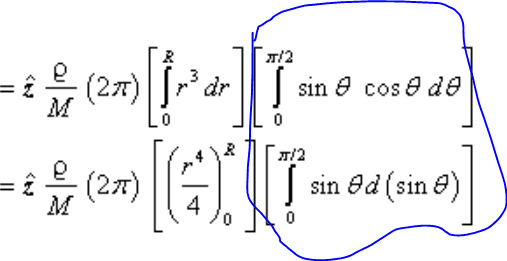
Two lines of handwritten-style typeset math: a polar-coordinate integral with the inner integral of sin θ cos θ dθ from 0 to π/2 circled in blue, rewritten below as the integral of sin θ d(sin θ) over the same limits.

How did these terms (circled in blue) change like that? I've never seen a step like that before..
 
Abdul.119 said:
So I was reading a solution of a problem that has to do with integration in polar coordinates, and in one of the steps it did this

Two lines of handwritten-style integral equations; the upper integrand sin θ cos θ dθ over 0 to π/2 is circled in blue, and the lower line rewrites it as sin θ d(sin θ).

How did these terms (circled in blue) change like that? I've never seen a step like that before..
What is the differential of ##\sin \theta##?

If y = f(x), the differential of y is defined as dy = f'(x) dx
 
The substitution rule says
##\int f(x) \, \frac{du}{dx} \, dx = \int f(u(x)) \, du(x)##
Hence, ##\theta = x##, ##\frac{du}{dx} = \cos\theta## and ##u = \sin \theta## gives
##\int f(\theta) \, cos(\theta) \, d\theta = \int f(\theta) \, d(\sin(\theta))##
 
pwsnafu said:
The substitution rule says
##\int f(x) \, \frac{du}{dx} \, dx = \int f(u(x)) \, du(x)##
Hence, ##\theta = x##, ##\frac{du}{dx} = \cos\theta## and ##u = \sin \theta## gives
##\int f(\theta) \, cos(\theta) \, d\theta = \int f(\theta) \, d(\sin(\theta))##

Why didn't they use the regular u-substitution, where u = cos(θ) , and du = -sin(θ) dθ ?
 
u = sin(θ) , and du = cos(θ) dθ avoids the complication of sign change.
 
Abdul.119 said:
Why didn't they use the regular u-substitution, where u = cos(θ) , and du = -sin(θ) dθ ?
I'm not sure why you call that "the regular u-substitution". To integrate something like [itex]\int sin(\theta) cos(\theta) d\theta[/itex] either [itex]u= cos(\theta)[/itex], [itex]du= -sin(\theta)d\theta[/itex] or [itex]u= sin(\theta)[/itex], [itex]du= cos(\theta)d\theta[/itex] will work. And, I suspect that most people would use the latter since, as mathman said, it avoids the negative sign.