Kinematic in Quadratic Form Equation (missing something simple)

Click For Summary
SUMMARY

The forum discussion centers on solving a kinematic equation for an object thrown vertically. A student throws a pencil upward at 18.3 m/s and seeks to determine the time it takes to reach a height of 12.2 m. The correct solutions are t1 = 0.869s and t2 = 2.86s. Errors in calculations were identified, including incorrect application of factors and unit tracking, leading to negative time results. The discussion emphasizes the importance of proper algebraic manipulation and unit consistency in kinematic problems.

PREREQUISITES
  • Kinematic equations, specifically the equation of motion: s = v_0t - 1/2 gt²
  • Understanding of acceleration due to gravity, g = 9.81 m/s²
  • Basic algebra skills for manipulating equations
  • Familiarity with quadratic equations and their solutions
NEXT STEPS
  • Study the derivation and application of kinematic equations in physics
  • Learn how to use scientific calculators for solving quadratic equations
  • Explore unit conversion and dimensional analysis in physics problems
  • Practice solving real-world problems using kinematic formulas
USEFUL FOR

Students learning physics, educators teaching kinematics, and anyone interested in mastering the application of kinematic equations in real-life scenarios.

Delta_Craig
Messages
5
Reaction score
4
I just ran this pretty quick at work. But this is the general outline. Sorry for the slop, it will get better with time. Thanks in advance and any additional info can be supplied.

The material is from the Khan free course.

.....

A student is fed up with doing her kinematic formula homework, so she throws her pencil straight upward at 18.3 m/s.

How long does it take the pencil to first reach a point 12.2 m higher than where it was thrown?

Answers are suppose to be

t1= 0.869s
t2= 2.86s

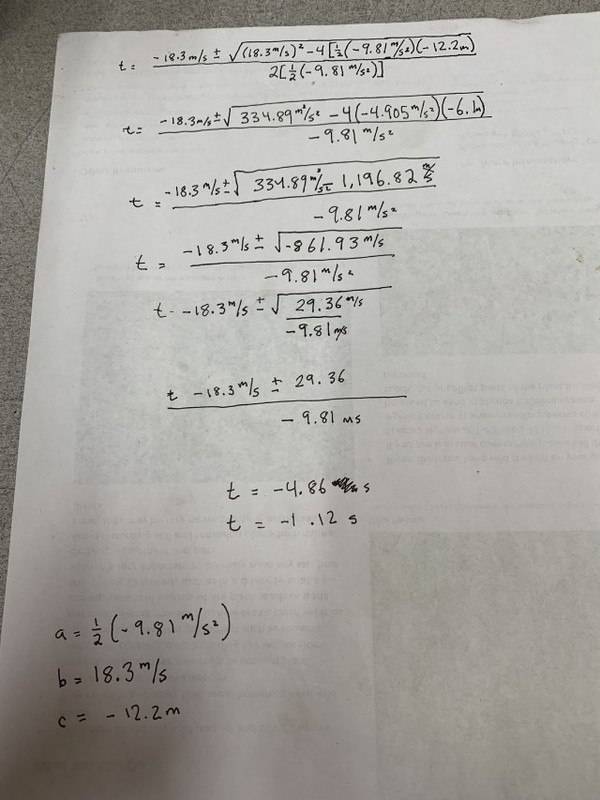
My answers are negative time which is a neat concept. Doesn’t add up.
FCD73-EB0-F990-4-F26-8967-A025560163-A7.jpg
 

Attachments

  • 7D0DFE23-D781-442E-8C99-77D503A36C0B.png
    7D0DFE23-D781-442E-8C99-77D503A36C0B.png
    19.9 KB · Views: 289
  • EFF51297-2203-4AFD-9B77-8518733D306B.png
    EFF51297-2203-4AFD-9B77-8518733D306B.png
    22.2 KB · Views: 320
Physics news on Phys.org
There are a lot of numbers there. Maybe a bit of algebra first would help?
 
  • Like
Likes   Reactions: Delta_Craig
Agreed, amongst other mathematics.
But, it does seem pretty straight forward.
I’ll keep plugging at it, I know it’s an order of op that’s got me on the wrong path.
 
Delta_Craig said:
Agreed, amongst other mathematics.
But, it does seem pretty straight forward.
I’ll keep plugging at it, I know it’s an order of op that’s got me on the wrong path.

Which direction are you taking as positive? Up or down?
 
  • Like
Likes   Reactions: Delta_Craig
PeroK said:
Which direction are you taking as positive? Up or down?

Up for positive.
I have acceleration @ -9.81m/s
 
Delta_Craig said:
Up for positive.
I have acceleration @ -9.81m/s

It would be interesting to see your quadratic equation for ##t##.
 
Your first error is in line 2, where you have applied the same factor 1/2 to both g and s.
The next error is in multiplying those out you got a number near 1200 instead of near 120.
The result of that error was a negative number to square root, but instead of recognising something was wrong you just ignored the sign.
In your posted image, you then erroneously retained the square root sign having already substituted the root value.
Finally, you somehow got two positive results from -18.3±29.36.
 
haruspex said:
Your first error is in line 2, where you have applied the same factor 1/2 to both g and s.
The next error is in multiplying those out you got a number near 1200 instead of near 120.
The result of that error was a negative number to square root, but instead of recognising something was wrong you just ignored the sign.
In your posted image, you then erroneously retained the square root sign having already substituted the root value.
Finally, you somehow got two positive results from -18.3±29.36.

It's so easy to go wrong with numbers I always find. ##g## is one symbol; whereas ##9.81m/s^2## is eight symbols.

Why would anyone prefer eight symbols when one would do?
 
Delta_Craig said:
A student is fed up with doing her kinematic formula homework, so she throws her pencil straight upward at 18.3 m/s.

How long does it take the pencil to first reach a point 12.2 m higher than where it was thrown?

Answers are suppose to be

t1= 0.869s
t2= 2.86s

My answers are negative time which is a neat concept. Doesn’t add up.

Do they really teach you to do it that way? It seems extraordinary to me. I would never think of doing like that.

I just did, with up positive:

##s = v_0t - \frac 1 2 gt^2##

##\frac 1 2 gt^2 -v_0t + s = 0##

##t = \frac{v_0 \pm \sqrt{v_0^2 - 2gs}}{g}##

And I just plugged the numbers in a spreadsheet and out came the answer you quoted.
 
  • #10
PeroK said:
Do they really teach you to do it that way? It seems extraordinary to me. I would never think of doing like that.

I just did, with up positive:

##s = v_0t - \frac 1 2 gt^2##

##\frac 1 2 gt^2 -v_0t + s = 0##

##t = \frac{v_0 \pm \sqrt{v_0^2 - 2gs}}{g}##

And I just plugged the numbers in a spreadsheet and out came the answer you quoted.
I’m sure you have a better grasp on this to make a statement like that, and I believe what your saying. I’m just going to run all the free courses (edit: knowing they are less than adequate, but a fair primer) I can before I start academically.

That’s the thing too, kinematic formulas are 100% new to me, so just learning these little gems is a lot of fun. I don’t have the perspective to know it’s not the most efficient way. I’m just hoping pencil on paper = progress

I’ll play with your formula tonight.
 
  • #11
Delta_Craig said:
I’m sure you have a better grasp on this to make a statement like that, and I believe what your saying. I’m just going to run all the free courses (edit: knowing they are less than adequate, but a fair primer) I can before I start academically.

That’s the thing too, kinematic formulas are 100% new to me, so just learning these little gems is a lot of fun. I don’t have the perspective to know it’s not the most efficient way. I’m just hoping pencil on paper = progress

I’ll play with your formula tonight.

Or, try the calculator on your phone. Mine is a basic phone, but the calculator has an option to go into "scientific" mode. It's really easy to do formulas like that.
 
  • #12
9897-BD6-F-1-A22-407-B-B883-A91257982-FAE.jpg


I’ll admit I rushed the formula at work, no excuse...

I’ll keep it cleaner from here on out, sorry for the waste of time on anyone’s part.

sat down and figured out the issue pretty quick.
 
  • #13
On line 2, under the square root you are subtracting a velocity (m/s) from a squared velocity (m2/s2).

On line 3, the squared velocity is no longer squared. But you are about to take the square root of it.

On line 4, the square root of an un-squared velocity turns into an un-squared velocity.

If you are going to track units, track units.
 
  • Like
Likes   Reactions: Delta_Craig

Similar threads

  • · Replies 11 ·
Replies
11
Views
2K
Replies
12
Views
2K
Replies
5
Views
3K
  • · Replies 8 ·
Replies
8
Views
13K
  • · Replies 1 ·
Replies
1
Views
4K
  • · Replies 2 ·
Replies
2
Views
3K
  • · Replies 2 ·
Replies
2
Views
3K
  • · Replies 1 ·
Replies
1
Views
3K
  • · Replies 10 ·
Replies
10
Views
4K
  • · Replies 21 ·
Replies
21
Views
13K