Kinetic energy of ball sliding down slope with electric field?

Click For Summary

Homework Help Overview

The problem involves a positively charged ball sliding down a slope in a uniform electric field. The ball starts from rest at a height and the discussion centers around calculating its kinetic energy at a lower point, considering both gravitational and electric potential energies.

Discussion Character

  • Exploratory, Conceptual clarification, Mathematical reasoning, Assumption checking

Approaches and Questions Raised

  • Participants discuss using energy conservation principles, considering both gravitational potential energy and electric potential energy. There are questions about the correct application of formulas and whether to use the ramp length or the vertical height in calculations.

Discussion Status

Some participants have provided guidance on how to combine gravitational and electric potential energies to find kinetic energy. There is an ongoing exploration of the implications of the electric field's direction and its effect on energy calculations. Multiple interpretations of the problem setup are being considered.

Contextual Notes

Participants note the absence of a figure, which may affect their understanding of the problem's geometry. There is also mention of potential confusion regarding the direction of forces and energy calculations related to the electric field.

asdf12312
Messages
198
Reaction score
1
Kinetic energy of ball sliding down slope with electric field??
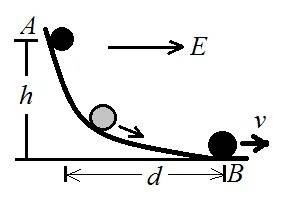
34pe6mb.jpg


Homework Statement


As shown in the figure above, a positively charged ball is placed at point A and slides down the slope from rest. The area has a uniform electric field E = 26.1 N/C, pointing to the right. The mass of the ball is m = 27 kg and the charge is q = +4.6 C. When the ball reaches point B, it travels horizontally there after. The height from A to B is h = 23 m and the horizontal distance between A and B is d = 47 m. You can ignore friction and use g = 10 m/s2 for your calculation.

1. How much is the kinetic energy of the ball when it reaches at B (in the unit of J)?

2. If the electric field is changed to the opposite direction, How much is the kinetic energy of the ball when it reaches at B (in the unit of J) now?

3. What is the minimum strength of electric field E that can be used to stop the particle right at Point B?


Homework Equations


The Attempt at a Solution


probably need to use Ke = qEd ..? i tried but getting the wrong answer. for d i calculate using pythorean x^2+y^2=d^2 so 23^2+47^2=d^2 is that rite way to do?
 
Last edited:
Physics news on Phys.org


Energy conservation is a good approach, but you have to consider both the electric and the gravitational energy of the ball.
The distances in those formulas are always along the direction of the force. You don't need the length of the ramp ("d").

I don't see any figure, but I can imagine how the setup looks like.


I would use d as you derived it. Then compute force along d times distance for the E and the g fields.


ok i have gravitation potential energy U=mgh=27*10*23=6210 but how do i use this with the Ke equation (qEd)?


asdf12312 said:
ok i have gravitation potential energy U=mgh=27*10*23=6210 but how do i use this with the Ke equation (qEd)?

Compute the force along d due to the electric field, multiply by d, and you have a (negative) energy to subtract from the gravitational potential energy. The difference is your k.e. at B.

BTW qEd is not energy. It's force.


asdf12312 said:
ok i have gravitation potential energy U=mgh=27*10*23=6210 but how do i use this with the Ke equation (qEd)?

next, try getting the potential energy from the electric field... add the two potential energies and get the velocity after that!


rude man said:
...you have a (negative) energy to subtract from the gravitational potential energy. The difference is your k.e. at B.
why negative energy? the charge is positive right?


rude man said:
Compute the force along d due to the electric field, multiply by d, and you have a (negative) energy to subtract from the gravitational potential energy. The difference is your k.e. at B.

BTW qEd is not energy. It's force.

Ke = q*E*d - -(m*g*d)

is d the same for both calculations?
Ke = d(qE+mg)

something like that?


asdf12312 said:
Ke = q*E*d - m*g*d

is d the same for both calculations?
Ke = d(qE-mg)

something like that?

wait... it's Ke=qEd+mgh... not mgd...
yup that's all!
 
  • #10


deep838 said:
wait... it's Ke=qEd+mgh... not mgd...
yup that's all!

i see..so we simply use d and h given in the problem? no need to use pythagorean theorem then.

Ke=qEd+mgh=5643+6210= ~11 900 JSo I understand #2 as well, for #3 do we have to get Ke to equal 0? So then 6210/qd= ~29N/C electric field (negative in value)
did i do this rite?
 
Last edited:
  • #11


asdf12312 said:
i see..so we simply use d and h given in the problem? no need to use pythagorean theorem then.
Right.
The approach "rude man" described is possible, too, but it requires more calculations.
 
  • #12


deep838 said:
why negative energy? the charge is positive right?

Right. I was not privy to the illustration originally & imagined the ramp to go to the left & the E field to the right. This was obviously also buttressed by part c of the question ...

I also agree that this should be done via energy conservation since the ramp is not linear as I had imagined from the OP's initial submission.
 
  • #13


asdf12312 said:
i see..so we simply use d and h given in the problem? no need to use pythagorean theorem then.

Ke=qEd+mgh=5643+6210= ~11 900 J


So I understand #2 as well, for #3 do we have to get Ke to equal 0? So then 6210/qd= ~29N/C electric field (negative in value)
did i do this rite?

You have my vote!
 
  • #14


yup...that's all for this problem...
 

Similar threads

  • · Replies 32 ·
2
Replies
32
Views
3K
Replies
1
Views
2K
Replies
1
Views
1K
  • · Replies 12 ·
Replies
12
Views
2K
  • · Replies 8 ·
Replies
8
Views
3K
  • · Replies 16 ·
Replies
16
Views
1K
Replies
2
Views
3K
  • · Replies 6 ·
Replies
6
Views
3K
  • · Replies 10 ·
Replies
10
Views
3K