Kleppner 7.10 — Using a gyroscope to measure latitude

Click For Summary
SUMMARY

The discussion focuses on using a gyroscope to measure latitude, specifically addressing the behavior of a gyroscope's spin axis in relation to the Earth's rotation and the polar star. Key concepts include the absence of torque affecting the gyroscope's angular momentum and the influence of centrifugal and Coriolis forces. Participants explore the conditions under which the gyroscope remains stationary relative to an observer on Earth's surface, particularly when aligned with true north. The conversation highlights the mathematical proof needed to validate these principles.

PREREQUISITES
  • Understanding of gyroscopic motion and angular momentum
  • Familiarity with centrifugal and Coriolis forces
  • Basic knowledge of Earth's rotation and latitude
  • Mathematical proof techniques for physical concepts
NEXT STEPS
  • Research the mathematical principles behind gyroscopic stability
  • Explore the effects of centrifugal and Coriolis forces on rotating bodies
  • Learn about the relationship between gyroscopes and navigation systems
  • Investigate practical applications of gyroscopes in modern technology
USEFUL FOR

Students and professionals in physics, aerospace engineering, and navigation technology who seek to understand the principles of gyroscopic motion and its applications in measuring latitude.

LCSphysicist
Messages
644
Reaction score
162
Homework Statement
Latitude can be measured with a gyro by mounting the gyro with
its axle horizontal and lying along the east·west axis.


a. Show that the gyro can remain stationary when its spin axis is
parallel to the polar axis and is at the latitude angle A with the horizontal.
Relevant Equations
fg = mg
t = rf
l = Io*w
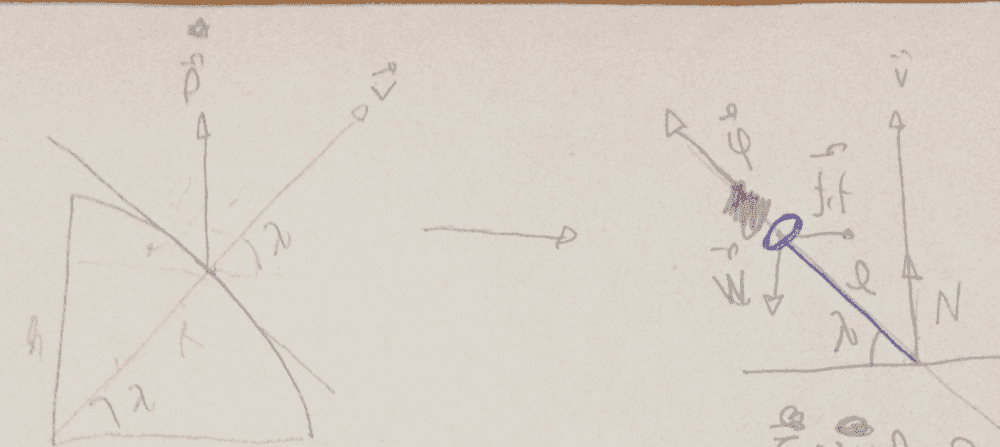
I am not sure about a, but i think as long as there is no torque about the Lp direction, it will remain constant with relation to the polar star. I would like help in proof this mathematically.
1589253385263.png

I just don't know how to proceed, i wonder if i would need to consider the torque provide by Centrifuge and Coriolis force, well... It made me wonder if I'm really on the right track.

p is a vector pointing polar star
v is a vertical vector.
Lambda is latitude
W is weight
fcf is force centrifuge
N is reaction in a pivot
 
Physics news on Phys.org
You don't need any formulas for this.
What is the basic characteristic of the spin axis of a (gimbaled) gyroscope?
Now pretend you point the gyro axis at the specified angle on a globe. Rotate the globe to simulate diurnal spin.
What has happened to the gyro spin axis, looking at the globe?
What if you are at latitude 45 deg. and you point the gyro spin axis horizontally instead of latitudinally along the Earth's polar axis?
 
Actually i think don't understood much 'bout this.
I know if a gyroscope is put in rotation about an axis, let's say East.West, since there is no torque on the flywheel, it will keep your angular momentum direction.
1590058597016.png

I don't know why is necessary point to Polar, and don't know too why in some cases it rotation direction will line up with the Earth rotation axis
 
LCSphysicist said:
Actually i think don't understood much 'bout this.
I know if a gyroscope is put in rotation about an axis, let's say East.West, since there is no torque on the flywheel, it will keep your angular momentum direction.
View attachment 263199
I don't know why is necessary point to Polar, and don't know too why in some cases it rotation direction will line up with the Earth rotation axis
In your diagram, with the gyro axis initially EW, the observer sees the axis swing to vertical. What would the observer see if the initial axis were NS?
 
1590065314604.png

Not sure, i got struck in that thought, but seems the gyroscope always will point in the same direction.

". Show that the gyro can remain stationary when its spin axis is
parallel to the polar axis and is at the latitude angle A with the horizontal. "
Nice XD Thank you both
 
There is some "torque inertial or torque fictitious" to a person in the Earth reference frame justify why the axis swing to vertical in the first case?
 
LCSphysicist said:
the gyroscope always will point in the same direction.
Yes, but the observer doesn't.
 
haruspex said:
Yes, but the observer doesn't.
I am not sure if i got it.
What i understood is: If we want to know where is what we call true north, we need to find a direction where the gyroscope will stay stationary even to a person who is in the earth, right?
 
LCSphysicist said:
I am not sure if i got it.
What i understood is: If we want to know where is what we call true north, we need to find a direction where the gyroscope will stay stationary even to a person who is in the earth, right?
The question says nothing about using it to find true north. I don't think it would be a very practical method.
But to word it more precisely, the axis will only appear stationary in the reference frame of an observer on the Earth's surface if it is aligned to true north.
 
  • Like
Likes LCSphysicist

Similar threads

  • · Replies 18 ·
Replies
18
Views
2K
  • · Replies 1 ·
Replies
1
Views
2K
  • · Replies 10 ·
Replies
10
Views
3K
  • · Replies 49 ·
2
Replies
49
Views
4K
  • · Replies 9 ·
Replies
9
Views
8K
  • · Replies 4 ·
Replies
4
Views
3K
  • · Replies 1 ·
Replies
1
Views
2K
Replies
2
Views
9K
  • · Replies 9 ·
Replies
9
Views
2K
  • · Replies 10 ·
Replies
10
Views
2K