

Physics news on Phys.org
- 20,815
- 28,438
Ask yourself the question where the weight is derived.

- 20,815
- 28,438
I assume that its gravity center is within the rear half of the weight, such that the component of the force in opposite direction of the screws is low and the main component is downwards. E.g.YKD said:
Where does the main force on the screws go?
A similar picture can be drawn for the reverse L.
Attachments

berkeman
Admin
- 69,308
- 24,542
I don't know what a "reverse" L-bracket is. Your pictures show a reinforced L-bracket and a non-reinforced L-bracket, so the answer to the question of which one is stronger seems kind of obvious, no?YKD said:L or reverse L is of more supporting force if all things being equal?
sophiecentaur
Science Advisor
Homework Helper
- 30,285
- 7,444
It depends upon what you mean by "stronger'. If you are talking in terms of ability to support a similar load using the same screws at the same points in the wall, the forces on the screws would be identical (as long as the unsupported l is strong enough not to deform and as long as the weight of the bracket can be ignored).YKD said:L or reverse L is of more supporting force if all things being equal? Why?
If you are thinking in terms of the strengths of the two structures then clearly the braced bracket would be much stronger because the naked L has to rely on the corner joint alone.
If you want a definitive answer to this then you must also make your question much better defined. Two separate diagrams (not photos) please with labels and reference letters on all parts of the diagram would be needed.
YKD
- 10
- 0
Thanks for the replies!
Sorry, make the questions more clear: which one is more supporting for the same heavy load?
Q1. A: naked L bracket vs B: reverse naked L bracket
Q2. C: braced L bracket vs D: reverse braced L bracket
Thank you so much!
Sorry, make the questions more clear: which one is more supporting for the same heavy load?
Q1. A: naked L bracket vs B: reverse naked L bracket
Q2. C: braced L bracket vs D: reverse braced L bracket
Thank you so much!
- 20,815
- 28,438
Reverse L underneath is better than L, because more forces are derived into the wall instead of the screws. With a cross brace it's even better, because even more force is derived into the wall.
Of course such an answer depends also on the given situation, will say the dimensions and kind of screws and dowels, the material and kind of the wall, e.g. if it is hollow or not etc. But in general a supporting system is stronger than a hanging system.
Of course such an answer depends also on the given situation, will say the dimensions and kind of screws and dowels, the material and kind of the wall, e.g. if it is hollow or not etc. But in general a supporting system is stronger than a hanging system.
NascentOxygen
Staff Emeritus
Science Advisor
Homework Helper
- 9,249
- 1,080
If fixed into wall material with screws, I see the Achille's heel here to be the topmost screw in a supporting L bracket (inverted L). That will be first to pull out of the wall as load on the shelf is increased. For a practical design to withstand maximum abuse, I'd favour the hanging braced L bracket above the shelf.
- 20,815
- 28,438
But the top most screw of an L design is equally at risk. The reverse L can be improved by a longer leg. A longer leg of an L design only increases the lever.
berkeman
Admin
- 69,308
- 24,542
IMO, they are the same to within a few percent. If I understand what you are calling "reversed" (whether the letter "L" is upright or upside-down when viewed from the side), then the only consideration is whether you can cut slots in the shelf to accommodate the brace for the "upright L" version of the bracket.YKD said:Thanks for the replies!
Sorry, make the questions more clear: which one is more supporting for the same heavy load?
Q1. A: naked L bracket vs B: reverse naked L bracket
Q2. C: braced L bracket vs D: reverse braced L bracket
Thank you so much!
Why are you asking this?
NascentOxygen
Staff Emeritus
Science Advisor
Homework Helper
- 9,249
- 1,080
decreasesfresh_42 said:But the top most screw of an L design is equally at risk. The reverse L can be improved by a longer leg. A longer leg of an L design only increases the lever.
A longer vertical of a hanging bracket decreases the leverage the load has on the screw, and for most home installations it's the weak strength of the wall as anchor for a screw that is the point of failure.
sophiecentaur
Science Advisor
Homework Helper
- 30,285
- 7,444
You can pretty much "tell' how strong a bracket is, just by looking or trying to flex it with your own strength. What the wall or fixings can take is more a matter of faith. Using all of the available screw holes in the bracket is a wise move if in doubt. A redundant structure gives confidence. One fixing is bound to end up in a weak mortar joint in a brick wall.NascentOxygen said:decreases
A longer vertical of a hanging bracket decreases the leverage the load has on the screw, and for most home installations it's the weak strength of the wall as anchor for a screw that is the point of failure.
- 20,815
- 28,438
Yeah, right. What I meant was that the radius is larger and so the direction of the force on the screw is greater in its horizontal direction. To me the whole question is, how much force is supported by the wall in contrast to the screw. And that's why I favor the ##\lceil## because the wall beats the screw (I think - I should draw another picture though).NascentOxygen said:decreases
NascentOxygen
Staff Emeritus
Science Advisor
Homework Helper
- 9,249
- 1,080
Your sample shows a strong bracket, so I conclude that the limitation in your proposed shelf resides in the uppermost screw's tendency to pull out of the typical wall material. For the sample supplied, I'd estimate the L support to be able to carry up to 3 times the load of the inverted-L, assuming the bracket itself doesn't break.
Rotating forces are shown, with the pivot point lying somewhere in the region of the ∆ markers, depending on flexure of the vertical arm. By my estimate, the load here has a leverage advantage over the screw's holding force of something like ×2 – ×5, meaning it looks like it could be much easier for the load to overcome the hold of the uppermost wall screw in this configuration.
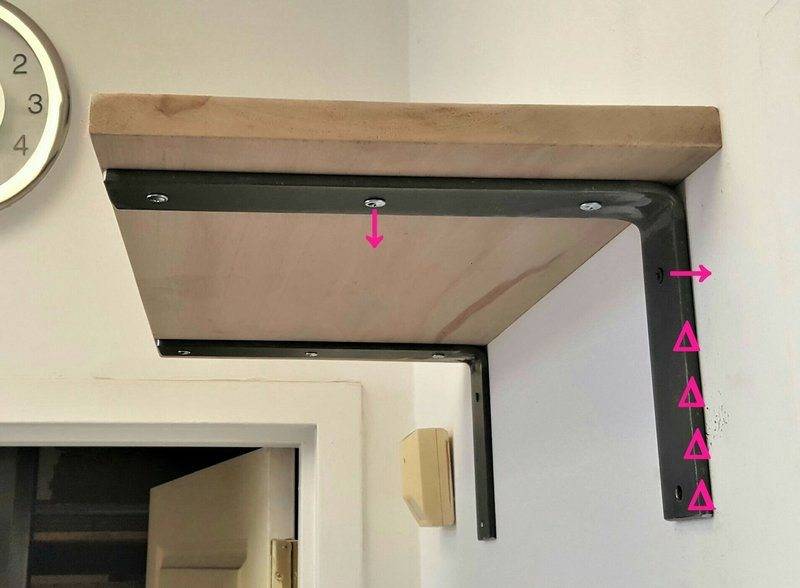
Rotating forces are shown, with the pivot point lying somewhere in the region of the ∆ markers, depending on flexure of the vertical arm. By my estimate, the load here has a leverage advantage over the screw's holding force of something like ×2 – ×5, meaning it looks like it could be much easier for the load to overcome the hold of the uppermost wall screw in this configuration.
Attachments

Similar threads
- Replies
- 1
- Views
- 6K
- Replies
- 1
- Views
- 2K
- · Replies 24 ·
- Replies
- 24
- Views
- 1K
- · Replies 1 ·
- Replies
- 1
- Views
- 4K
- · Replies 12 ·
- Replies
- 12
- Views
- 2K
- · Replies 4 ·
- Replies
- 4
- Views
- 2K
- · Replies 3 ·
- Replies
- 3
- Views
- 1K
- Replies
- 12
- Views
- 3K
- Replies
- 7
- Views
- 2K
- · Replies 33 ·
- Replies
- 33
- Views
- 3K