Lagrangian function of a double undamped pendulum

6 replies · 2K views · last reply
PaBlo14101066
Messages
4
Reaction score
1
I must find the Lagrangian for an undamped pendulum using the diagram showed below, I've no idea what to do with the second angle φ2 because is measured from the line that joins the two pivot points.
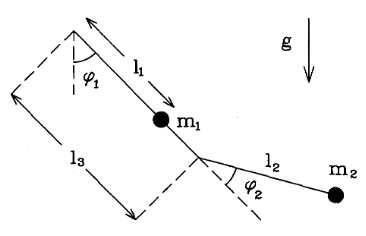
Diagram of a double pendulum: rod l1 hangs from a top pivot at angle φ1 from vertical, mass m1 on it; rod l2 hangs from m1 at angle φ2 from a dashed line l3 joining the pivots, ending in mass m2; arrow g points down.

The ecuations I must obtain are as follows
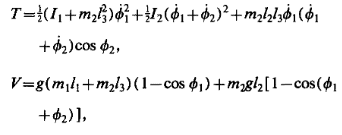
Two printed equations giving the kinetic energy T and potential energy V of a double pendulum in terms of angles φ1 and φ2, with masses m1, m2, m3 and lengths l1, l2, l3, and gravity g.

I get so many different things but I can't reach the desired result
 
PaBlo14101066 said:
I've no idea what to do
If all else fails, you could try $$T = {1\over 2} m_1\Bigl(\dot x_1^2+\dot y_1^2\Bigr) + {1\over 2} m_2\Bigl(\dot x_2^2+\dot y_2^2\Bigr) $$ but of course you already know how the subscript 1 term ends up, so the work is in the ##m_2## term.

Idem ##V##.
 
  • Like
Likes   Reactions: PaBlo14101066
BvU said:
If all else fails, you could try $$T = {1\over 2} m_1\Bigl(\dot x_1^2+\dot y_1^2\Bigr) + {1\over 2} m_2\Bigl(\dot x_2^2+\dot y_2^2\Bigr) $$ but of course you already know how the subscript 1 term ends up, so the work is in the ##m_2## term.

Idem ##V##.
Yes, I know, and also there must be a rotational kinetic energy, I made the algebra considering that φ2 is measured from the vertical and obtained
Equation for the kinetic energy T of a double pendulum: one half m1 l1 squared times theta1-dot squared, plus one half m2 L squared theta1-dot squared, plus one half m2 l2 squared theta2-dot squared, plus m2 L l2 cos(theta1 minus theta2) theta1-dot theta2-dot, plus one half I1 theta1-dot squared, plus one half I2 theta2-dot squared.

But even though I consider $$\phi_2=\phi_1+\phi'$$ I don't get to the equations of the second image
 
Don't you get, in terms of ##\hat{x}## and ##\hat{y}##,$$\dot{\mathbf{r}}_1 = l_1 \dot{\varphi}_1 \begin{pmatrix} \cos{\varphi_1} \\ \sin{\varphi_1} \end{pmatrix}$$and$$\dot{\mathbf{r}}_2 = l_3 \dot{\varphi}_1 \begin{pmatrix} \cos{\varphi_1} \\ \sin{\varphi_1} \end{pmatrix}

+ l_2 (\dot{\varphi}_1 + \dot{\varphi}_2) \begin{pmatrix} \cos{(\varphi_1 + \varphi_2)} \\ \sin{(\varphi_1 + \varphi_2)} \end{pmatrix}

$$Now you can find ##\dot{\mathbf{r}}_1 \cdot \dot{\mathbf{r}}_1## and ##\dot{\mathbf{r}}_2 \cdot \dot{\mathbf{r}}_2##. Does that work?
 
  • Like
  • Wow
Likes   Reactions: BvU and PaBlo14101066
etotheipi said:
Don't you get, in terms of ##\hat{x}## and ##\hat{y}##,$$\dot{\mathbf{r}}_1 = l_1 \dot{\varphi}_1 \begin{pmatrix} \cos{\varphi_1} \\ \sin{\varphi_1} \end{pmatrix}$$and$$\dot{\mathbf{r}}_2 = l_3 \dot{\varphi}_1 \begin{pmatrix} \cos{\varphi_1} \\ \sin{\varphi_1} \end{pmatrix}

+ l_2 (\dot{\varphi}_1 + \dot{\varphi}_2) \begin{pmatrix} \cos{(\varphi_1 + \varphi_2)} \\ \sin{(\varphi_1 + \varphi_2)} \end{pmatrix}

$$Now you can find ##\dot{\mathbf{r}}_1 \cdot \dot{\mathbf{r}}_1## and ##\dot{\mathbf{r}}_2 \cdot \dot{\mathbf{r}}_2##. Does that work?
I think that's it, I would have to do the algebra, but as far as it looks, looks fine
 
PaBlo14101066 said:
I think that's it, I would have to do the algebra, but as far as it looks, looks fine

Yes, I believe it does indeed get what you're after. The only fiddly part of the calculation is$$
\begin{align*}
\begin{pmatrix} \cos{\varphi_1} \\ \sin{\varphi_1} \end{pmatrix} \cdot \begin{pmatrix} \cos{(\varphi_1 + \varphi_2)} \\ \sin{(\varphi_1 + \varphi_2)} \end{pmatrix} &=

\cos{\varphi_1} \left( \cos{\varphi_1} \cos{\varphi_2} - \sin{\varphi_1} \sin{\varphi_2}\right) + \sin{\varphi_1} \left( \sin{\varphi_1} \cos{\varphi_2} + \cos{\varphi_1} \sin{\varphi_2}\right)

\\
&= \cos{\varphi_2} \left( \cos^2{\varphi_1} + \sin^2{\varphi_1} \right) \\

&= \cos{\varphi_2}

\end{align*}
$$but the rest should fall out okay.
 
  • Like
Likes   Reactions: docnet and PaBlo14101066
etotheipi said:
Yes, I believe it does indeed get what you're after. The only fiddly part of the calculation is$$
\begin{align*}
\begin{pmatrix} \cos{\varphi_1} \\ \sin{\varphi_1} \end{pmatrix} \cdot \begin{pmatrix} \cos{(\varphi_1 + \varphi_2)} \\ \sin{(\varphi_1 + \varphi_2)} \end{pmatrix} &=

\cos{\varphi_1} \left( \cos{\varphi_1} \cos{\varphi_2} - \sin{\varphi_1} \sin{\varphi_2}\right) + \sin{\varphi_1} \left( \sin{\varphi_1} \cos{\varphi_2} + \cos{\varphi_1} \sin{\varphi_2}\right)

\\
&= \cos{\varphi_2} \left( \cos^2{\varphi_1} + \sin^2{\varphi_1} \right) \\

&= \cos{\varphi_2}

\end{align*}
$$but the rest should fall out okay.
Yes, that's it. Thank you very much. You've earned heaven (whatever heaven is to you) :)
 
  • Love
Likes   Reactions: etotheipi