Lagrangian mechanics: central-force-like problem

Click For Summary

Homework Help Overview

The discussion revolves around a problem in Lagrangian mechanics, specifically focusing on a central-force-like scenario. The original poster expresses difficulty with part d of the problem, indicating uncertainty in how to approach the setup and utilize information from previous parts.

Discussion Character

  • Exploratory, Assumption checking, Conceptual clarification

Approaches and Questions Raised

  • Participants discuss the use of the effective potential and its second derivative to determine the oscillator constant and period of oscillation. There are questions regarding the validity of this approach in different contexts and the relationship between small oscillations and orbital frequency.

Discussion Status

Some participants have provided guidance on evaluating the second derivative of the effective potential at a specific radius and suggested expressing certain quantities in terms of the unperturbed radius. However, there is no explicit consensus on the applicability of these methods across all scenarios.

Contextual Notes

The original poster has successfully addressed parts a to c but is struggling with part d. There is an emphasis on the need to clarify assumptions regarding the relationship between different frequencies and the definitions of variables involved.

LuccaP4
Messages
24
Reaction score
9
Homework Statement
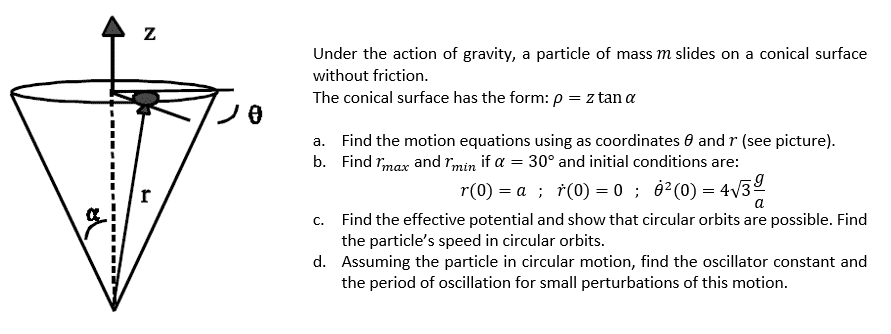
Under the action of gravity, a particle of mass m slides on a conical surface without friction.
The conical surface has the form: ρ=z tan⁡α

a. Find the motion equations using as coordinates θ and r (see picture).
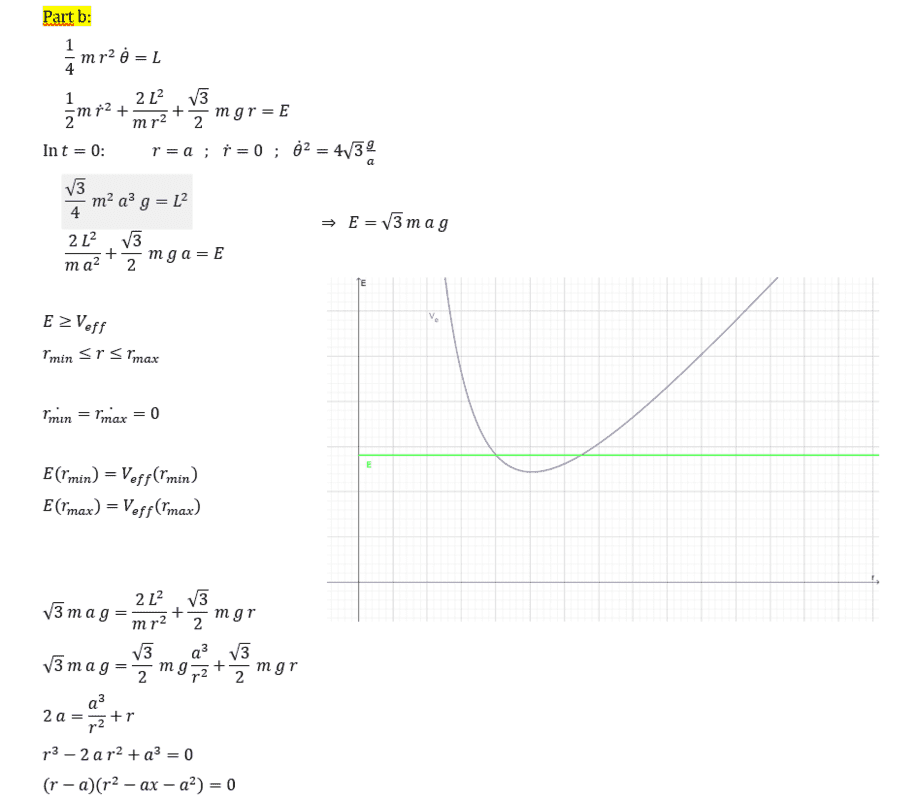
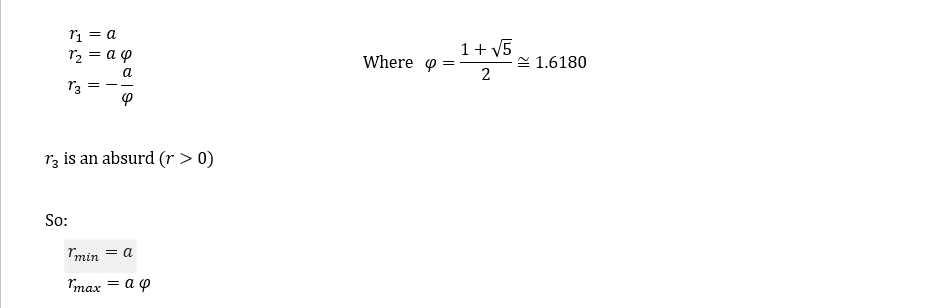
b. Find r_max and r_min if α=30° and initial conditions are:
r(0)=a ; r ̇(0)=0 ; θ ̇^2 (0)=4√3 g/a
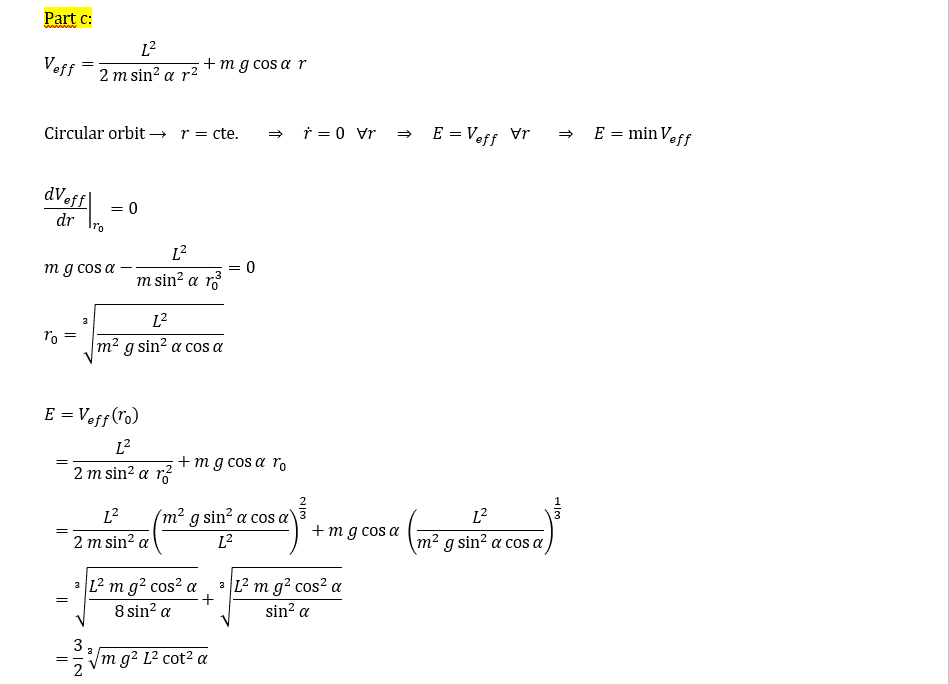
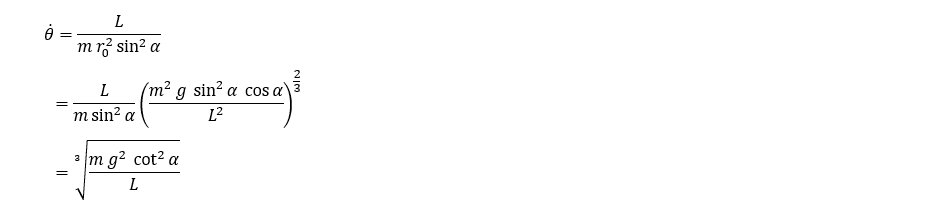
c. Find the effective potential and show that circular orbits are possible. Find the particle’s speed in circular orbits.
d. Assuming the particle in circular motion, find the oscillator constant and the period of oscillation for small perturbations of this motion.
Relevant Equations
Lagrange equations
I copy again the statement here:
Statement.png


So, I think I solved parts a to c but I don't get part d. I couldn't even start it because I don't understand how to set the problem.
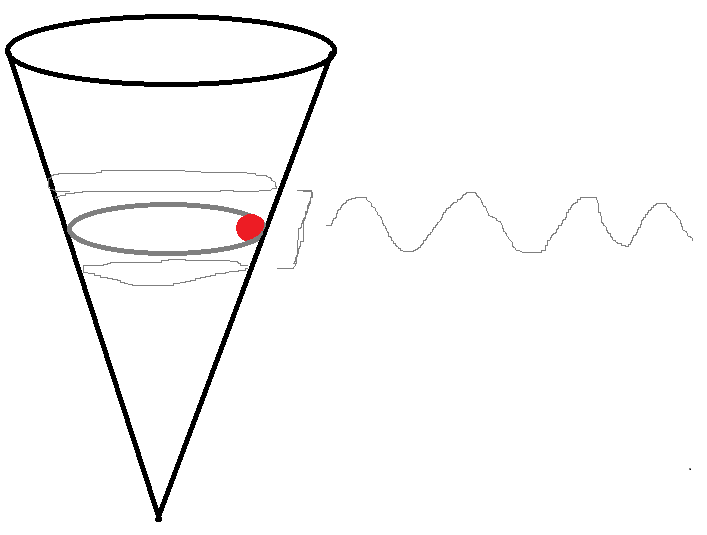
I think it refers to some kind of motion like this one in the picture, so I'll have a maximum and a minimum r, and I can get the energy and initial speed of a circular motion from part c, but I don't know how to use them.
d.png


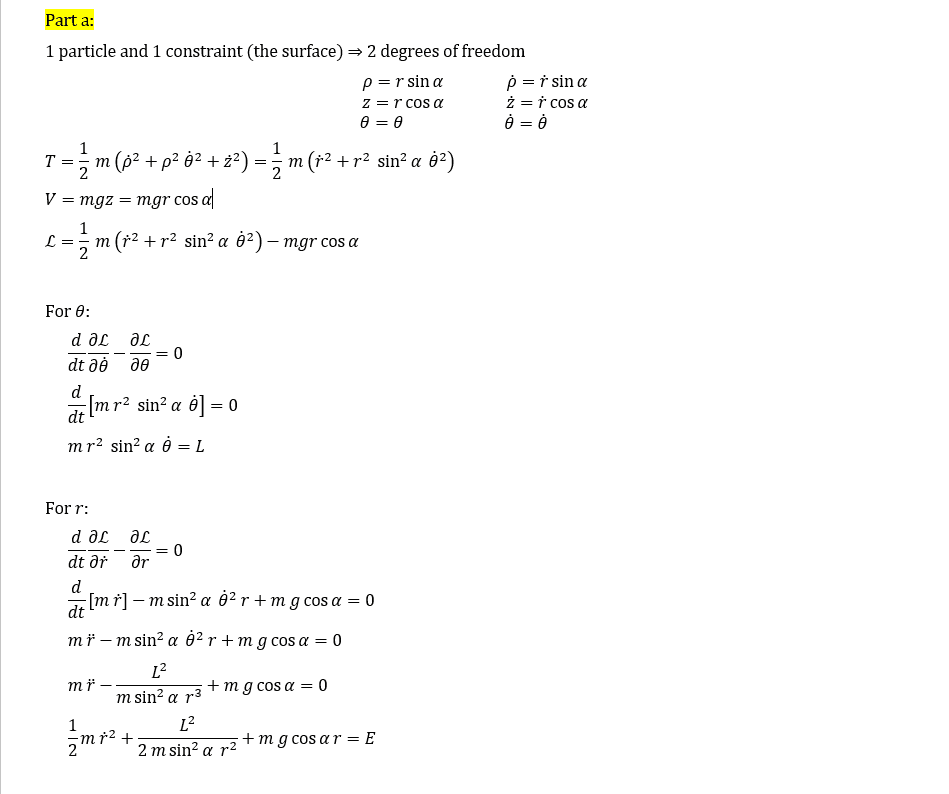
I attach my resolution on the other parts.
a.png

b1.png

b2.png

c1.png

c2.png
 

Attachments

  • b2.png
    b2.png
    2.2 KB · Views: 301
  • Like
Likes   Reactions: JD_PM and Delta2
Physics news on Phys.org
You can use ##V_{\rm eff}''(r_0)## to find the "oscillator constant" ##k## and the period of oscillation for small perturbations of the circular motion. See this and also page 2 of this example.
 
  • Like
Likes   Reactions: LuccaP4, JD_PM and Delta2
Many thanks!
 
Is this valid in every case?
dc182d7dc4c73be5b52da8a2283cc4ac.png


In the frecuency ##\omega##, I should evaluate the second derivative in ##r_0##, shouldn't I?
 
LuccaP4 said:
Is this valid in every case?
View attachment 263728

In the frecuency ##\omega##, I should evaluate the second derivative in ##r_0##, shouldn't I?
The frequency of small oscillations does not equal the orbital frequency, in general. The example in the link is an interesting exception where they are equal.

Yes, you need to find ##\frac{d^2 V_{\rm eff}(r)}{dr^2} |_{r = r_0}##.

For part (c), I would express ##\dot \theta## in terms of ##r_0##, rather than ##L##. You are also asked to "find the speed". I think this is probably the linear speed of the particle.

For part (d), I would express the "oscillation constant" and the period of the oscillations in terms of the unperturbed radius ##r_0##, rather than in terms of the angular momentum ##L##.
 
Okay, thanks!
 

Similar threads

Replies
5
Views
2K
  • · Replies 13 ·
Replies
13
Views
3K
  • · Replies 1 ·
Replies
1
Views
2K
  • · Replies 4 ·
Replies
4
Views
3K
  • · Replies 2 ·
Replies
2
Views
2K
  • · Replies 6 ·
Replies
6
Views
3K
Replies
6
Views
4K
  • · Replies 1 ·
Replies
1
Views
2K
  • · Replies 2 ·
Replies
2
Views
2K
  • · Replies 11 ·
Replies
11
Views
3K