SUMMARY
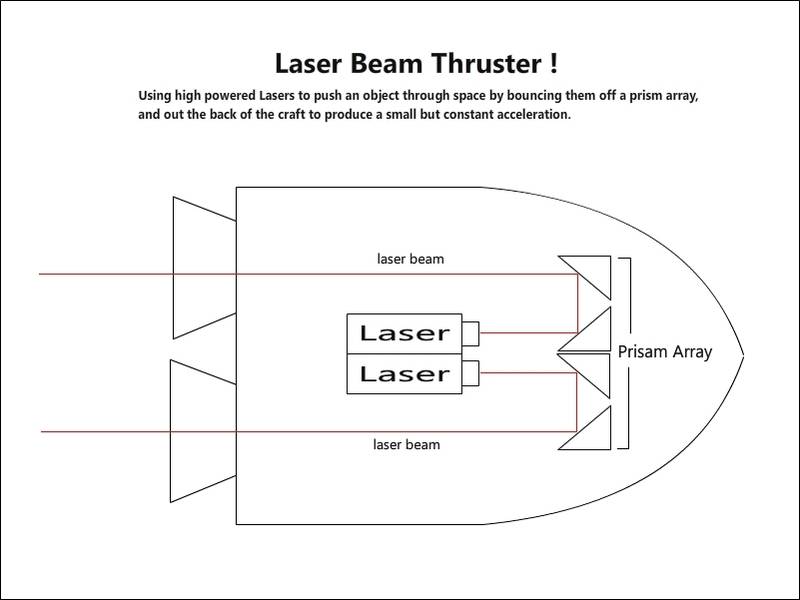
The discussion centers on the feasibility of using laser propulsion with the EM Drive and prisms to achieve thrust in space. Participants highlight that while using electromagnetic (EM) waves for thrust is theoretically possible, it requires immense power and is inefficient when using onboard lasers. The consensus is that firing lasers directly backward would yield the same momentum transfer as using prisms, due to Newton's Third Law. Additionally, the concept of collecting CO2 from astronauts for propulsion is dismissed as impractical, as it does not impart momentum effectively.
PREREQUISITES
- Understanding of Newton's Third Law of Motion
- Familiarity with electromagnetic (EM) propulsion concepts
- Knowledge of laser technology and its applications in propulsion
- Basic principles of momentum transfer in physics
NEXT STEPS
- Research the principles of laser propulsion systems
- Explore the efficiency of different propulsion methods, including solar sails
- Study the mechanics of momentum transfer in various propulsion scenarios
- Investigate the use of CO2 scrubbers in spacecraft and their limitations
USEFUL FOR
Aerospace engineers, physicists, and enthusiasts interested in advanced propulsion technologies and the practical applications of laser systems in space travel.