LED module failing due to DC motor?

Click For Summary

Discussion Overview

The discussion centers around the failure of an LED module when used in conjunction with a DC motor controlled by a relay module. Participants explore potential causes for the LED failure, including voltage spikes, inrush currents, and relay connection issues. The conversation includes technical considerations regarding circuit protection methods and component specifications.

Discussion Character

  • Technical explanation
  • Debate/contested
  • Mathematical reasoning

Main Points Raised

  • One participant suggests that surge voltage or inrush current from the motor could be causing the LED module to fail.
  • Another participant proposes that voltage spikes from motor inductance when switching relays may be damaging the LEDs and recommends adding a capacitor and diodes for protection.
  • Some participants discuss the need for kickback protection diodes for the relay coils to prevent voltage spikes when the coils are de-energized.
  • There is a suggestion to use a bridge rectifier to manage voltage spikes and to include a bypass capacitor to absorb inductive pulse energy.
  • One participant questions the effectiveness of using a varistor for voltage spike protection and suggests that clamp diodes may be more reliable.
  • Another participant mentions the importance of ensuring that the motor current has a path to flow to avoid voltage spikes when the relay switches.
  • Concerns are raised about the reverse voltage that LEDs may experience from the motor, which could exceed their ratings.
  • Participants discuss the choice of capacitors and TVS diodes for protecting the circuit, with varying opinions on their specifications and effectiveness.

Areas of Agreement / Disagreement

Participants express multiple competing views on the causes of the LED failure and the best methods for circuit protection. There is no consensus on a single solution, as various protective measures are proposed and debated.

Contextual Notes

Limitations include the lack of specific information about the relay's interrupting rating and the maximum current draw of the motor. There are also unresolved questions regarding the best choice of components for protection against voltage spikes.

Who May Find This Useful

This discussion may be useful for individuals working with relay-controlled motors and LED modules, particularly those interested in circuit protection strategies and troubleshooting electronic failures.
Vatech
Messages
53
Reaction score
7
TL;DR
A led module gets damaged. Surge Voltage ? Inrush current or am i missing something?
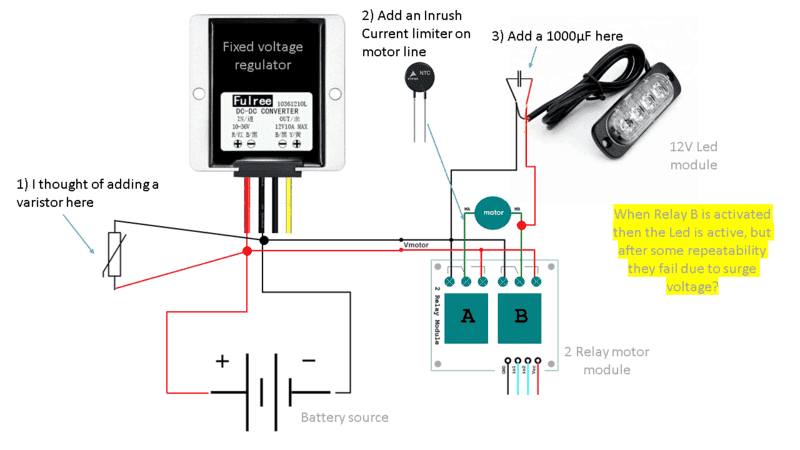
I use a 2 Relay Motor module to control Direction on a motor (linear actuator). When Relay A is active, actuator retracts. When Relay B is active, actuator extents and Led Module is activated. After some repetitions Led module fail.

Cause of the fail?
I believe Surge voltage, although i am not an expert on electronics. Inrush current or instant voltage drop due to high load could also be the reason.
Maybe i am missing something on Relay connection
Please excuse me for the rough presentation, but will help enough to give you a visual perspective of the problem.
Thank you in advance for your suggestions.
1625227247570.png
 
Engineering news on Phys.org
My guess is that the LEDs are failing due to voltage spikes produced by the motor inductance when it is switched. Have you installed the 1000 uF capacitor?

Next use a couple of diodes to protect the LED from negative voltages. One diode in parallel across the LED, another in series with the positive lead to the LED.
Select the diode based on the current drawn by the LED module when turned on.
 
  • Like
Likes   Reactions: Vatech
Baluncore said:
use a couple of diodes to protect the LED from negative voltages. One diode in parallel across the LED, another in series with the positive lead to the LED.
My impression is that this is an "LED Module", implying that it is a module that drives several LEDs, not individual LEDs that could be protected separately.

@Vatech -- Any time you drive a relay primary coil, you need to be sure to add a kickback protection diode for when the coil is opened (if it is not already a part of the coil drive circuit).

1625268976548.png

https://www.circuitstoday.com/types-of-relays
 
  • Like
Likes   Reactions: Vatech and hutchphd
berkeman said:
My impression is that this is an "LED Module", implying that it is a module that drives several LEDs, not individual LEDs that could be protected separately.

@Vatech -- Any time you drive a relay primary coil, you need to be sure to add a kickback protection diode for when the coil is opened (if it is not already a part of the coil drive circuit).

View attachment 285373
https://www.circuitstoday.com/types-of-relays

" kickback protection diode" . Could you use my picture to draw the circuit needed? Also, the varistor, do you think that will not be needed? Leds failed after adding the motor (althought they worked for 3-4 times with the motor added)
 
We don't see any nameplate info. What is the max current draw of the motor? What is the interrupting rating of the relay?
 
Correct, i am sorry, Motor Current 2.5A, Motor Inrush Current <>7.5A. and the relays are gk3ff-12vdc-s-a
 
Your relays will momentarily disconnect the motor wire from any connection while it is switching*. The motor inductance will then create a voltage spike if it was previously energized. You should always provide a path for the motor current to flow somewhere.

So, what I would try first is adding 4 fast recovery diodes, 2 on each winding as shown below.

20210703_101332~2.jpg


* some relays will momentarily short all of the contacts together when they switch, but these aren't common, and wouldn't be used in a circuit like this.
 
  • Like
Likes   Reactions: Tom.G, Rive and Vatech
I don't believe it is the relay coil causing the problem. It is the motor inductance when a relay switches or the brushes bounce. The two relays make a full bridge. As suggested by @DaveE the voltage spikes could be caught by adding a bridge rectifier to the circuit. The + goes to the positive supply, the – to the negative rail. The AC terminals are connected to the motor terminals.
However the supply rails have inductance also, so they need the 1000 uF capacitor to catch the inductive pulse energy.
Power supplies are not designed to work backwards, holding the output voltage down. There needs to be an over-voltage clamp for the supply rails to protect the LEDs.
 
  • Like
Likes   Reactions: hutchphd and Vatech
If i add a 18V varistor between the + and GND line, to be protected by voltage spikes, and a 1000uF on Led line, will not be enough? (The Power source is a 12V battery)
 
  • #10
Vatech said:
If i add a 18V varistor between the + and GND line, to be protected by voltage spikes, and a 1000uF on Led line, will not be enough? (The Power source is a 12V battery)
Maybe, but probably not. Use the clamp diodes, plus a bypass capacitor, as @Baluncore said. They will reliably limit all of the motor voltages to the range -1V to 13V or so, and it is easy to implement.

Varistors are quite sloppy devices and hard to specify. An 18V varistor is a value basically designer to have 18V across it without doing anything; it actually clamps at a significantly higher voltage.
 
  • Like
Likes   Reactions: Vatech, Baluncore and hutchphd
  • #11
DaveE said:
Your relays will momentarily disconnect the motor wire from any connection while it is switching*. The motor inductance will then create a voltage spike if it was previously energized. You should always provide a path for the motor current to flow somewhere.

So, what I would try first is adding 4 fast recovery diodes, 2 on each winding as shown below.

View attachment 285405

* some relays will momentarily short all of the contacts together when they switch, but these aren't common, and wouldn't be used in a circuit like this.
The approach by @DaveE is the most straightforward and likely the most effective to protect both the LEDs AND the relays.

The LEDs are probably being damaged by the reverse voltage from the motor when it turns off (disconnects from the supply). This could be several hundred volts, whereas the reverse voltage rating of LEDs is a few volts.

The suggested configuration will also help protect the relays by diverting the voltage spike to the supply voltage.

Another possible approach is to wire a diode in series with each LED individually, and also wire a diode reversed polarity across each LED; but the approach by DaveE would be simpler.

Cheers,
Tom
 
  • Like
Likes   Reactions: Vatech
  • #12
Tom.G said:
The approach by @DaveE is the most straightforward and likely the most effective to protect both the LEDs AND the relays.

The LEDs are probably being damaged by the reverse voltage from the motor when it turns off (disconnects from the supply). This could be several hundred volts, whereas the reverse voltage rating of LEDs is a few volts.

The suggested configuration will also help protect the relays by diverting the voltage spike to the supply voltage.

Another possible approach is to wire a diode in series with each LED individually, and also wire a diode reversed polarity across each LED; but the approach by DaveE would be simpler.

Cheers,
Tom
I will follow the advice by @DaveE and @Baluncore . If you agree with the connection diagram Please let me know
1) Should i use Tantalum, Ceramic or Electrolytic Capacitor (1000μF)?
2)Do you agree wit the use of TVS diode(transient voltage suppression diode)? and if yes , should i add Unidirectional OR Bidirectional? and is 15V a good selection?
THANK YOU ALL FOR HELPING ME
1625381931827.png
 

Attachments

  • 1625380665749.png
    1625380665749.png
    31.3 KB · Views: 227
Last edited:
  • #13
Vatech said:
I will follow the advice by @DaveE and @Baluncore .
That wasn't our advice. But, sure you can do that. It's not what I would do but it's better than your first version. It will probably work.

Vatech said:
1) Should i use Tantalum, Ceramic or Electrolytic Capacitor (1000μF)?
Electrolytic. 1000uF sounds OK. I would also add a ceramic 0.1uF in parallel with the electrolytic, but you can probably get away with leaving it out.

Vatech said:
2)Do you agree wit the use of TVS diode(transient voltage suppression diode)?
See the first paragraph. TVS diodes are easier to specify than varistors with tighter tolerances. But you will still be clamping at higher voltages than simple clamp diodes back to the supply. The other issue with TVS diodes is that you have to be careful to choose one that can absorb the energy you will put into it during clamping.

Vatech said:
could you suggest one?
If you can't read the datasheets and pick your own, then I'm not sure you should use them at all. Plus, we don't really know about your worst case battery voltages.
Look here: https://www.digikey.com/en/products/filter/tvs-diodes/144?s=N4IgjCBcpg7AzABiqAxlAZgQwDYGcBTAGhAHsoBtcEAXRIAcAXKEASQDtGCBzAgJxABfEmACcADlEoQ6SNnzEylEMjogmLAMqM%2BAS3bchJALQAmabJ0BXReUhUArLWEhjT6DMy5CJO1QBs5iT%2BECTwzi7m9iCMAG54AAQAJrqkSQR4zkA

Anyway, I'd choose a bridge rectifier, not a TVS diode.
 
  • Like
Likes   Reactions: Vatech
  • #14
Deads_LED_circuit.png
 
  • Like
Likes   Reactions: Vatech
  • #15
Dear @DaveE , can a bridge rectifier protect from overvoltageas like the TVS will do?
i found the following TVS diodes available in my country
1625384224581.png

And, should i use Unidirectional TVS or Bidirectional TVS?
Dear @Baluncore , i see you moved the capacitor and added a second Diode in parallel with the TVS diode
This is out of my field, i am not an expert on electronics , but i have to implement a project that involves a lot of electronics. Thats why i was not sure how to connect your suggested schematic between the motor relay and the power line, if @Baluncore you could modify my diagram would be helpful
 
Last edited:
  • #16
I don't trust TVS diodes. When I think it needs one then I could do better by stopping the transients being produced in the first place. The four diodes in the bridge rectifier do just that. They only conduct during transient voltage excursions. Because the high voltage spikes produced by the motor transients are caught by the bridge, the relay contacts will not get burned by the DC arc each time a relay switches off.

The second diode in parallel with the LED module is a cheap investment. It prevents fast negative transients from reaching the LEDs. For negative spikes the parallel diode is duplicating the TVS. The TVS is not essential if the bridge and the 1000 uF are present.
 
  • Like
Likes   Reactions: Tom.G and DaveE
  • #17
Baluncore said:
I don't trust TVS diodes. When I think it needs one then I could do better by stopping the transients being produced in the first place. The four diodes in the bridge rectifier do just that. They only conduct during transient voltage excursions. Because the high voltage spikes produced by the motor transients are caught by the bridge, the relay contacts will not get burned by the DC arc each time a relay switches off.

The second diode in parallel with the LED module is a cheap investment. It prevents fast negative transients from reaching the LEDs. For negative spikes the parallel diode is duplicating the TVS. The TVS is not essential if the bridge and the 1000 uF are present.
Thank you. Then i will not use TVS. Dear @Baluncore & @DaveE , is the folloowing diagramm correct according the use of bridge rectifier?
1625397306033.png
 
  • Like
Likes   Reactions: DaveE
  • #18
That is correct for the bridge.
If you use the bridge you must use the 1000 uF across the motor supply.
 
  • Like
Likes   Reactions: Tom.G and Vatech

Similar threads

  • · Replies 19 ·
Replies
19
Views
3K
Replies
2
Views
2K
  • · Replies 5 ·
Replies
5
Views
5K
  • · Replies 4 ·
Replies
4
Views
2K
  • · Replies 5 ·
Replies
5
Views
2K
Replies
12
Views
3K
  • · Replies 26 ·
Replies
26
Views
7K
  • · Replies 11 ·
Replies
11
Views
3K
  • · Replies 1 ·
Replies
1
Views
2K
Replies
11
Views
3K