Length of a string over a 2 pulley system

Click For Summary

Homework Help Overview

The discussion revolves around a physics lab report concerning a pulley system with weights. Participants are exploring how the length of the string (L) changes as additional weight (mb) is added to the system, particularly focusing on the relationship between the string's configuration and the forces involved.

Discussion Character

  • Exploratory, Assumption checking, Problem interpretation

Approaches and Questions Raised

  • Participants are attempting to understand the implications of adding weight to the system and how it affects the length of the string. Questions arise about the fixed endpoints of the string and the mechanics of how the string interacts with the pulleys.

Discussion Status

Some participants are providing clarifications regarding the setup of the pulley system and the nature of the weights involved. There is an ongoing exploration of the distances related to the pulleys and the weights, with participants questioning the assumptions about the string's behavior as it interacts with the pulleys.

Contextual Notes

Participants are discussing the specifics of the pulley system's configuration, including the nature of the string and the weights. There is mention of a diagram that may contain inaccuracies, and participants are open to correcting any misunderstandings based on visual representations.

breid040
Messages
9
Reaction score
1
Homework Statement
How does L change as mb gets heavier?
Relevant Equations
d=m(L/2)/(sqrt((2M)^2-(m)^2))
Hello all,
I am working on a lab report for physics, and am a bit stuck on one aspect. The basic layout of the pulley system is attached. (This is a diagram I made, so if there are any inaccuracies in this one either, I am happy to fix it.
image

So, I mostly understand the lab. My TA said, though, that L/2 changes as more weight is added onto mb.
Here is my attempt at understanding why:
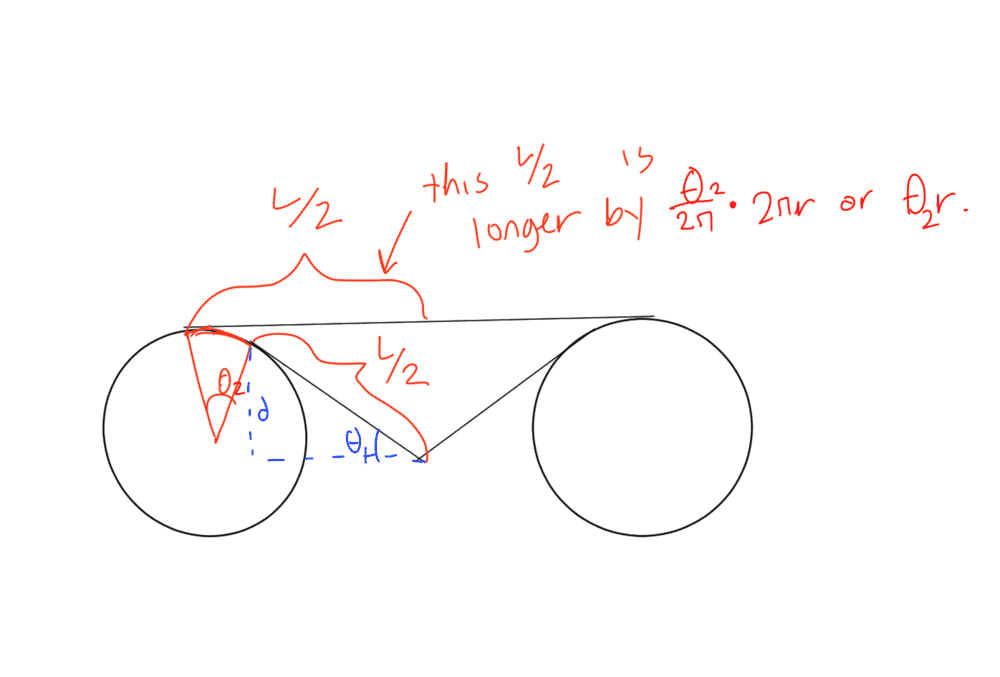
1573595267408.png

Is this accurate? I just wanted to check.
 
Physics news on Phys.org
breid040 said:
Homework Statement: How does L change as mb gets heavier?
Homework Equations: d=m(L/2)/(sqrt((2M)^2-(m)^2))

Hello all,
I am working on a lab report for physics, and am a bit stuck on one aspect. The basic layout of the pulley system is attached. (This is a diagram I made, so if there are any inaccuracies in this one either, I am happy to fix it.
image

So, I mostly understand the lab. My TA said, though, that L/2 changes as more weight is added onto mb.
Here is my attempt at understanding why:
View attachment 252745
Is this accurate? I just wanted to check.

What is mb?
 
mb is the weight in the middle, the diagram shows it if you can see the diagram :smile:
 
breid040 said:
mb is the weight in the middle, the diagram shows it if you can see the diagram :smile:

Are the string endpoints fixed to the tops of the pulleys?
 
MichaelJ12 said:
Are the string endpoints fixed to the tops of the pulleys?
No, it's one long string that has 3 weights on it, and goes through both the pulleys. Would the amount of string lost on the inside by wrapping over the pulley be made up for by pulling more string over?
 
breid040 said:
No, it's one long string that has 3 weights on it, and goes through both the pulleys. Would the amount of string lost on the inside by wrapping over the pulley be made up for by pulling more string over?
Consider the point where the string touches the (rotated) pulley. How far is it from a vertical line through the pulley's centre? How far is it from a vertical line through the mass? What equation does that allow you to write?
 
If I'm interpreting you right, the point where the string touches the pulley to the center should just be the radius of the pulley? The distance to the mass would be the changed L/2? I tried drawing out a diagram.
Screen Shot 2019-11-12 at 8.37.44 PM.png
I am a bit confused on where to go from here, however?
 
breid040 said:
where the string touches the pulley to the center
No, not to the centre of the pulley; the horizontal distance to the vertical through the centre.
breid040 said:
The distance to the mass would be the changed L/2?
Again, I asked for the horizontal distance to a vertical line through the mass. Express this in terms of what you are calling the "changed L/2", but please don’t call it that. Let's call it x.
 

Similar threads

  • · Replies 5 ·
Replies
5
Views
1K
  • · Replies 18 ·
Replies
18
Views
2K
  • · Replies 22 ·
Replies
22
Views
7K
  • · Replies 4 ·
Replies
4
Views
2K
  • · Replies 18 ·
Replies
18
Views
4K
  • · Replies 22 ·
Replies
22
Views
2K
  • · Replies 15 ·
Replies
15
Views
6K
  • · Replies 22 ·
Replies
22
Views
3K
  • · Replies 3 ·
Replies
3
Views
3K
  • · Replies 8 ·
Replies
8
Views
3K