Lensmaker's equation when the 2 mediums on both sides of the lens are different

  • Context: Graduate 
  • Thread starter Thread starter phantomvommand
  • Start date Start date
  • Tags Tags
    Lens
Click For Summary
SUMMARY

The discussion centers on the application of the lensmaker's equation when the refractive indices of the two mediums surrounding a lens are different. The focal lengths, denoted as f1 and f2, were analyzed, revealing that f1 does not incorporate the refractive index of the opposite medium, while f2 does. The calculations were verified using Snell's law and paraxial approximations, confirming the correctness of the textbook's expression for f2. The discussion emphasizes the need for precise calculations when dealing with lenses in varying mediums.

PREREQUISITES
  • Understanding of Snell's law in optics
  • Familiarity with the lensmaker's equation
  • Knowledge of paraxial approximations in ray optics
  • Concept of refractive index and its implications in lens design
NEXT STEPS
  • Study the derivation of the lensmaker's equation for different refractive indices
  • Explore advanced applications of Snell's law in optical systems
  • Investigate the effects of varying refractive indices on lens performance
  • Learn about paraxial ray tracing techniques in optical design
USEFUL FOR

Optical engineers, physicists, and students studying optics who seek to deepen their understanding of lens design and the effects of surrounding mediums on focal lengths.

phantomvommand
Messages
287
Reaction score
39
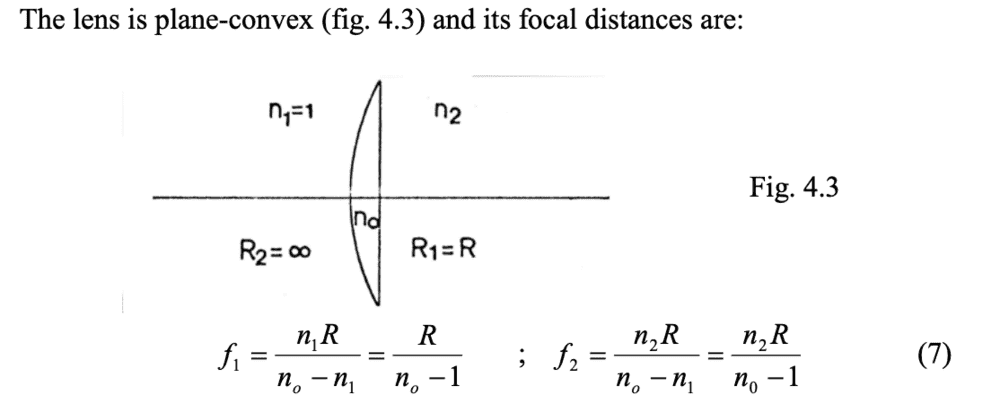
Hi, I chanced upon an interesting diagram lately, and was wondering what the lensmakers equation for such a lens would be. Attached below is the diagram. Basically, the refractive indexes of the 2 mediums surrounding each side of the lens are different.

They have also calculated the focal distances as shown below. However, I notice some inconsistency. f1 seems not to involve the refractive index of the opposite medium, while f2 does. Is the calculation of focal length correct, and what is the lensmakers equation when the mediums around the lens are different?
Screenshot 2021-02-15 at 12.56.24 PM.png
 
Last edited by a moderator:
Science news on Phys.org
I verified the expression for ## f_2 ##. To do this from first principles, (which I did), you have parallel rays incident from the left, and compute the refraction at the first surface for a height ## h ## using Snell's law with paraxial approximations. Next compute the refraction at the second surface, and finally compute the focal length, where the parallel rays converge on axis, independent of ## h##.
It would be a similar calculation for ## f_1 ##.
I think the textbook is correct.
Note: To compute the angle ## \phi ## of the normal of the curved surface as a function of ## h ##, you can use
## \frac{d \phi}{dh} \approx \frac{1}{R} ##, so that ## \phi=\frac{h}{R} ## in the paraxial ray aprroximation. (Traveling on a circle, ## \frac{d \phi}{ds}=\frac{1}{R} ##, where ## s ## is the arc length. Near the optic axis, ## h \approx s ##).
 
Last edited:

Similar threads

  • · Replies 1 ·
Replies
1
Views
2K
  • · Replies 17 ·
Replies
17
Views
3K
  • · Replies 1 ·
Replies
1
Views
3K
  • · Replies 5 ·
Replies
5
Views
2K
  • · Replies 20 ·
Replies
20
Views
4K
  • · Replies 1 ·
Replies
1
Views
3K
  • · Replies 1 ·
Replies
1
Views
1K
Replies
2
Views
3K
  • · Replies 1 ·
Replies
1
Views
2K
Replies
1
Views
13K