Lever question when lever is angled

  • Context: Undergrad 
  • Thread starter Thread starter JCaleb
  • Start date Start date
  • Tags Tags
    Lever
Click For Summary
SUMMARY

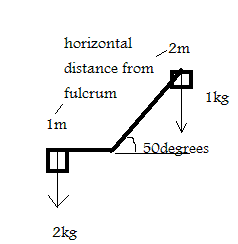
The discussion centers on the mechanics of a lever system configured at an angle, specifically analyzing the forces acting on a see-saw. The user presents a scenario where a 2kg force at 1m on one side and a 1kg force adjusted by the cosine of the angle at 2m on the other side are compared. The conclusion drawn is that the system will not achieve static equilibrium, as the left side's moment (2*1) exceeds the right side's moment (0.64*2). Additionally, the user questions the definition of distance in this context and notes that a point of support is necessary to maintain equilibrium.

PREREQUISITES
  • Understanding of static equilibrium equations in mechanics
  • Knowledge of trigonometric functions, specifically sine and cosine
  • Familiarity with lever systems and their components
  • Basic principles of forces and moments in physics
NEXT STEPS
  • Study the principles of torque and moment arms in lever systems
  • Learn about static equilibrium conditions in mechanical systems
  • Explore the applications of trigonometry in physics problems
  • Investigate real-world examples of lever systems and their analysis
USEFUL FOR

Students of physics, mechanical engineers, and anyone interested in understanding the dynamics of lever systems and static equilibrium analysis.

JCaleb
Messages
1
Reaction score
0
Hello, I have a question about a see-saw / lever problem. Does this configuration I have shown here allow me to treat the system like a regular lever if I make the downward force at the horizontal point from the center to be the cosine of the angle? In this example the downward force on the left would be 2kg at 1m whereas on the right it would be 1kg * cos(5) at 2m.

Based on the static equilibrium equation of a lever F1*d1= F2*d2 the system would not be in equilibrium and would fall to the left. 2*1 > 0.64*2

Is this correct?

Would that mean that there is a compression force of the sine of the angle down the shaft towards the fulcrum on the right side? 1kg*sin(50) ?
attachment.php?attachmentid=19081&stc=1&d=1243206314.gif
 

Attachments

  • leverquestion.gif
    leverquestion.gif
    2.7 KB · Views: 686
Physics news on Phys.org
In this example the downward force on the left would be 2kg at 1m whereas on the right it would be 1kg * cos(5) at 2m.

How do you define the distance?

Based on the static equilibrium equation of a lever F1*d1= F2*d2 the system would not be in equilibrium and would fall to the left. 2*1 > 0.64*2p

The object will fall unless a 1m point is made to hold. If this is done, then it'll be a net equilibrium.

No it will not rotate while falling due to gravity.
 

Similar threads

  • · Replies 8 ·
Replies
8
Views
2K
  • · Replies 4 ·
Replies
4
Views
2K
  • · Replies 4 ·
Replies
4
Views
8K
  • · Replies 15 ·
Replies
15
Views
3K
  • · Replies 2 ·
Replies
2
Views
2K
  • · Replies 5 ·
Replies
5
Views
3K
  • · Replies 2 ·
Replies
2
Views
3K
  • · Replies 7 ·
Replies
7
Views
2K
  • · Replies 2 ·
Replies
2
Views
2K
  • · Replies 35 ·
2
Replies
35
Views
5K