Discussion Overview
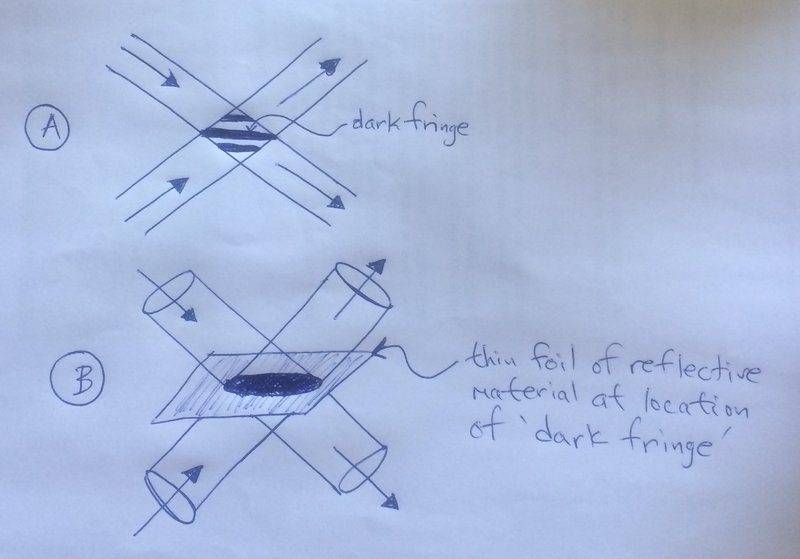
The discussion revolves around the behavior of light beams when a reflective barrier is introduced in their path, particularly focusing on the implications for wave propagation and interference patterns. Participants explore theoretical aspects, potential paradoxes, and interpretations from both classical and quantum perspectives.
Discussion Character
- Debate/contested
- Conceptual clarification
- Exploratory
- Technical explanation
Main Points Raised
- Some participants assert that introducing a reflective barrier will block or reflect the light waves, arguing that the waves cannot propagate through the barrier.
- Others challenge this view, suggesting that the phenomenon could be counterintuitive and may have implications similar to tunneling effects in quantum mechanics.
- There are claims that the interference pattern depicted in the original setup is incorrect, with some participants suggesting that the fringes would appear both vertically and horizontally.
- Some participants emphasize the need for a mathematical justification of the claims regarding wave behavior in the presence of a barrier, referencing classical electrodynamics and the wave equation.
- Others argue that photons should not be conceptualized as particles in a classical sense, insisting that classical electrodynamics is sufficient for analyzing the problem without invoking quantum mechanics.
- A participant mentions the "Afshar Experiment" as an example where similar effects were observed, suggesting that there may be experimental support for the claims being discussed.
Areas of Agreement / Disagreement
Participants express multiple competing views regarding the behavior of light beams in the presence of a barrier, with no consensus reached on whether the beams can be said to "persist and freely propagate" or whether they are definitively blocked or reflected.
Contextual Notes
Limitations include varying interpretations of wave behavior, assumptions about the nature of barriers, and the applicability of quantum mechanics versus classical physics in this context. The discussion also highlights the need for clarity in the mathematical treatment of the problem.