SUMMARY
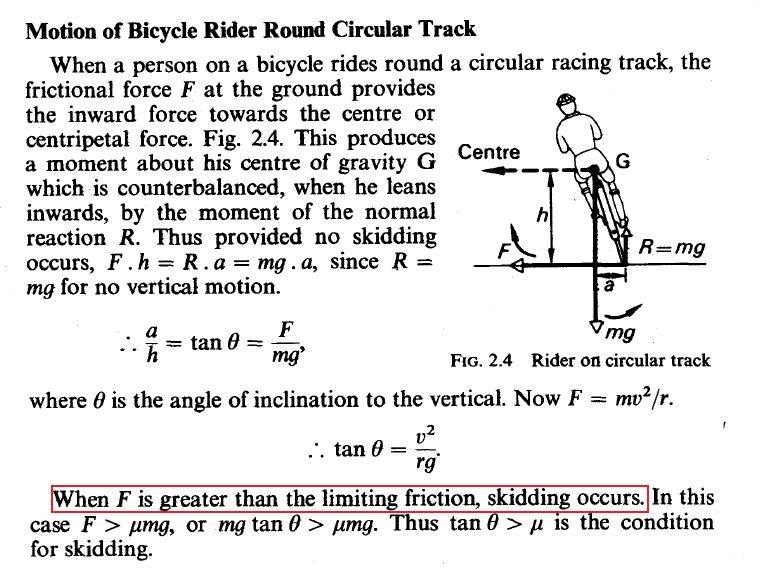
The discussion clarifies the relationship between limiting friction and centripetal force, emphasizing that limiting friction is the maximum frictional force that can be exerted before motion occurs. It is established that centripetal force, necessary for circular motion, is provided by friction when the required centripetal force does not exceed the limiting friction. The conversation also highlights that when the required centripetal force surpasses the available friction, additional forces, such as gravity or external propulsion, must be applied to maintain motion. Key concepts include the self-adjusting nature of friction and the factors influencing both centripetal and frictional forces.
PREREQUISITES
- Understanding of Newton's laws of motion
- Familiarity with the concepts of friction and centripetal force
- Knowledge of basic physics principles related to motion and forces
- Ability to interpret force diagrams and equations
NEXT STEPS
- Study the mathematical relationship between centripetal force and limiting friction using the formula F = mv²/r
- Explore the concept of static versus kinetic friction and their applications in real-world scenarios
- Investigate the effects of surface materials on friction coefficients and their implications for motion
- Examine case studies involving vehicles navigating turns on various surfaces to understand frictional limits
USEFUL FOR
Physics students, mechanical engineers, and anyone interested in understanding the dynamics of motion and forces, particularly in relation to friction and circular motion.