Line integral of a vector field.

Click For Summary
The discussion focuses on solving a line integral problem involving a vector field, where the user is initially confused about the concepts of vector notation and integration. Key points include defining the differential vector dr and correctly substituting variables in the integral. The user successfully computes the integral with limits from 0 to 1, arriving at a result of 2, which is confirmed by others in the thread. The conversation also touches on the significance of the curl being zero, indicating that the vector field is conservative, meaning the line integral is path-independent. Overall, the user gains clarity on the problem and expresses gratitude for the assistance received.
Jack_O
Messages
64
Reaction score
0
Hi all, I'm new to the forums so if i do something stupid don't hesitate to tell me.

Anyway I'm struggling with this problem:

mathsproblem-1.jpg


I could do part a ok, but part b has me stumped, I am in the second year of a physics degree and this is a from a maths problem sheet, i haven't done line integrals before now and they have me a bit confused, my textbook has a few examples but none of them include vectors and http://en.wikipedia.org/wiki/Line_integral" has me even more confused.

Here is my attempt so far:
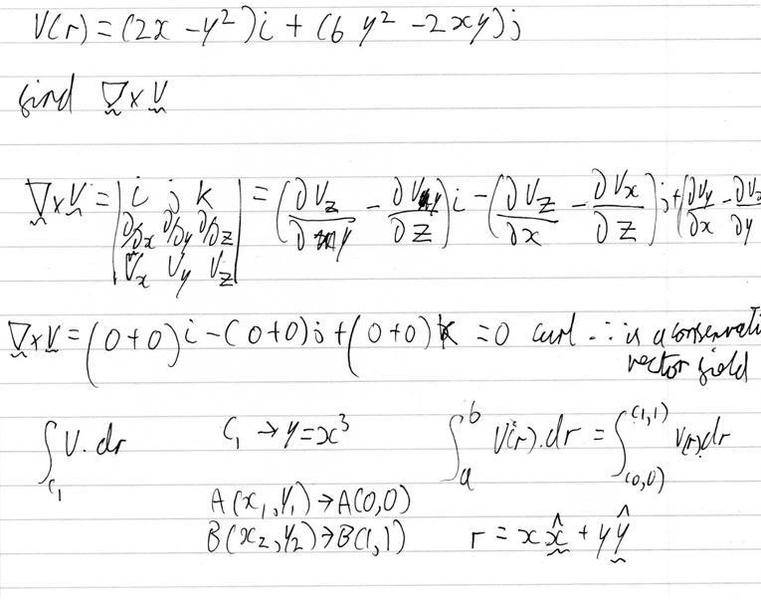
mathsproblemattempt.jpg

(please excuse bad handwriting, i am dyslexic)

I basically don't know where to begin with it, any help much appreciated.
 
Last edited by a moderator:
Physics news on Phys.org
Use that along your path y=x^3. So r=x*i+x^3*j. (i=x hat and j=y hat). What is the vector dr? Change the y's in V to x^3's as well and integrate dx.
 
I think dr is just a small difference in the postion vector r, so dr = dx*i+dy*j ? r isn't mentioned anywhere else in the question.
 
Jack_O said:
I think dr is just a small difference in the postion vector r, so dr = dx*i+dy*j ? r isn't mentioned anywhere else in the question.

Sure it is. But now let's decide to integrate dx. Replace y with x^3. Now what's dr?
 
dr=x*i +(x^3)j

I also have V(r)=(2x-x^6)i + [(6x^6)-(2x^4)]j

But i am a bit unsure about V.dr, is it {[ (2x^2)-(x^7) ]i + [ (6x^9)-(2x^7) ]j}dx ?
 
What happened to the 'd's on the right side of dr? You've got y*j, shouldn't it be d(y)*j? Same for i. Let's get dr right before going to the dot product.
 
OK, i jumped the gun a bit with dr, is it d(r) = d(x)*i + d(y)*j = d(x)*i + d(x^3)*j ?
 
Right. And d(x^3)=3*x^2*dx, right? So dr=(i+3x^2*j)dx.Now do the dot product and you'll get a single integral dx.
 
Ok, V.dr=[(2x-x^6)+(18x^8)-(6x^6)]dx

When i integrate this with the limits x1=0 and x2=1 i get 2, does this sound about right?
 
  • #10
Jack_O said:
Ok, V.dr=[(2x-x^6)+(18x^8)-(6x^6)]dx

When i integrate this with the limits x1=0 and x2=1 i get 2, does this sound about right?

That's what I got. Not so hard, hmm?
 
  • #11
Dick said:
That's what I got. Not so hard, hmm?

Yeah thanks that's been a great help.

Part c seems trivial now but part d seems a bit daunting still.
 
  • #12
Don't be daunted. You know dphi/dx=2x-y^2 (partial derivative). What does that tell you about phi?
 
  • #13
Hmm, after much head scratching i think what you are getting at is that \nabla(phi(x,y))=(dphi/dx)i+(dphi/dy)j, which means:

phi(x,y)=[int(2x-y^2)dx] + [int((6y^2)-2xy)]

which gives:

phi=x2 + 2y3 -xy2

Which does seem to give 2 when i do phi(1,1) - phi(0,0)
 
  • #14
The answer is right. Since dphi/dx=2x-y^2, that means phi=x^2-x*y^2+f(y). Yeah, that is 'integral dx' with f(y) being the constant of integration. That gives dphi/dy=-2xy+f'(y). Since you are supposed to get 6y^2-2xy, you can figure that the f'(y) part must be the 6y^2, so if you put it all together, phi=x^2-xy^2+2y^3.
 
  • #15
Jack_O said:
Hmm, after much head scratching i think what you are getting at is that \nabla(phi(x,y))=(dphi/dx)i+(dphi/dy)j, which means:

phi(x,y)=[int(2x-y^2)dx] + [int((6y^2)-2xy)]

which gives:

phi=x2 + 2y3 -xy2

Which does seem to give 2 when i do phi(1,1) - phi(0,0)

I'm not taking your int()+int() formula literally. If I did I would get a -xy^2 term from each one of those. For a total of -2xy^2, which is not right.
 
  • #16
Well I've managed to do the problem, and i could probably do others now using that technique, but I'm not sure i understand why it works, i mean in questions b, c and d the only constant is x1=0, y1=0, x2=1 and y2=1, why doesn't the chosen path have an effect, is it something to do with the curl being 0?
 
  • #17
It has everything to do with the curl being zero. It's one of the conditions you need for V to be conservative. 'Conservative' means that the line integral between two points is independent of the path chosen. If they hadn't given you a conservative V, then the answer would depend on the path.
 
  • #18
Ok i get it now! Thanks for your help, i wouldn't have been able to do this much without it.
 

Similar threads

  • · Replies 6 ·
Replies
6
Views
2K
  • · Replies 5 ·
Replies
5
Views
2K
Replies
6
Views
3K
Replies
12
Views
4K
  • · Replies 8 ·
Replies
8
Views
4K
  • · Replies 7 ·
Replies
7
Views
2K
  • · Replies 3 ·
Replies
3
Views
1K
  • · Replies 3 ·
Replies
3
Views
2K
  • · Replies 2 ·
Replies
2
Views
2K