Highway
- 349
- 1
Homework Statement
Homework Equations
The Attempt at a Solution
2) No clue.
Deveno said:for (2), do you know how you check that a subset S of a vector space V is a subspace?
there are 2 closure conditions, and a third condition...any guess as to what these are?
Deveno said:yes. so...how do you show that the sum of two skew-symmetric matrics is skew-symmetric?
Deveno said:as for finding a basis, can you think of linear combinations of a basis for Mnxn that might be symmetric matrices?
do you know of any bases for Mnxn (hint: think of a matrix as being n n-vectors laid "end-to-end"...what is an obvious basis for Rn2?)
(3) you're close. suppose that every element of a subspace is a multiple of some vector v. prove that {v} is a basis for that subspace.
(5) if you keep careful track of which row-operations you performed, these will give you a way to construct a linear combination of the 3 vectors you started out with. what exactly did you do to row 2, that made it 0? express that as an equation involving u,v and w.
Highway said:it's a theorem or definition in the book. . . you would just make up two arbitrary ones and show that it holds, right?
Highway said:I'm kinda confused about this, is this part of what we were already talking about in the other discussion posts?
I know what you are saying, but I'm having trouble figuring out how I would exactly do that. I know what you are saying to do, and how/why that works. . .
I have my 3 row operations listed, but I'm not sure how I would write that up. . . it seems like it would make more sense to re-do the reduction with column operations, so that everything would be in terms of u, v, w alone. . .
Highway said:2a) I am not sure if this is the proper way to show addition and multiplication... also, I am not sure how to show that the zero vector is included in this subset... is the 2x2 zero matrix skew-symmetric... I'll check to see if that is the case now.
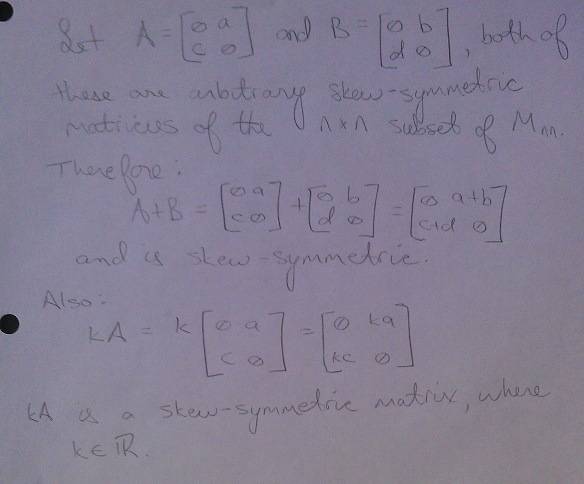
Highway said:
is this the definition you are talking about?
where the first part is the skew-symmetric part and the second is the symmetric part?
Deveno said:you need to show that kA is skew-symmetric if A is (we need closure under scalar multiplication, not matrix multiplication. matrix multiplication is not part of what makes nxn matrices a vector space, it's uh...erm...a bonus!).
Highway said:does anyone know how i can show that a skew-symmetric matrix contains the zero vector?
as for #3, i wrote my answer to include the zero vectors for u and v with w being my vector solution from finding the nullspace since u,v,w are linearly independent and span...
for #5 i was able to write (0,0,0) as a linear combination of the three vectors that were given (in terms of u, v and w).
Deveno said:use the fact that 0T = 0...
never, never, never put a 0-vector in a basis. the 0-vector always makes ANY set linearly dependent.
good :)