Liquid being pushed out of a nozzle - how to calculate it?

  • Context: Undergrad 
  • Thread starter Thread starter Rob2009
  • Start date Start date
  • Tags Tags
    Liquid Nozzle
Click For Summary

Discussion Overview

The discussion revolves around calculating the behavior of a liquid being expelled from a nozzle after an explosive charge is detonated behind a plunger. Participants explore various factors affecting the distance the liquid travels and the optimal design of the nozzle, considering aspects of fluid dynamics and thermodynamics.

Discussion Character

  • Exploratory
  • Technical explanation
  • Debate/contested
  • Mathematical reasoning

Main Points Raised

  • One participant notes the need for information on the pressure generated by the explosion, suggesting that the size of the chamber affects the strength and duration of the liquid jet.
  • Another participant emphasizes the importance of various factors such as viscosity, energy transfer efficiency, friction, outside pressure, and gravity in calculating the liquid's behavior.
  • There is a discussion on whether the conical shape of the plunger affects the jet's performance, with some arguing that under certain assumptions, the shape may not matter.
  • One participant proposes that maximizing the work done by the explosion involves considering the nozzle size to balance the amount of liquid expelled and the kinetic energy transferred.
  • Another participant mentions that the chamber's volume, occupied by the explosive charge, is relevant to the calculations due to the initial high-pressure gases involved.

Areas of Agreement / Disagreement

Participants express differing views on the significance of the nozzle shape and the assumptions regarding energy transfer and friction. There is no consensus on the optimal design or the calculations necessary to predict the liquid's behavior accurately.

Contextual Notes

Participants highlight several assumptions that may limit the accuracy of their calculations, including neglecting friction and assuming complete energy transfer. The discussion also acknowledges the complexity of modeling the liquid's trajectory and evaporation once expelled.

Rob2009
Messages
2
Reaction score
0
Hi guys,
I'm relatively new to physics, so please bear with me. :)

Let's image we have a cylinder like this, filled with 8760 mm3 of liquid, with a nozzle on one end and a plunger on the other.
An explosive charge goes off behind the plunger, releasing 45 joules of energy, and pushing the liquid out of the nozzle.
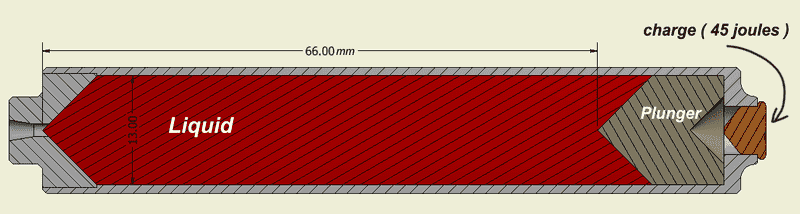
62a879eccfc5.png


I want to calculate
1. how far will the liquid go, before dispersing into mist?
2. what is the optimal shape and size of the nozzle, to make the liquid go as far as possible?

Where do you think should I start?

Thanks! :smile:
 
Last edited:
Physics news on Phys.org
I don't think there's enough information. You need to know what pressure will be generated. If the explosion is in a relatively large chamber then the pressure will be low but persist, so the jet will be weak but last some seconds. With a smaller chamber you'll get a stronger but briefer spurt.
 
As you can see from the drawing, the charge ( that copper-color thing ) is basically next to the plunger, so at least at first there isn't any chamber. The goal is the make the jet as strong and as fast as possible.

And one more thing :) does the conical shape of the front end of the plunger help or basically the result would be the same as with a simple flat plunger?
 
Last edited:
This sounds complicated.

To calculate anything, you will need to know/assume:

-Viscosity of the liquid
-Does the charge transfer all energy into horizontal kinetic energy for the plunger?
-Friction? (probably just neglect it)
-Outside pressure (probably atmospheric?)
-Gravity (earth's gravity)?
-Temperatures (probably assume a constant temperature for all parts)
-Heat of vaporization of the liquid
-Vapor pressure of the liquid
-density of the liquid
-atmospheric heat capacity

The way I'm thinking of it is, you don't know how much liquid will get shot out, and at what speed. This depends on how much energy is transferred, and how dense/viscous the liquid is.

Once the liquid is shooting out, you will now have a mass transfer problem where the liquid is exposed to the atmosphere, and you will have to determine how quickly it evaporates. This is mainly dependent on the vapor pressure of the liquid, surface area, and the speed of the liquid.

Assuming you are far above the ground, the actual trajectory probably doesn't matter, as long as you assume a cylindrical stream. This won't be completely accurate, but I'm not sure how you would predict the stream shape.

2. The shape of the nozzle, I'm not sure. You probably want a trajectory angle of 45°, and I don't know about shape. You want a narrow stream for maximum initial velocity, but you want a broad stream for minimum surface area to volume ratio. The best solution would depend on values of your variables.
 
Rob2009 said:
As you can see from the drawing, the charge ( that copper-color thing ) is basically next to the plunger, so at least at first there isn't any chamber. The goal is the make the jet as strong and as fast as possible.

And one more thing :) does the conical shape of the front end of the plunger help or basically the result would be the same as with a simple flat plunger?

I don't think the shape matters, because we want to assume complete/instantaneous energy transfer, and no friction, for both cases (to make it easier!). If we didn't make those assumptions, then yeah, it would matter.
 
pa5tabear said:
I don't think the shape matters, because we want to assume complete/instantaneous energy transfer, and no friction, for both cases (to make it easier!). If we didn't make those assumptions, then yeah, it would matter.

I don't think it does matter either. This would be a different story if the liquid were compressible, which is usually assumed not to be. You can see that no matter the shape of the inside of the plunger, the dV/dx of the mass inside the tube will be the same, because the other side of the plunger is uniform and so the volume space increased on that end is independent of plunger shape, ie its linear with position change (assuming a cyclinder).

This is very much a thermodynamics problem. You wish to maximize the work done by the explosion to transfer as kinetic energy to the mass leaving the other end. I think the ideal nozzle size would be as small as possible without losing the ability to maintain the pressure change, ie without exploding (to consider it in hyperbole, if you could minimize the nozzle to pass just 1 particle with an energy of 45 joules, that would be the best you could get). In that case it becomes a question of how much mass do you want to push out. If you can push out a little bit of it with a high average kinetic energy summed to 45 joules, or all of it with a lower average kinetic energy summed to 45 joules, which would you choose? That will tell you how big to make your nozzle I believe.
 
Last edited:
Rob2009 said:
As you can see from the drawing, the charge ( that copper-color thing ) is basically next to the plunger, so at least at first there isn't any chamber. The goal is the make the jet as strong and as fast as possible.

And one more thing :) does the conical shape of the front end of the plunger help or basically the result would be the same as with a simple flat plunger?

Small as it is, the chamber (the vol occupied by the charge) is part of the calculation. The energy released will initially take the form of hot gases at high pressure occupying that volume. Subsequent developments will follow adiabatic gas expansion laws.
 

Similar threads

  • · Replies 1 ·
Replies
1
Views
1K
  • · Replies 12 ·
Replies
12
Views
7K
  • · Replies 11 ·
Replies
11
Views
4K
  • · Replies 6 ·
Replies
6
Views
47K
  • · Replies 3 ·
Replies
3
Views
4K
  • · Replies 2 ·
Replies
2
Views
11K
  • · Replies 62 ·
3
Replies
62
Views
30K
Replies
23
Views
3K
  • · Replies 9 ·
Replies
9
Views
2K
Replies
4
Views
2K