kingneptune11
- 10
- 0
Hello all,
I have a (at what first seemed) fairly simple question about calculating the forces on this fulcrum design I have.
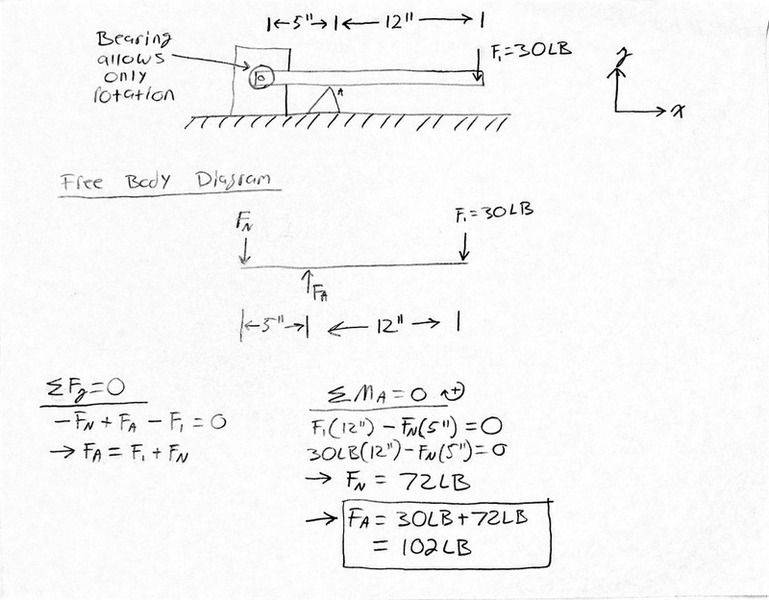
Here is an image of the sketch and free body diagram that I drew:
Basically, the pivot point in my real life application is actually a cam, but for the sake of this question, imagine it as a simple fulcrum.
On the right hand side of the fulcrum bar, I have a 30lb force pushing down. On the left hand side, I have a the fulcrum bar mounted to a bearing that only allows rotation.
For my FBD, I labeled there being a reaction force at the fulcrum pivot (obviously), which I labeled F_A. I also put a reaction force at the bearing, labeled F_N. This is the force I am slightly confused by. I know there has to be a reaction force here, but I am worried I am calculating it wrong, therefore calculating F_A wrong.
I am trying to figure out the force on the fulcrum pivot point, which I termed F_A in my drawing. Please look through my calculations. According to this, F_A is equal to 102LB, more than three times the original, single force in my system! Does this really mean that I just translated 30LB into 102LB, simply by fixing the far left end of the fulcrum bar with that bearing? Did I do the calculations correct?
This just seems a little goofy to me. I am having trouble grasping the fact that F_N, which is PURELY a reaction force, is contributing to the downward force on the fulcrum pivot, F_A. I was under the impression that since my singlular force of 30LB is the only force originally there, my F_A couldn't possibly be more than that. My calculations say otherwise.
Let me know if you think I am correct in my calculations. If I am not, how can I rectify this? Where did I go wrong?
Thank you for your time.
I have a (at what first seemed) fairly simple question about calculating the forces on this fulcrum design I have.
Here is an image of the sketch and free body diagram that I drew:
Basically, the pivot point in my real life application is actually a cam, but for the sake of this question, imagine it as a simple fulcrum.
On the right hand side of the fulcrum bar, I have a 30lb force pushing down. On the left hand side, I have a the fulcrum bar mounted to a bearing that only allows rotation.
For my FBD, I labeled there being a reaction force at the fulcrum pivot (obviously), which I labeled F_A. I also put a reaction force at the bearing, labeled F_N. This is the force I am slightly confused by. I know there has to be a reaction force here, but I am worried I am calculating it wrong, therefore calculating F_A wrong.
I am trying to figure out the force on the fulcrum pivot point, which I termed F_A in my drawing. Please look through my calculations. According to this, F_A is equal to 102LB, more than three times the original, single force in my system! Does this really mean that I just translated 30LB into 102LB, simply by fixing the far left end of the fulcrum bar with that bearing? Did I do the calculations correct?
This just seems a little goofy to me. I am having trouble grasping the fact that F_N, which is PURELY a reaction force, is contributing to the downward force on the fulcrum pivot, F_A. I was under the impression that since my singlular force of 30LB is the only force originally there, my F_A couldn't possibly be more than that. My calculations say otherwise.
Let me know if you think I am correct in my calculations. If I am not, how can I rectify this? Where did I go wrong?
Thank you for your time.