Looking for intuition on differentials and arc length

Click For Summary
SUMMARY

The discussion centers on understanding the differential of arc length, specifically the formula ##ds = \sqrt{(dx)^2 + (dy)^2}##, which represents the hypotenuse of a right triangle formed by infinitesimal changes in x and y. The participants clarify that ##ds## signifies an infinitesimal change in the length along a curve, dependent on both ##dx## and ##dy##. They also explore the application of this concept in calculating the arc length of a function, such as ##y = 2\sqrt{5x+1}##, using the integral ##\int_{10}^{40} \sqrt{\frac{5x+26}{5x+1}}dx##. This discussion is foundational for students in Calculus I, emphasizing the importance of understanding differentials in the context of curve lengths.

PREREQUISITES
  • Understanding of basic calculus concepts, including derivatives and integrals.
  • Familiarity with the Pythagorean theorem and its application in two dimensions.
  • Knowledge of function notation and how to manipulate algebraic expressions.
  • Basic understanding of vector notation and its relevance in calculus.
NEXT STEPS
  • Study the derivation of the arc length formula in calculus, focusing on the relationship between differentials and integrals.
  • Learn how to apply the integral for arc length to various functions, including polynomials and transcendental functions.
  • Explore the concept of differential geometry and its applications in higher dimensions.
  • Review the properties of derivatives and their geometric interpretations, particularly in relation to curve behavior.
USEFUL FOR

Students in Calculus I, educators teaching differential calculus, and anyone seeking to deepen their understanding of arc length and differentials in mathematical analysis.

opus
Gold Member
Messages
717
Reaction score
131
Please see the attached image. It's a part of a study guide for my final, but I didn't put it in the homework section because I already got the answer, I just don't know what it means.
The question has to do with the differential of an arc length. I made some drawings to see if I could make some sense out of it but I don't think I'm quite there.

So when we're talking about the differential of an arc length, what exactly does this mean?
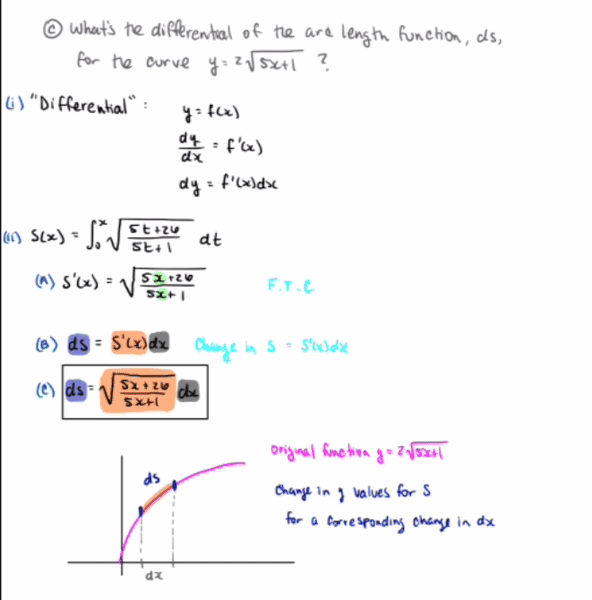
Screen Shot 2018-12-09 at 7.06.17 PM.png
 

Attachments

  • Screen Shot 2018-12-09 at 7.06.17 PM.png
    Screen Shot 2018-12-09 at 7.06.17 PM.png
    29.3 KB · Views: 598
Physics news on Phys.org
##d\vec s=dx~\hat i+dy~\hat j##
##ds =\sqrt{d\vec s \cdot d\vec s}=\sqrt{(dx)^2+(dy)^2}=dx\sqrt{1+(\frac{dy}{dx})^2}##
What's ##(\frac{dy}{dx})^2~?##
 
  • Like
Likes   Reactions: opus
Apologies, but I don't understand the notation. This is for Calculus I if that gives an idea. It does look like you're doing something with Pythagorean's though!
 
Sorry, I thought you understood vectors. Yes, it has to do with the Pythagorean theorem. A two dimensional displacement ##ds## has a horizontal part ##dx## and a vertical part ##dy##. The two form a right triangle and ##ds=\sqrt{(dx)^2+(dy)^2}## is the hypotenuse.
 
Ok that's much more clear, thanks!
So then, since our ##dx## is extremely small, we can pretty much say that the curve of the graph is a straight line in that ##dx##.
This would give us a right triangle with the base as ##dx##, the hypotenuse as ##ds##, and the side length as what? It would have to be the change in y values corresponding the the change in x values (##dx##), but in terms of notation, what would this be?
 
Look at post #2. If ##ds =dx\sqrt{1+(\frac{dy}{dx})^2}##, what is ##ds## when ##y=2\sqrt{5x+1}?##
 
##ds=dx\sqrt{\frac{5x+26}{5x+1}}##?
 
Right. Does this answer your original question or is there more to it?
 
I guess I don't understand what the question is really asking me, so I suppose there's more to it. In words, how would you ask the given question to me? For example, "here is a function, what is it doing from here to here?"
 
  • #10
The question is asking you to find ##ds## if ##y=2\sqrt{5x+1}## and you have done that. How would you approach the following problem:
You drive your car from x = 10 units to x = 40 units along the curve given by ##y=2\sqrt{5x+1}##. How much distance has been added to your car's odometer?
 
  • #11
The distance added to the odometer would be equal to the length of the curve, which is Arc Length ##= \int_{10}^{40} \sqrt{\frac{5x+26}{5x+1}}dx## which is a specific integral to the more general ##s(x)## or ##ds## too. I guess this notation is throwing me for barrel rolls. It keeps changing and I think it's distracting me from the picture.
 
  • #12
opus said:
The distance added to the odometer would be equal to the length of the curve, which is Arc Length ##= \int_{10}^{40} \sqrt{\frac{5x+26}{5x+1}}dx## which is a specific integral to the more general ##s(x)## or ##ds## too. I guess this notation is throwing me for barrel rolls. It keeps changing and I think it's distracting me from the picture.
It's standard notation, it's part of "the picture" and eventually you will get used to it (I hope).
 
  • #13
So then ##ds## is saying the change in the function ##s(x)## which is a function that gives the arc length of the function ##y##. Why are we putting it in terms of ##ds##? Why are we concerned with change at all when we are looking for the length of a curve? We had a perfectly good way to find the length when we had the formula ##s(x) = \int_{0}^{x}\sqrt{\frac{5t+26}{5t+1}}dt## What's the difference?
 
  • #14
opus said:
So then ##ds## is saying the change in the function ##s(x)## which is a function that gives the arc length of the function ##y##. Why are we putting it in terms of ##ds##? Why are we concerned with change at all when we are looking for the length of a curve? We had a perfectly good way to find the length when we had the formula ##s(x) = \int_{0}^{x}\sqrt{\frac{5t+26}{5t+1}}dt## What's the difference?
When you get to differential geometry, several basic formulas are expressed in terms of ds.

Also, check out https://en.wikipedia.org/wiki/Arc_length.
 
  • #15
opus said:
So then ##ds## is saying the change in the function ##s(x)## which is a function that gives the arc length of the function ##y##. Why are we putting it in terms of ##ds##? Why are we concerned with change at all when we are looking for the length of a curve? We had a perfectly good way to find the length when we had the formula ##s(x) = \int_{0}^{x}\sqrt{\frac{5t+26}{5t+1}}dt## What's the difference?
Suppose someone asked you to find the length of the curve represented by the polynomial ##y=x^4+3x^3+6x## from ##x=0## to ##x=8##. What then? No formula is given to you and clearly you can't use ##s(x) = \int_{0}^{x}\sqrt{\frac{5t+26}{5t+1}}dt##. This example shows how to derive and apply the appropriate formula.
 
  • #16
opus said:
This is for Calculus I if that gives an idea. It does look like you're doing something with Pythagorean's though!
Exactly.
opus said:
So then ##ds## is saying the change in the function ##s(x)## which is a function that gives the arc length of the function ##y##. Why are we putting it in terms of ##ds##? Why are we concerned with change at all when we are looking for the length of a curve? We had a perfectly good way to find the length when we had the formula ##s(x) = \int_{0}^{x}\sqrt{\frac{5t+26}{5t+1}}dt## What's the difference?
ds represents an infinitesimal change in the length along the curve. This length depends on both dx and dy, not just dx.
The formula for s(x) that you show is not a general formula for arc length. This integral comes from the general formula for arc length, in which ds is defined as the hypotenuse on a right triangle whose legs are dx and dy.

Here's a picture.
arclength.png

So ##ds^2 = dx^s + dy^2##, or ##ds = \sqrt{dx^s + dy^2}##. This latter equation can take different forms, using algebraic manipulations. One form is ##ds = \sqrt{1 + \left(\frac{dy}{dx}\right)^2}~dx##, if y is given as a function of x. Another form has ##1 + \left( \frac{dx}{dy}\right)^2## inside the radical, for when x is given as a function of y.
 

Attachments

  • arclength.png
    arclength.png
    1.4 KB · Views: 562
Last edited:
  • #17
The differential is the approximation to the change of the function along the tangent line ( Or, in higher dimension the tangent plane, etc.).
 

Similar threads

  • · Replies 3 ·
Replies
3
Views
2K
Replies
7
Views
3K
  • · Replies 3 ·
Replies
3
Views
3K
  • · Replies 3 ·
Replies
3
Views
4K
  • · Replies 9 ·
Replies
9
Views
2K
  • · Replies 7 ·
Replies
7
Views
3K
  • · Replies 9 ·
Replies
9
Views
3K
  • · Replies 2 ·
Replies
2
Views
2K
  • · Replies 2 ·
Replies
2
Views
5K
  • · Replies 1 ·
Replies
1
Views
2K