Lorentz force in different frames of reference

Click For Summary

Discussion Overview

The discussion revolves around the Lorentz force experienced by a charged particle in different inertial frames of reference. Participants explore the implications of relative motion on the observed force and electromagnetic fields, addressing both theoretical and conceptual aspects of the topic.

Discussion Character

  • Exploratory
  • Technical explanation
  • Conceptual clarification
  • Debate/contested

Main Points Raised

  • One participant questions how the force on a charged particle can be the same in different inertial frames when the particle's velocity appears different in each frame.
  • Another participant notes that electromagnetic fields also transform between frames, suggesting that the fields are not invariant.
  • Some participants propose using Lorentz transformations on the electromagnetic field tensor to find the fields in a new inertial frame.
  • Concerns are raised about the appropriateness of tensor notation for the original poster, with suggestions that simpler methods may be more accessible.
  • Examples are provided involving transformations of electric fields in Cartesian coordinates, but there is confusion regarding the validity and interpretation of these transformations.
  • One participant expresses uncertainty about the integral approach used in transforming fields, questioning its relevance to proper Lorentz transformations.
  • A later reply emphasizes that electromagnetic phenomena do not adhere to classical principles of relativity, referencing Einstein's work on the subject.

Areas of Agreement / Disagreement

Participants express differing views on the transformation of forces and fields between inertial frames, with no consensus reached on the correct approach or interpretation of the Lorentz force in this context.

Contextual Notes

Some participants highlight limitations in understanding tensor notation and the mathematical intricacies involved in Lorentz transformations, indicating that assumptions about prior knowledge may affect the discussion.

Aman Chauhan
Messages
6
Reaction score
0
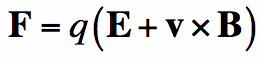
Hi, I have been studying lorentz force . The book says force experienced by a charge in magnetic field is
lorentz-force-equation.gif

But velocity is a relative concept . In one frame of reference(inertial frame) I might observe the charge moving with some velocity and in the 2nd frame(inertial too) I might observe the charge to be at rest . Does this mean that the force on the particle will be different in the 2 frames? .But since my frames are inertial I should observe the same force on the particle. How is this possible! please help.
 
Physics news on Phys.org
Just like the velocity, the fields are different in different frames.
 
  • Like
Likes   Reactions: Noctisdark
hilbert2 said:
You can find the fields in a new inertial frame by doing a Lorentz transformation on the electromagnetic field tensor ##F^{\mu\nu}##.

https://en.wikipedia.org/wiki/Electromagnetic_tensor
For some reason I doubt that this is at the appropriate level for the OP. Based on the question, I would be surprised if he/she knew what a tensor is.
 
  • Like
Likes   Reactions: stedwards
^ That's possible, but the procedure is as simple as writing the transformation and field tensors in matrix form and doing a matrix multiplication.
 
I know it is simple, if you know how to do it and how to interpret the result. If you have no idea what a tensor is, you would first have to learn that, learn tensor notation in SR, decipher the Wiki page, and then do the simple manipulations. If you skip any of the steps, you will just be left with a feeling of "what did I just do and why?"
 
An example in cartesian co-ordinates, E = ∫dE/dt dt = ∫(∂E/∂x * ∂x/∂t + ∂E/∂y * ∂y/∂t + ∂E/∂z * ∂z/∂t)dt, I will assume that the field is moving at a constant velocity v, ∂x/∂t = vx, ∂y/∂t = vy, ∂z/∂t = vz,
E = ∫vx∂E/∂x dt + ...
by this way you can transform a field from an INERTIAL frame to the other, Cheers !,
 
Last edited:
Noctisdark said:
An example in cartesian co-ordinates, E = ∫∂E/∂t dt = ∫(∂E/∂x * ∂x/∂t + ∂E/∂y * ∂y/∂t + ∂E/∂z * ∂z/∂t)dt, I will assume that the field is moving at a constant velocity v, ∂x/∂t = vx, ∂y/∂t = vy, ∂z/∂t = vz,
E = ∫vx∂E/∂x dt + ...
by this way you can transform a field from an INERTIAL frame to the other, Cheers !,

It is unclear how you are constructing that integral and what it actually means. It also seems to give you the wrong transformation properties. Transformation properties are not based on the change of variables in an integral, they are based on local coordinate transformations and how different frames relate to each other.
 
  • Like
Likes   Reactions: Noctisdark
  • #10
Sorry if i have made ugly mistakes, All I have done is chain rule, I admit I have dropped the arrows of the vectors (Don't know how the write them) and this result isn't relativistic, but ∂x/∂t = vx isn't wrong (is it ?), for example if I have a an electric field E = xyz (just saying) that is moving a some velocity v in the x direction then E = v*∫yz dt= yz*vt + K., so sorry if I made other mistakes, but I think even tensors transform this way :/
 
  • #11
Noctisdark said:
Sorry if i have made ugly mistakes, All I have done is chain rule, I admit I have dropped the arrows of the vectors (Don't know how the write them) and this result isn't relativistic, but ∂x/∂t = vx isn't wrong (is it ?), for example if I have a an electric field E = xyz (just saying) that is moving a some velocity v in the x direction then E = v*∫yz dt= yz*vt + K., so sorry if I made other mistakes, but I think even tensors transform this way :/

It is completely unclear why you are even doing an integral. Why are you differentiating the field with respect to time? It seemingly has absolutely nothing to do with a proper Lorentz transformation of the fields.
 
  • #12
Orodruin said:
It is completely unclear why you are even doing an integral. Why are you differentiating the field with respect to time? It seemingly has absolutely nothing to do with a proper Lorentz transformation of the fields.
The problem is in E = ∫dE/dt * dt ?, Ok thanks for the feedback, I think I will have to update by checking some Wikipedia pages :)
 
  • #13
Aman Chauhan said:
Hi, I have been studying lorentz force . The book says force experienced by a charge in magnetic field is
lorentz-force-equation.gif

But velocity is a relative concept . In one frame of reference(inertial frame) I might observe the charge moving with some velocity and in the 2nd frame(inertial too) I might observe the charge to be at rest . Does this mean that the force on the particle will be different in the 2 frames? .But since my frames are inertial I should observe the same force on the particle. How is this possible! please help.
The issue is in the phrase "since my frames are inertial I should observe the same force on the particle". Electromagnetic phenomena do not obey the principle of relativity in classical physics, and it was this kind of things that led to the development of special relativity.

"It is known that Maxwell's electrodynamics—as usually understood at the present time—when applied to moving bodies, leads to asymmetries which do not appear to be inherent in the phenomena". -http://fourmilab.ch/etexts/einstein/specrel/www/

For a detailed discussion I think that this is not the right sub forum, but you can find the answer in §6 of Einstein's paper.
In a nutshell, the lateral force will be different according to measurements in different frames, but because also time and distance are measured differently, still the same predictions will be made.
 

Similar threads

  • · Replies 11 ·
Replies
11
Views
3K
  • · Replies 5 ·
Replies
5
Views
1K
  • · Replies 4 ·
Replies
4
Views
2K
  • · Replies 2 ·
Replies
2
Views
1K
  • · Replies 9 ·
Replies
9
Views
3K
  • · Replies 3 ·
Replies
3
Views
2K
  • · Replies 1 ·
Replies
1
Views
993
  • · Replies 8 ·
Replies
8
Views
2K
  • · Replies 5 ·
Replies
5
Views
2K
  • · Replies 2 ·
Replies
2
Views
2K