M 7.7 Quake, Indonesia

  • Thread starter Thread starter davenn
  • Start date Start date
Join the discussion
Registration is free. Ask a follow-up in this thread, or start your own.
5 replies · 716 views
Science Advisor
Gold Member
Messages
9,738
Reaction score
11,938
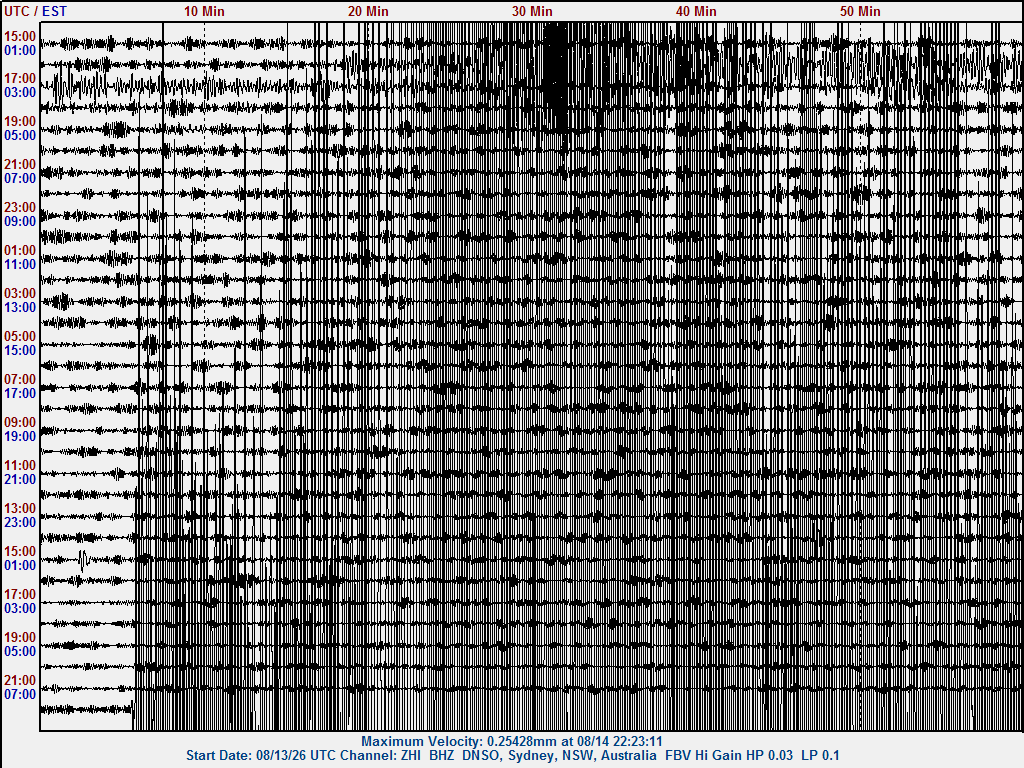
Another large quake on my seismo ( In Sydney, Australia) this morning ....

260814 2158UT M7.7 Indonesia zhi.gif


Saved image before the trace started overwriting itself ... that's 55 minutes of recording shown

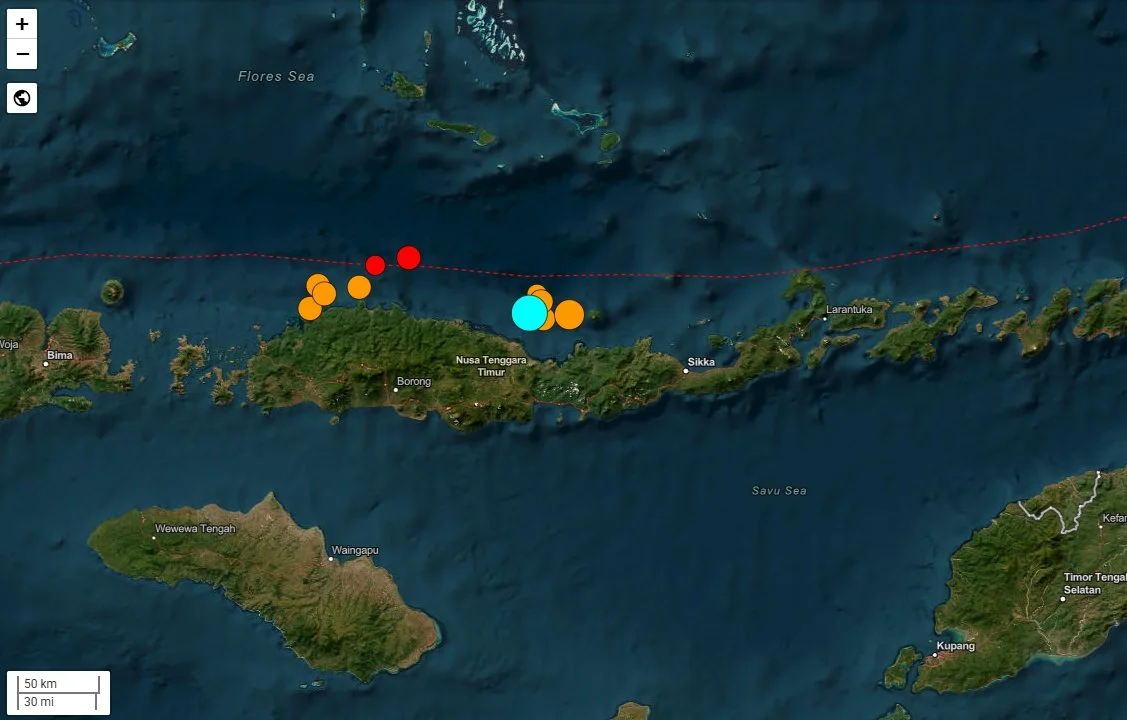
M 7.7 - 68 km NNW of Ende, Indonesia​

  • 2026-08-14 21:58:21 (UTC)
  • 8.310°S 121.352°E
  • 10.0 km depth

This is the 11th M 7.0 - 7.9 for the year and we are half way through August.
So far, the numbers are trending about normal for the annual average of 18 / year.

M7.0 - 7.9's / year range from around 12 to 25 or around 1 every 20 days.
That allows for any approx. 6 more M7 events over the next 4 months till the end of the year
and still be at the annual average.

260814 2158UT M7.7 Indonesia map.webp


cheers
Dave
 
Reply
  • Wow
  • Informative
Likes   Reactions: Astronuc and ohwilleke
Earth sciences news on Phys.org
davenn said:
Another large quake on my seismo ( In Sydney, Australia) this morning ....

View attachment 373626


Saved image before the trace started overwriting itself ... that's 55 minutes of recording shown

M 7.7 - 68 km NNW of Ende, Indonesia​

  • 2026-08-14 21:58:21 (UTC)
  • 8.310°S 121.352°E
  • 10.0 km depth

This is the 11th M 7.0 - 7.9 for the year and we are half way through August.
So far, the numbers are trending about normal for the annual average of 18 / year.

M7.0 - 7.9's / year range from around 12 to 25 or around 1 every 20 days.
That allows for any approx. 6 more M7 events over the next 4 months till the end of the year
and still be at the annual average.

View attachment 373627


cheers
Dave
Dang. What would the tsunami risk for these quakes be? I see a city named Sikka near the coast. Is the water deep enough to be conducive for tsunami formation? Hopefully, people and buildings are safe.
 
Reply
  • Like
Likes   Reactions: ohwilleke and WWGD
AlexB23 said:
What would the tsunami risk for these quakes be?
It depends on the type of quake. Where there is a rapid or significant upheaval (vertical displacement) of the ocean floor, as happened off the coast of Japan in the Great Tohoku earthquake, a significant tsunami threat results. Lateral displacements without significant vertical displacement do not produce strong tsunami.

In the current case, there was no significant tsunami: "A tsunami with a maximum height of 1.61 m (5 ft 3 in) was reported in Reok, Manggarai Regency. A 0.94 m (3 ft 1 in) tsunami was recorded at Maurole District in Ende Regency while at Labuan Bajo in East Nusa Tenggara, a 30 cm (12 in) tsunami was recorded. A 0.17 m (6.7 in) tsunami occurred in Dompu."
https://en.wikipedia.org/wiki/2026_Flores_earthquake#Tsunami

https://earthquake.usgs.gov/earthquakes/eventpage/us6000tkt2/executive
The August 14, 2026, M7.7 Flores Sea earthquake occurred off the northern coast of East Nusa Tenggara, Indonesia, as the result of reverse faulting at shallow depth. The earthquake is located in a seismically active area dominated by convergence between the Australia and Sunda plates. Focal mechanism solutions indicate that the rupture occurred on either a west-striking fault dipping moderately to the north or an east-striking fault dipping shallowly to the south. The location, depth, and preliminary focal mechanism solution for this earthquake indicate the event is likely the result of thrust faulting within the overriding Sunda plate. At the location of this earthquake, the Australian plate is moving towards the north with respect to the Sunda plate at approximately 69 mm/yr. These two plates meet at the Sunda Trench, located approximately 350 km south of this earthquake.

While commonly plotted as points on maps, earthquakes of this size are more appropriately described as slip over a larger fault area. Reverse-faulting events of the size of the August 14, 2026, earthquake are typically about 90 by 45 km in size (length x width).

Earthquakes are common in this region. Since 1950, there have been 37 other earthquakes of magnitude 6 and greater, including five other earthquakes of magnitude 7 and larger within 250 km of the August 14, 2026, earthquake. In 1992, a M7.8 earthquake occurred just 63 km east-southeast of the August 14, 2026, earthquake. The 1992 earthquake and resulting tsunami destroyed tens of thousands of homes and resulted in at least 2500 fatalities.

There may be conditions (certain geometries, e.g., a bay) where a strike-slip fault may cause a significant tsunami.
Anatomy of strike-slip fault tsunami genesis
https://www.pnas.org/doi/10.1073/pnas.2025632118

Contrary to Previous Belief, Strike-Slip Faults Can Generate Large Tsunamis (May 03, 2021)
https://www.caltech.edu/about/news/...trike-slip-faults-can-generate-large-tsunamis
On September 28, 2018, an inexplicably large tsunami devastated the Indonesian coastal city of Palu and several others nearby. Between the tsunami and the magnitude 7.5 earthquake that caused it, some 4,340 people were killed, making it the deadliest earthquake that year.
https://en.wikipedia.org/wiki/2018_Sulawesi_earthquake_and_tsunami#Tsunami
Residents of Donggala were told to expect tsunamis with heights of 0.5 to 3 metres, while residents in Palu were told to expect tsunamis with heights of less than 0.5 metres. The tsunami, however, struck higher than expected. Residents of Palu reported waves with heights of more than 2 metres while several others stated that the waves managed to reach the second floor.
 
Reply
  • Informative
  • Like
Likes   Reactions: davenn, berkeman and AlexB23
Astronuc said:
It depends on the type of quake. Where there is a rapid or significant upheaval (vertical displacement) of the ocean floor, as happened off the coast of Japan in the Great Tohoku earthquake, a significant tsunami threat results. Lateral displacements without significant vertical displacement do not produce strong tsunami.

In the current case, there was no significant tsunami: "A tsunami with a maximum height of 1.61 m (5 ft 3 in) was reported in Reok, Manggarai Regency. A 0.94 m (3 ft 1 in) tsunami was recorded at Maurole District in Ende Regency while at Labuan Bajo in East Nusa Tenggara, a 30 cm (12 in) tsunami was recorded. A 0.17 m (6.7 in) tsunami occurred in Dompu."
https://en.wikipedia.org/wiki/2026_Flores_earthquake#Tsunami

https://earthquake.usgs.gov/earthquakes/eventpage/us6000tkt2/executive


There may be conditions (certain geometries, e.g., a bay) where a strike-slip fault may cause a significant tsunami.
Anatomy of strike-slip fault tsunami genesis
https://www.pnas.org/doi/10.1073/pnas.2025632118

Contrary to Previous Belief, Strike-Slip Faults Can Generate Large Tsunamis (May 03, 2021)
https://www.caltech.edu/about/news/...trike-slip-faults-can-generate-large-tsunamis

https://en.wikipedia.org/wiki/2018_Sulawesi_earthquake_and_tsunami#Tsunami
No tsunami. That is all I needed to know, which means less damage and loss of life.
 
AlexB23 said:
No tsunami.
Careful. In the current case, there was no significant tsunami: "A tsunami with a maximum height of 1.61 m (5 ft 3 in) was reported in Reok, Manggarai Regency. A 0.94 m (3 ft 1 in) tsunami was recorded at Maurole District in Ende Regency while at Labuan Bajo in East Nusa Tenggara, a 30 cm (12 in) tsunami was recorded. A 0.17 m (6.7 in) tsunami occurred in Dompu."
There were minor tsunami waves, with one recorded at 1.61 m, or 5.25 ft.

It was the nature of the type of earthquake and it's location (in relatively shallow water), and even though it was Mag 7.7, the tsunami waves were considered minor.


There have been at least 70 aftershocks (Mag 4 to 6.1) along the fault line since the Mag 7.7.
 
Reply
  • Like
Likes   Reactions: davenn and AlexB23
Astronuc said:
There were minor tsunami waves, with one recorded at 1.61 m, or 5.25 ft.

It was the nature of the type of earthquake and it's location (in relatively shallow water), and even though it was Mag 7.7, the tsunami waves were considered minor.


There have been at least 70 aftershocks (Mag 4 to 6.1) along the fault line since the Mag 7.7.
All is good then. Phew
 
Reply
  • Like
Likes   Reactions: berkeman