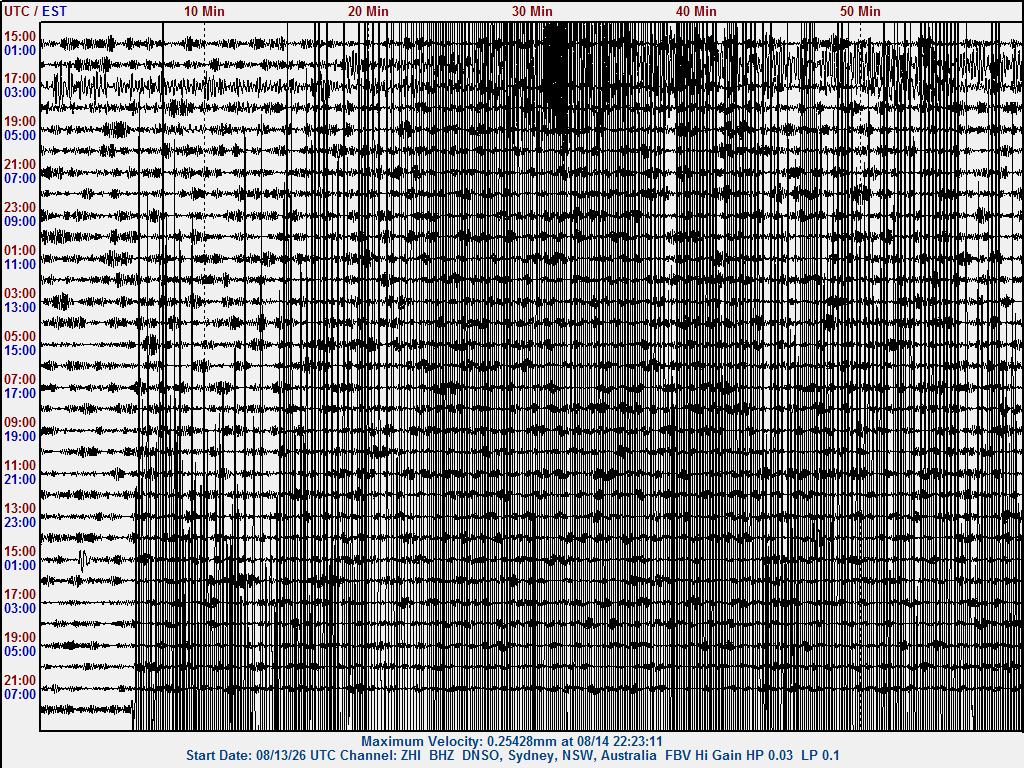
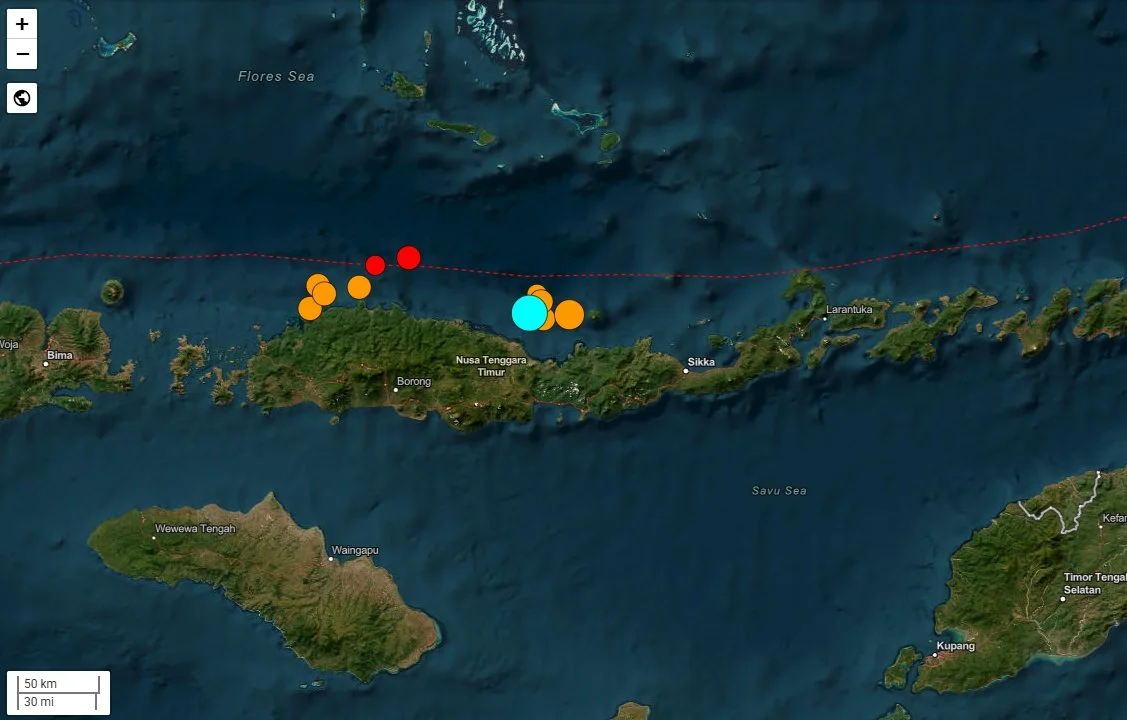
The earthquake has been upgraded to 7.8
Regional information -
https://earthquake.usgs.gov/earthquakes/eventpage/us7000tgrk/region-info
M 7.8 - 64 km NNW of Ende, Indonesia
https://earthquake.usgs.gov/earthquakes/eventpage/us6000tkt2/executive
- 2026-08-14 21:58:21 (UTC)
- 8.351°S 121.348°E
- 10.0 km depth
Two subsequent earthquakes occurred along the same subduction zone.
M 6.9 - 9 km WNW of Pematangsiantar, Indonesia
in Sumatera Utara province
- 2026-08-15 10:54:51 (UTC)
- 2.986°N 98.985°E
- 175.0 km depth
and more recently
M 6.5 - 126 km NNE of Teluknaga, Indonesia
north of Jakarta (137.1 km (85.2 mi) )
- 2026-09-11 21:23:55 (UTC)
- 4.983°S 106.874°E
- 372.0 km depth
During this period 6 volcanoes erupted (as of August 31)
1. Mount Semeru (East Java)
Indonesia’s tallest volcano on Java erupted several times beginning around 4.20am on 31 August, producing ash columns between 500 and 900 metres above the summit.
2. Mount Ibu (North Maluku)
Mount Ibu on Halmahera Island was arguably the busiest volcano of the day.
It erupted multiple times from just after midnight until the afternoon, with ash plumes reaching 400–600 metres above the crater.
3. Mount Anak Krakatau (Sunda Strait)
The most famous volcano on this list didn’t stop erupting after August 31.
Anak Krakatau produced a much larger eruption several days later, sending ash as high as 15 kilometres into the atmosphere.
The eruption forced the
temporary closure of eight Indonesian airports, disrupted more than 1,500 flights, and affected roughly 170,000 passengers. Schools in parts of Indonesia also switched to online learning due to ash fall.
4. Mount Sinabung (North Sumatra
Sinabung produced the largest ash plume of the six volcanoes, blasting volcanic material approximately 3,500 metres above its summit.
The eruption was significant enough for authorities to
raise the volcano’s alert level and advise residents to stay at least six kilometres away. Ash also blanketed nearby roads and villages, with protective masks distributed to residents.
5. Mount Ili Lewotolok (East Nusa Tenggara)
Located on Lembata Island, Ili Lewotolok erupted late in the morning, producing a 700-metre ash column drifting westward.
While smaller than Sinabung’s eruption, it remains one of eastern Indonesia’s regularly active volcanoes and is continuously monitored for lava, ash and lahar hazards.
It later erupted again last Sunday morning (6 September), sending up a plume of smoke and ash up to 400 metres.
6. Mount Lewotobi Laki-laki (East Flores)
The sixth volcano erupted shortly before 1pm, sending a 300-metre grey ash plume towards the west and northwest.
Lewotobi Laki-laki has been closely watched since its major eruptions over the past two years, with surrounding communities remaining on alert for renewed volcanic activity.
Ref: Six Indonesian Volcanoes Erupted On 31 August, And They’re Still Erupting Indonesia sits along the Pacific Ring of Fire, where as many as 120 volcanoes are active.
https://www.therakyatpost.com/news/...1-august-and-theyre-still-erupting/#gsc.tab=0
On September 7, Indonesia reported volcanic eruption at Anak Krakatau is easing but keeps airports and schools closed
(Monday, September 7) Indonesia kept several airports closed and shifted schools to remote learning Monday after a volcano erupted Sunday. The continuous, 25-hour eruption of Anak Krakatau that produced a fountain of lava and a boom heard 700 kilometers (435 miles) away ended Sunday, the country's Geological Agency said. But it remained active Monday with moderate, intermittent eruptions, dark ash emissions and small, localized earthquakes, the agency said in a statement. Weather was obscuring visual observations of the eruption.The volcanic island of Anak Krakatau, located in Indonesia’s Sunda Strait between the main Java and Sumatra islands, had shown signs of activity since Friday before erupting for 30 seconds at 3:53 a.m. Sunday and for 16 seconds about three hours later, Indonesia’s Geological Agency said. Closed-circuit camera footage showed lava flares from the volcano.