Mach Zehnder Interferometer Interference fringes issue

  • Context: Graduate 
  • Thread starter Thread starter tanhanhbi
  • Start date Start date
  • Tags Tags
    Interference fringes
Click For Summary

Discussion Overview

The discussion revolves around issues encountered while constructing a white light Mach Zehnder Interferometer, specifically focusing on the interference fringes observed. Participants explore the effects of beam size differences, alignment constraints, and the optical components used in the setup.

Discussion Character

  • Exploratory
  • Technical explanation
  • Debate/contested
  • Mathematical reasoning

Main Points Raised

  • One participant notes that the interference pattern is small due to differing beam sizes in the two arms of the interferometer, raising concerns about achieving a uniform interference pattern.
  • Another participant suggests that providing more information, such as a diagram or a clearer description of the configuration, could facilitate better assistance.
  • Concerns are raised about the stringent alignment requirements of a white light interferometer, particularly regarding lens aberrations.
  • Questions are posed about the use of spatial filtering and the characteristics of the 700nm filter, with some suggesting that a narrower passband could help in finding fringes more easily.
  • Participants discuss the potential impact of defocus between the two arms and the implications for observing interference patterns, with one participant suggesting that removing components could simplify troubleshooting.
  • Clarifications are made regarding the polarization of the light source and the roles of various optical components, including the Half Wave Plate (HWP) and Quarter Wave Plate (QWP).
  • One participant mentions adjusting the intensity ratio between the two arms to achieve similar intensities, rather than relying on a 50/50 split.

Areas of Agreement / Disagreement

Participants express various viewpoints and suggestions, but no consensus is reached regarding the optimal configuration or solution to the interference fringe issue. Multiple competing views on the setup and troubleshooting methods remain evident.

Contextual Notes

Participants highlight potential limitations in the setup, including alignment issues, the effects of defocus, and the need for clearer imaging conditions. The discussion reflects a range of assumptions about the optical components and their interactions.

tanhanhbi
Messages
9
Reaction score
3
TL;DR
I try to make white light Mach Zehnder Interferometer. I managed to find the interference fringes but the fringe is too small compared to the beam size
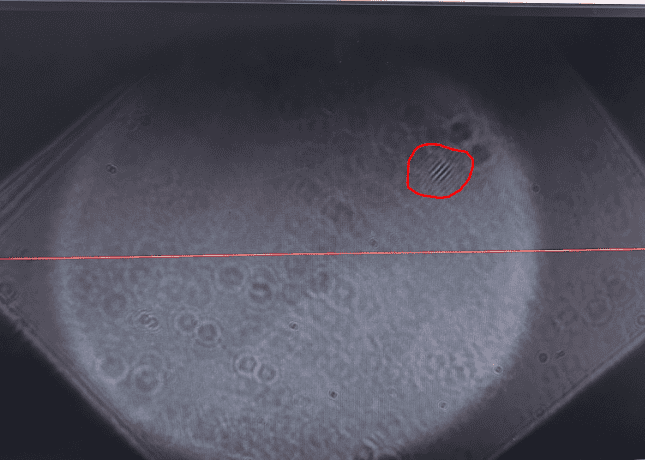
I am trying to make the white light Mach Zehnder Interferometer. After going here and there, I got this small interference pattern. Sadly.

Due to the configuration, the beam size of the two arms is not the same ( One arm is equipped with two object lenses, so this arm has a smaller beam size).

Although having different beam sizes, I made two beams with the same intensity by adjusting HWP+ PBS. It is supposed to have an interference pattern in the whole area of small beam size.

I would appreciate it if anyone has a clue to solve this issue.
1705925093437.png
 
Science news on Phys.org
tanhanhbi said:
TL;DR Summary: I try to make white light Mach Zehnder Interferometer. I managed to find the interference fringes but the fringe is too small compared to the beam size

Due to the configuration
Don't you think you would get better assistance when you provide a little more information ? A diagram and a picture of the setup? You leave us guessing what precisely this 'configuration' is, what the picture represents, what PBS+ HWP has to do with it, etc, etc

Do you have the option of using a laser pointer instead of white light ?

##\ ##
 
tanhanhbi said:
TL;DR Summary: I try to make white light Mach Zehnder Interferometer. I managed to find the interference fringes but the fringe is too small compared to the beam size

I am trying to make the white light Mach Zehnder Interferometer. After going here and there, I got this small interference pattern. Sadly.

[...]
What is your illumination source? A true "white light" interferometer has exceedingly stringent alignment constraints on every aspect of the device, and that includes aberrations from the lenses.
 
BvU said:
Don't you think you would get better assistance when you provide a little more information ? A diagram and a picture of the setup? You leave us guessing what precisely this 'configuration' is, what the picture represents, what PBS+ HWP has to do with it, etc, etc

Do you have the option of using a laser pointer instead of white light ?

##\ ##
This is the setup diagram.
Sadly I do not have the option to use laser.
z5099313538355_f40432099a53c0e1c94b09c116417f54.jpg

Andy Resnick said:
What is your illumination source? A true "white light" interferometer has exceedingly stringent alignment constraints on every aspect of the device, and that includes aberrations from the lenses.
I use Thorlabs CSBLS SLS201L as light source.
But I also use a 700nm filter in front of CCD camera to make it easier to find the interferograms.
 
  • Like
Likes   Reactions: BvU
tanhanhbi said:
I use Thorlabs CSBLS SLS201L as light source.
But I also use a 700nm filter in front of CCD camera to make it easier to find the interferograms.

That helps, but now I have two follow-up questions:

1) Do you spatial filter the source (for example, with a pinhole), or do you just use whatever is coming out of the fiber "raw"?
2) what is the passband of the 700nm filter?

The narrower the passband, the easier it is to find fringes. The better spatially filtered the source, the larger the area that has fringes.
 
  • Like
Likes   Reactions: tanhanhbi, Gleb1964 and BvU
Andy Resnick said:
That helps, but now I have two follow-up questions:

1) Do you spatial filter the source (for example, with a pinhole), or do you just use whatever is coming out of the fiber "raw"?
2) what is the passband of the 700nm filter?

The narrower the passband, the easier it is to find fringes. The better spatially filtered the source, the larger the area that has fringes.
Thank you for your reply !
1. Yes, I also use pinhole after the light source as spatial filter.
2. The FWHM bandwidth of my 700nm filter is 10nm.
 
tanhanhbi said:
This is the setup diagram.
Sadly I do not have the option to use laser.
View attachment 339027

I use Thorlabs CSBLS SLS201L as light source.
But I also use a 700nm filter in front of CCD camera to make it easier to find the interferograms.
Thanks. It is quite clear how it works.
Question: What is about interferogram imagine condition? I assume that CCD camera has no lens and micro objectives are with infinity conjugation? Right?
Or, in case if you imaging the interferogram what would be conjugation points?
Looking on you image I would say there is defocus between two arms, where two spherical wavefronts of different curvature coincide by OPD on a local spot, but the phase difference is increasing beyond where you can observe a secondary interference ring with the opposite phase surrounding the main interference spot.
sport in Mach Zender interferometer.jpg
 
  • Like
Likes   Reactions: tanhanhbi
tanhanhbi said:
Thank you for your reply !
1. Yes, I also use pinhole after the light source as spatial filter.
2. The FWHM bandwidth of my 700nm filter is 10nm.

Hmmm.... I think @Gleb1964 makes a good point about defocus.

When troubleshooting, I usually start by removing as many components as possible to try and diagnose the misalignment.

Does the source emit polarized light? Given your source (a halogen bulb), it's not clear what the HWP is doing. Similarly, it's not clear what the QWP is doing in your setup. Does M2 have tip/tilt capability?

I would start by removing both objective lenses and the QWP/ M1 components, then you have a much simpler configuration to work with.
 
  • Like
Likes   Reactions: sophiecentaur and tanhanhbi
Andy Resnick said:
Does the source emit polarized light? Given your source (a halogen bulb), it's not clear what the HWP is doing. Similarly, it's not clear what the QWP is doing in your setup. Does M2 have tip/tilt capability?
I am not sure about what is doing the HWP (=Half Wave Plate), but after passing the first PBS (=Polarizing Beam Splitter) the light is splitting into two ortogonal linear polarisations going different ways.
The combination of PBS+QWP+Mirror2 is showed on the illustration - linearly polarised light is passing through the beamsplitter, the combination of QWP+Mirror is tilting polarization to ortogonal so on a way back light is reflected by PBS.
pbs+qwp+mirror.jpg


The second branch of interferometer is done in a similar way to equalize the path length , but light first reflected by PBS and then transmitted. Both branches are approximately the same optical path length, but one is included tuning of the mirror M2 position to adjust the pass length.
 
  • #10
Thank you all for your replies ! I am appreciate it.
Gleb1964 said:
Thanks. It is quite clear how it works.
Question: What is about interferogram imagine condition? I assume that CCD camera has no lens and micro objectives are with infinity conjugation? Right?
Or, in case if you imaging the interferogram what would be conjugation points?
Looking on you image I would say there is defocus between two arms, where two spherical wavefronts of different curvature coincide by OPD on a local spot, but the phase difference is increasing beyond where you can observe a secondary interference ring with the opposite phase surrounding the main interference spot.
View attachment 339084
1. We tried to match the imaging condition first before finding the interferogram; we used a resolution test target in the middle of 2 objective lenses and adjusted the CCD and tube lens distance. ( I did not mention tube length in the diagram; my bad !)
2. Your point in defocus is nice! I have the same thinking but have yet to come up with why there is a 2nd interference ring!
Andy Resnick said:
Hmmm.... I think @Gleb1964 makes a good point about defocus.

When troubleshooting, I usually start by removing as many components as possible to try and diagnose the misalignment.

Does the source emit polarized light? Given your source (a halogen bulb), it's not clear what the HWP is doing. Similarly, it's not clear what the QWP is doing in your setup. Does M2 have tip/tilt capability?

I would start by removing both objective lenses and the QWP/ M1 components, then you have a much simpler configuration to work with.
1. The light source is unpolarized. I use HWP + PBS to adjust the intensity ratio between 2 arms. I want to control them instead of letting them 50/50 in the second arm; after passing the object lens, the beam intensity is much higher than the reference arm. So, I want to control the ratio that can make them have the same intensity.

2. For the roles of QWP, @Gleb1964 has an excellent explanation!
In my first setup, I only used one PBS and 3 BS, but the BS, regardless of the ratio, would decrease my intensity at two arms, So I switched to the PBS + QWP + M so that all the light would stay in the system instead of becoming a wasted beam.
 
  • #11
tanhanhbi said:
Thank you all for your replies ! I am appreciate it.

1. We tried to match the imaging condition first before finding the interferogram; we used a resolution test target in the middle of 2 objective lenses and adjusted the CCD and tube lens distance. ( I did not mention tube length in the diagram; my bad !)
2. Your point in defocus is nice! I have the same thinking but have yet to come up with why there is a 2nd interference ring!

1. The light source is unpolarized. I use HWP + PBS to adjust the intensity ratio between 2 arms. I want to control them instead of letting them 50/50 in the second arm; after passing the object lens, the beam intensity is much higher than the reference arm. So, I want to control the ratio that can make them have the same intensity.

2. For the roles of QWP, @Gleb1964 has an excellent explanation!
In my first setup, I only used one PBS and 3 BS, but the BS, regardless of the ratio, would decrease my intensity at two arms, So I switched to the PBS + QWP + M so that all the light would stay in the system instead of becoming a wasted beam.

If the source is randomly polarized, then rotating the HWP shouldn't do anything; conversely, if rotating the HWP does indeed alter the relative intensities, then the source is not randomly polarized.

Regardless, I stand by my suggestion to remove the objective lenses and see if you can get fringes over the entire active area. That will tell you if your problem is the objective lenses or not. If you remove the objective lenses and still can't get fringes over an appreciable area, then you have misalignment somewhere else.
 
  • Like
Likes   Reactions: BvU

Similar threads

  • · Replies 10 ·
Replies
10
Views
3K
  • · Replies 30 ·
2
Replies
30
Views
2K
  • · Replies 4 ·
Replies
4
Views
3K
  • · Replies 1 ·
Replies
1
Views
1K
  • · Replies 8 ·
Replies
8
Views
21K
  • · Replies 1 ·
Replies
1
Views
2K
  • · Replies 33 ·
2
Replies
33
Views
3K
Replies
1
Views
2K
  • · Replies 2 ·
Replies
2
Views
1K
  • · Replies 2 ·
Replies
2
Views
2K