"Magic" AA batteries in a home device?

Click For Summary

Discussion Overview

The discussion revolves around a malfunctioning number-combo door lock powered by AA batteries, focusing on the challenges faced when replacing the batteries. Participants explore potential reasons for the device's failure to operate with new batteries, including issues related to battery contacts, battery types, and the quality of battery holders.

Discussion Character

  • Exploratory
  • Technical explanation
  • Debate/contested

Main Points Raised

  • One participant notes that the device works only with the original batteries, suggesting a possible connection issue with new batteries.
  • Another participant proposes that the positive end of the AA battery may not be making proper contact due to design changes over the years.
  • Some participants suggest using shims, such as aluminum foil or metal, to improve contact between the batteries and the device.
  • Concerns are raised about the quality of battery holders and their impact on device functionality.
  • A participant mentions that certain devices may require specific battery types, such as Carbon/Zinc cells, which could affect performance.
  • There is a suggestion that some devices measure the internal impedance of batteries, which could explain why certain batteries do not work.
  • One participant expresses frustration over the perceived decline in battery quality and the expectation of device reliability.

Areas of Agreement / Disagreement

Participants express multiple competing views regarding the cause of the issue, including battery contact problems, the need for specific battery types, and the quality of battery holders. The discussion remains unresolved, with no consensus on the root cause of the malfunction.

Contextual Notes

Participants mention various factors that could influence battery performance, such as the design of battery contacts and the specifications of different battery types. There is also a reference to the variability in battery quality across brands.

DaveC426913
Gold Member
2025 Award
Messages
24,286
Reaction score
8,439
TL;DR
My battery-operated door lock will not work with any other batteries than those in it now.
I am mystified. My number-combo door lock (one of two I have) is powered by 4 AA batteries. It has been working for so long I don't remember when I installed it - musta been ten years at least. The batteries have begun to run down - it labours to retract the dead bolt now - so it's time to replace them, as I do every year or two.

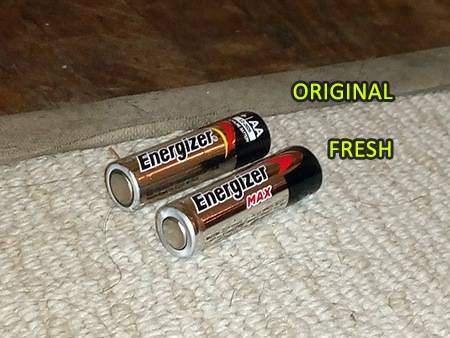
Grabbed four identical batteries out of the same box as the ones currently in the device (same expiry date - ten years from now). New batteries do nothing - device does not work. Will not light up the LED or beep or anything. Presumably, batteries from box are stale?

Battery meter says no, batteries are fine. I accuse battery meter of lying and go back to old batteries that still work - barely.

1639356708665.png

(I know these types of meters are not very reliable for absolute values, but I get pretty good values for relative comparsion.)I go out and buy a fresh batch of batteries - same brand (Energizer), but these one I notice are "Max" (I guess they're heavy duty). No joy. No light, no beep, nothing.

I try the original batteries, which work every time, even though slowly. I flip back and forth between originals, old replacements and fresh-from-store a dozen times. Results are exact: Originals work 100% all others work 0%. Combinations of old and new result in 0% - IOW, only all four original batteries work.

That being said: I can get replacements and fresh-for-store to work temporarily if I apply pressure by jamming my hand on the batteries.

As far as I can determine, it isn't oxidation on the contacts, or a bent contact, or weak batteries, or anything like that. I've tried six ways from Sunday.

My best hypothesis is that the device refuses to operate if the voltage/current is too high - except why does it work if I jam my hand on it?

Thoughts?
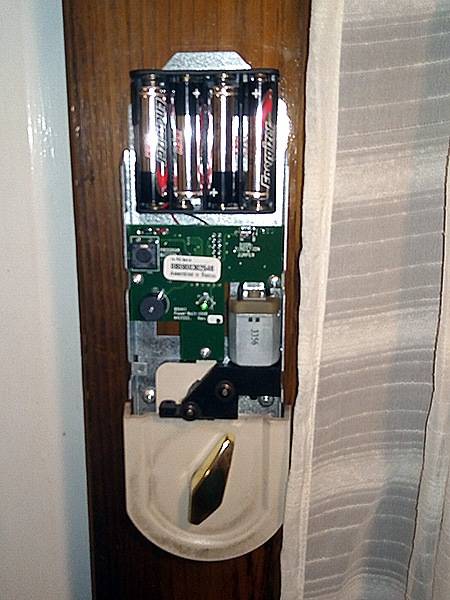
P_20211212_184436.jpg

P_20211212_184950.jpg
 
Last edited:
Engineering news on Phys.org
My guess is that there is a missed connection with the new batteries.
I would try replacement batteries that look like the old original ones - in the details of the form.

Also, those two black wires likely run to a through-hole soldered connection on the PC board. If that's the case, a little bit of sanding should allow you to get a good connection with the voltmeter probes. Take that in-circuit voltage measurement with the original and the fresh batteries. My guess is that the voltage will be zero (or very, very low) with the new batteries.
 
In my experience it is always the positive end of the AA battery (the protruding end) that is the issue. I think many devices recess that battery contact in the case to inhibit effect of wrong way insertion.
Because you can get contact by mashing it may be sufficient to insert the batteries and close all the retaining doors, making the plastic box more rigid. Smack the box sharply with the battery doors closed to see if you can "settle" them onto the contacts. And those battery testers work fine IMHO.
If you have a meter put it on V and check the voltage at each junction: black at - end and poking each in turn...you should get 1.5V,3V,4.5V,6.V.

If the locks misbehave are you out in the cold?
 
  • Like
Likes   Reactions: cmb and russ_watters
hutchphd said:
In my experience it is always the positive end of the AA battery (the protruding end) that is the issue. I think many devices recess that battery contact in the case to inhibit effect of wrong way insertion.
I agree. The buttons on the (+)ve end of batteries have become lower profile over the years, and the plastic around the holder socket has become thicker. Carefully reduce the battery holder plastic at the (+)ve end, to allow the battery to make contact, or insert a thin metal shim to make a contact if there is sufficient length in the holder.
 
  • Like
Likes   Reactions: dlgoff, xs2022 and Tom.G
Baluncore said:
or insert a thin metal shim to make a contact if there is sufficient length in the holder.
I used a ball of aluminum foil to make a shim in such cases. The battery can crush it to the needed size.
 
anorlunda said:
I used a ball of aluminum foil to make a shim in such cases. The battery can crush it to the needed size.
If it works, great. I use a bent bronze shim and avoid Al foil because Al has a sapphire coating and will corrode to crumb in marine environments.
 
It staggers me that we should have to be discussing this problem at all. At one time, we expected old discharged batteries to split and leak nasty stuff all over the battery holder. Now, at least, that doesn't often happen.

But this contact problem is criminal. Is it a conspiracy between battery makers and the companies that sell us more and more battery operated devices? I have become totally numbed by the fact that I buy pack after pack of AA and AAA cells. Why should we accept this? Do we have an option?
Even the mains adaptors are dodgy (except, of course, for the fancy Apple ones which cost a fortune).
 
  • Haha
Likes   Reactions: cmb
sophiecentaur said:
I have become totally numbed by the fact that I buy pack after pack of AA and AAA cells. Why should we accept this? Do we have an option?
Have you considered the quality of the battery holders as opposed to the batteries?
 
  • Like
Likes   Reactions: sophiecentaur
anorlunda said:
Have you considered the quality of the battery holders as opposed to the batteries?
You're probably right. All Duracells are the same quality and that can't be said of the devices they power.
 
  • #10
An AA cell measures 49.2–50.5 mm (1.94–1.99 in) in length, including the button terminal—and 13.5–14.5 mm (0.53–0.57 in) in diameter. The positive terminal button should be a minimum 1 mm high and a maximum 5.5 mm in diameter, the flat negative terminal should be a minimum diameter of 7 mm.
https://en.wikipedia.org/wiki/AA_battery#Dimensions
So the positive-terminal shroud on the battery-holder needs to be less than 1 mm deep to meet that spec. There also needs to be a minimum length of 1.3 mm spring in the holder.
 
  • Informative
Likes   Reactions: sophiecentaur
  • #11
1) Another (remote) possibility is that your device actually needs Carbon/Zinc (LeLanche) cells. The fresh open-circuit voltage is slightly higher than the now-common Alkaline chemistry. The Carbon/Zinc cells are frequently labelled "Heavy Duty" without the "Alkaline" labelling.

I have an old RCA VTVM (Vacuum Tube Volt Meter) that uses a 'D' cell for resistance measurement. The Resistance range will not Zero with an Alkaline cell, but works fine with a Carbon/Zinc cell.

2) Another possibility is the battery holder having a bad contact. Those holders that have a rivet as a contact sometimes are loose or have a bit of hidden corrosion under the rivet head. If you are adept at soldering, a bit can be added to bond the rivet to the associated conductor, without melting TOO much plastic.

Progress notes please.

Cheers,
Tom
 
  • Like
Likes   Reactions: Bystander
  • #12
Our carbon monoxide alarm only works with specific models of AA batteries. The manual actually contains a list of batteries that will work. My assumption is that the circuit actually -for whatever reasons- somehow measures the EMF to make sure it is in the right range and turns off it is not.

I don't think it is the case here, but I thought it might be worth pointing out that some circuits behave like this by design.
 
  • #13
They measure the internal impedance of the battery. IIRC, this is done by measuring the voltage drop during the Red "Heartbeat" flash of the LED. At least that is how it's done to detect an end-of-life battery condition.
 
  • Informative
Likes   Reactions: sophiecentaur
  • #14
sophiecentaur said:
You're probably right. All Duracells are the same quality and that can't be said of the devices they power.
Duracell is the best in my experience.
 
  • Like
Likes   Reactions: Tom.G and sophiecentaur
  • #15
I'm with the short +ve nipple suspect. I have routinely had this problem with rechargeable AAs where they seem to shave that nipple height right down to the spec minimum to get a bit more volume in the body of the cell.

You need to put the batteries in then, with it 'on' probe back from the power tracks to see where the power 'stops'. Often, when you insert the probe onto the +ve end the thing starts because you've just closed the connection to the terminal.
 
  • #16
sophiecentaur said:
I have become totally numbed by the fact that I buy pack after pack of AA and AAA cells. Why should we accept this? Do we have an option?
Yes. Buy a battery charger and a sufficient rechargeable batteries. No more recycling polluting old batteries and I haven't bought a battery for years.
 
  • Like
Likes   Reactions: jasonRF

Similar threads

Replies
54
Views
12K
  • · Replies 20 ·
Replies
20
Views
14K
Replies
1
Views
4K
Replies
17
Views
3K
Replies
7
Views
7K
  • · Replies 22 ·
Replies
22
Views
7K
  • · Replies 4 ·
Replies
4
Views
4K
  • · Replies 1 ·
Replies
1
Views
3K
  • · Replies 7 ·
Replies
7
Views
2K
  • · Replies 39 ·
2
Replies
39
Views
6K