Magnets and coils configuration for electricity generation

Click For Summary
SUMMARY

The forum discussion centers on the configuration of magnets and coils for electricity generation, specifically involving a solenoid with a diameter of 10 cm and 100 coils. The magnet, moving at 5 m/s with a strength of 0.334 T, is positioned 1 cm away from the coil. Key insights include the importance of minimizing the air gap to enhance power transfer and the necessity of using an iron core to maximize magnetic flux. Voltage generation is directly related to the rate of change of magnetic flux, which is influenced by the strength of the magnet and the gap width.

PREREQUISITES
  • Understanding of magnetic flux and its units (Weber, Tesla)
  • Knowledge of Faraday's Law of Electromagnetic Induction
  • Familiarity with coil configurations in generators
  • Basic principles of electromagnetism and energy conversion
NEXT STEPS
  • Research "Faraday's Law of Electromagnetic Induction" for voltage calculations
  • Explore "magnetic flux density" and its impact on coil performance
  • Study "DIY wind turbine designs" for practical applications of magnet-coil configurations
  • Investigate "iron core utilization in generators" to enhance efficiency
USEFUL FOR

This discussion is beneficial for hobbyists, electrical engineers, and anyone interested in renewable energy generation, particularly those exploring DIY projects involving magnets and coils.

Hons K Wyn
Messages
3
Reaction score
0
My dad is working on a project where he intends to convert mechanical into electrical energy, and he was wondering if a particular magnet and coil configuration works for electricity generation. And if it does, how are the voltage and current calculated.

Lets say:
  • The coils have a diameter of 10 cm
  • There are 100 coils in that solenoid
  • The magnets moved with a speed of 5 m/s
  • The magnet has a value of 0.334 T on its North face
  • There is a 1cm wide gap between the magnet and the coil

I created a little gif and attached it to this thread to illustrate the configuration that he was achieving. The coil is stationary, while the magnet moves across its surface.
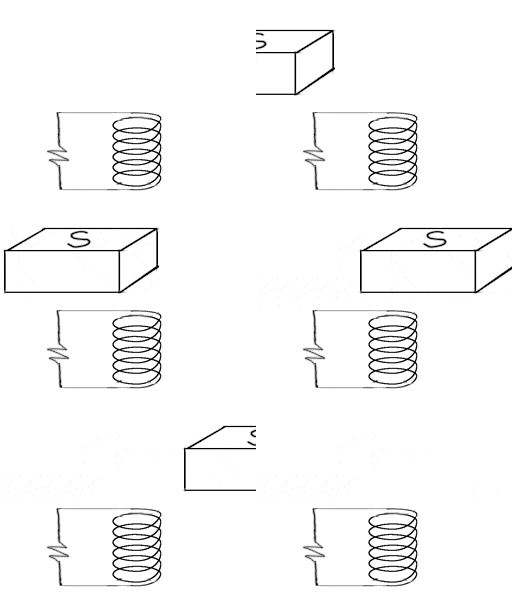
coil.gif
 
Engineering news on Phys.org
Hons K Wyn said:
There is a 1cm wide gap between the magnet and the coil
Welcome to the PF.

You need to minimize the gap width to maximize the power transfer... :smile:
 
First, i have no idea what you're describing.
Hons K Wyn said:
  • The coils have a diameter of 10 cm
  • There are 100 coils in that solenoid
  • The magnets moved with a speed of 5 m/s
  • The magnet has a value of 0.334 T on its North face
  • There is a 1cm wide gap between the magnet and the coil

You'll learn a lot studying how it's done in real products.
Take apart a lawnmower engine and study the charging coils
lawnmowercoil.jpg


voltage is in proportion to rate of change of magnetic flux.
Magnitude of flux is proportional to magnet strength and inversely proportional to air gap
observe that practical small generators have an air gap much smaller than 1 cm,
and
without an iron core in the coil to maximize magnetic flux you won't get much voltage

old jim
 
Thank you for you reply Jim,

Sorry for being vague, I was just giving any related information that my dad's giving me.

I see that most configurations in motors and generators have the coils in the middle and the magnets on the outer side (as shown in the lawnmower engine above). May I ask your opinion on this particular configuration (GIF below) if it was being use with the intention to convert mechanical to electrical energy? From what I've read, wind turbines uses a similar configuration?

magnet-coil-config.gif

If the GIF is too vague, the orange are the solenoids. The red/blue represents the N/S of the magnets (attached to a rotor).

Also, thank you for your info on the iron core.
 
Yes, there are many "youtubes" showing homebuilt alternators with that arrangement.

You will learn that magnetic flux travels in a closed loop just as does electric current
and it much prefers to travel in iron
that's why you minimize the fraction of the magnetic path that is air.
You'll want to get your head around magnetic basics, start with what are the units, look them up
Flux = Weber, you might also look up the old cgs unit "Line" or "Maxwell"
Flux Density = Tesla, look up also old cgs unit Gauss

then it's a lor easier to grasp the formulas

http://hyperphysics.phy-astr.gsu.edu/hbase/magnetic/fluxmg.html

http://hyperphysics.phy-astr.gsu.edu/hbase/electric/farlaw.html
 
Hi Jim,

I've been reading up on my physics, and watching the DIY wind turbines. My physics is just first year university level, and even then, I've forgotten a lot of my physics.

I'm able to make calculations for simple situations (e.g. where magnetic fields are assumed constant everywhere, where resistance is assumed to be zero, where there is no iron core) but I think it's much more complicated in this situation? Flux density is not constant everywhere, so I think different part of the coils will have different induced emf?

Do you know how energy production can be estimated? Or do you know an article/journal that can help in this situation?

Thanks Jim,
 
Hons K Wyn said:
Do you know how energy production can be estimated? Or do you know an article/journal that can help in this situation?
not really, i don't.
I never looked very hard at making a homebuilt-from-scratch axial flux machine because i'd use parts from an automobile or outboard motor instead.

Hobbyists are finding the new washing machine motors handy
http://www.cogenmicro.com/pdf/Fisher_and_Paykel_Smartdrive_Motor_2.PDF

some modify automotive alternators
http://www.windstuffnow.com/main/gm_alt_mod.htm

Voltage per turn is rate of change of flux inside the area encircled .
If you're alternating between ±0.334T , how many Webers (Teslas X square meters) is that and how many times per second does it happen?
Load current will make a mmf that opposes your permanent magnet, so #turns is a tradeoff between magnitude of voltage and 'stoutness' of voltage under load.
You'll have to know how much air is in the magnetic path to calculate much of anything.

Train your search engine... Keep searching on keywords in the articles you find and it will adjust itself to your interests..
 

Similar threads

Replies
7
Views
5K
  • · Replies 12 ·
Replies
12
Views
6K
  • · Replies 8 ·
Replies
8
Views
2K
  • · Replies 5 ·
Replies
5
Views
4K
Replies
4
Views
2K
  • · Replies 1 ·
Replies
1
Views
3K
  • · Replies 8 ·
Replies
8
Views
4K
  • · Replies 8 ·
Replies
8
Views
2K
  • · Replies 4 ·
Replies
4
Views
3K
  • · Replies 3 ·
Replies
3
Views
2K