Material starting form for stub axle

Click For Summary
SUMMARY

The discussion focuses on the manufacturing processes for stub axles, emphasizing the importance of material selection based on production quantity. For mass production, forging from steel is recommended due to its superior strength-to-weight ratio, while small batch production may utilize turning from rectangular blocks or weldments. The conversation also highlights the inappropriateness of cast forms due to their high structural integrity, suggesting alternatives like friction welding for two-part assemblies. Key techniques discussed include machining, forging, and welding.

PREREQUISITES
  • Understanding of manufacturing processes such as forging and machining
  • Familiarity with material properties, specifically steel and its behavior under stress
  • Knowledge of welding techniques, particularly friction welding and full penetration welds
  • Basic concepts of production scalability: one-off, small batch, and mass production
NEXT STEPS
  • Research the advantages of forging over casting in manufacturing components
  • Learn about the process of friction welding and its applications in assembly
  • Explore machining techniques for turning rectangular blocks into complex shapes
  • Investigate stress relief methods such as annealing in metalworking
USEFUL FOR

Manufacturing engineers, mechanical designers, and anyone involved in the production of automotive components, particularly those focused on optimizing the design and manufacturing processes of stub axles.

Saints-94
Messages
63
Reaction score
1
I am unsure whether I am posting in the right place, but was hoping someone could help me out.

I was wondering if anyone knows the shape of the material at the beginning of the manufacturing process of a stub axle, and how the shape will vary depending on the quantity of products being made (eg. one off, small batch and mass production). Only looking for basic ideas, nothing too in-depth.

See image of stub axle below.
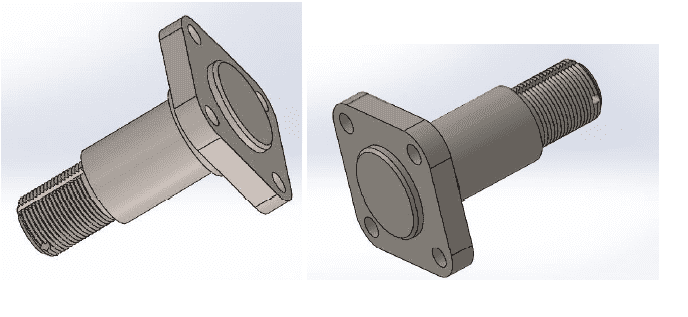
upload_2017-3-12_17-34-13.png
 
Engineering news on Phys.org
Machined from solid . Usually from long lengths of close to size plain bar .
Machined from forging . Very close to final shape and size - minimal metal removal to finish .
Machined from steel casting . Same as forging .
 
Nidum said:
Machined from solid . Usually from long lengths of close to size plain bar .
Machined from forging . Very close to final shape and size - minimal metal removal to finish .
Machined from steel casting . Same as forging .

Thanks for your response.

However, I have been advised that cast form is inapproriate due to its high structural integrity. Are there any alternatives?
 
However, I have been advised that cast form is inapproriate due to its high structural integrity.

Not quite sure what you are saying there - can you explain a bit more ?

There are certainly other ways to make stub axles and similar components .

One that works well but is seldom used in production is the two part assembly where the actual axle is friction welded to the flange .

What is your interest in this subject ?
 
Saints-94 said:
However, I have been advised that cast form is inappropriate due to its high structural integrity. Are there any alternatives?
You mean the device needs to be stronger than cast iron ? (or do you mean that cast form has high structural integrity which you don't want :rolleyes:)

The thing resembles a bolt - so http://blog.mechguru.com/machine-design/7-steps-manufacturing-process-bolts-screws-stud-fasteners/ is where I'd look.
 
Last edited by a moderator:
For quantity production.
For maximum strength to weight ratio, a stub axle needs to be forged from steel. Forging will allow the stretched fibres in the steel to follow the lines that will carry load when in operation. You could start with a short round bar. Upset or spread one end to make the flange, while thinning and lengthening the shaft. Once the basic shape has been formed it will need to be annealed to relieve stress and hard spots, then machined and finally surface hardened.

For small quantity production it could be turned from a rectangular block of steel in a lathe. That would be slow and wasteful.

You might also consider fabricating it from a flat square block with the round bar pressed into a central through hole. The bar would then be welded on the back of the flat plate with a deep V groove. That would not be the strongest for weight solution as the press fit would be at a stress concentration.
 
  • Like
Likes Averagesupernova, Wilson123 and Saints-94
For small quantities only, you might start with a weldment (short shaft inserted through a block, full penetration weld on all edges) and then machine to final shape.

For larger quantity, a forging is the way to go.
 

Similar threads

Replies
2
Views
2K
Replies
1
Views
1K
Replies
1
Views
1K
  • · Replies 5 ·
Replies
5
Views
2K
  • · Replies 39 ·
2
Replies
39
Views
16K
  • · Replies 4 ·
Replies
4
Views
2K
  • · Replies 3 ·
Replies
3
Views
3K
  • · Replies 6 ·
Replies
6
Views
4K
Replies
2
Views
4K
  • · Replies 6 ·
Replies
6
Views
3K