Matlab ODE Problem (paritcle trajectory)

Click For Summary
The discussion revolves around solving a MATLAB ODE related to particle trajectory. The user expresses difficulty in finding a solution and seeks guidance on the correct approach to modeling motion. They mention a temporary lack of access to MATLAB, which hinders their progress. The user contemplates turning their current work into a function for better organization. Ultimately, they resolve their issue with a specific function definition for the ODE.
intrepid44
Messages
3
Reaction score
0
Hi, I currently have this problem to solve, and I'm quite stuck. I would much appreciate it if anyone could point me in the direction on how to solve it.
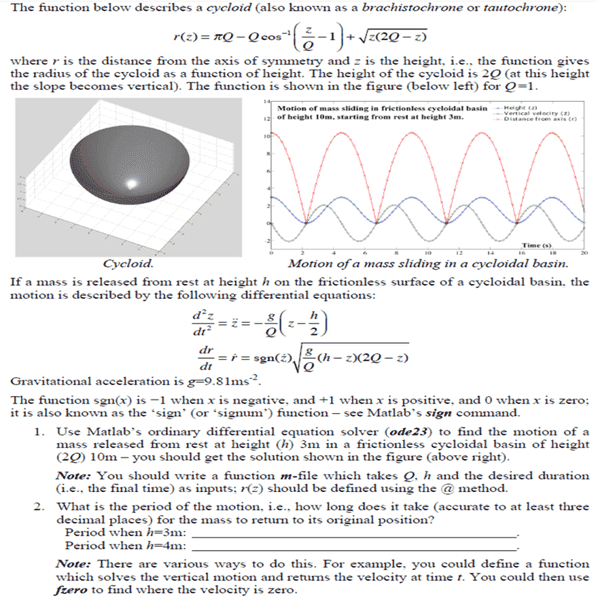
m1.png


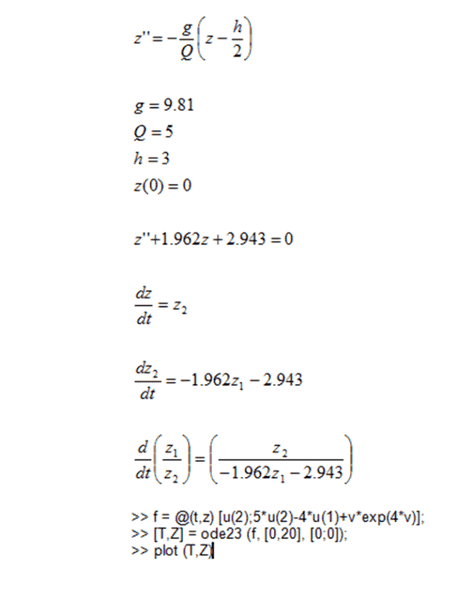
This is my go at it, although currently I don't have access to MATLAB until tomorrow as the university library has now closed.
m2.png


Is this the correct way to get the motion? If I then turn it into a function?

Many thanks.

Regards,
intrepid44
 
Physics news on Phys.org
The last bit should be: >> f = @(t,z) [z(2);-1.962*z(1)-2.943];
 
Got it sorted, never mind.
 
Question: A clock's minute hand has length 4 and its hour hand has length 3. What is the distance between the tips at the moment when it is increasing most rapidly?(Putnam Exam Question) Answer: Making assumption that both the hands moves at constant angular velocities, the answer is ## \sqrt{7} .## But don't you think this assumption is somewhat doubtful and wrong?

Similar threads

  • · Replies 5 ·
Replies
5
Views
2K
  • · Replies 3 ·
Replies
3
Views
2K
  • · Replies 4 ·
Replies
4
Views
2K
  • · Replies 9 ·
Replies
9
Views
3K
  • · Replies 2 ·
Replies
2
Views
2K
  • · Replies 1 ·
Replies
1
Views
1K
  • · Replies 3 ·
Replies
3
Views
2K
  • · Replies 3 ·
Replies
3
Views
2K
  • · Replies 1 ·
Replies
1
Views
3K
  • · Replies 2 ·
Replies
2
Views
3K