Does a Positive Definite Hermitian Matrix Always Have a Positive Determinant?

David932
Messages
7
Reaction score
0
1. Problem statement : suppose we have a Hermitian 3 x 3 Matrix A and X is any non-zero column vector. If
X(dagger) A X > 0 then it implies that determinant (A) > 0.

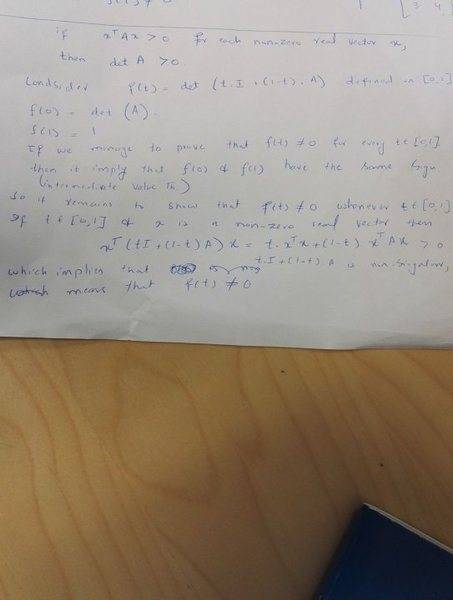
I tried to prove this statement and my attempt is attached as an image. Please can anyone guide me in a step by step way to approach this problem. I am not sure and not very clear about my way of approach about the problem.

P.S. I am new to the forum and I apologize if my post has flaws. I tried my best to formulate the problem and my attempt at it clearly but still I am not very proficient in this formatting stuff. I wrote it in MSword too and then posted it but the whole text appeared struck out and then it was removed.
Question1.jpg
 
Last edited by a moderator:
Physics news on Phys.org
With the free or cheap app DocScan HD you can make your page look like this:
2q0porc.jpg


In your case I don't know whether that's enough to get anyone to read it. :oldbiggrin:
 
Attempted transliteration:

David932 said:
1. Problem statement : suppose we have a Hermitian 3 x 3 Matrix A and X is any non-zero column vector. If
X(dagger) A X > 0 then it implies that determinant (A) > 0.

I tried to prove this statement...

Consider ##F(t) = det( t\ I + (1-t)A) ## defined on ## t \in [0,1] ##

##F(0) = det(A)##
##F(1) = 1 ##

If we manage to prove ##F(t) \ne 0## for each ##t \in [0,1]## then ##F(0)## and ##F(1)## have the same sign, by the intermediate value theorem.

If ##t \in [0,1]## and ##x## is a non-zero real vector then ##x^T( t\ I + (1 - t)A) x = t x^T x + (1-t)x^T A x > 0 ##

which implies ##t\ x + (1-t)A## is nonsingular. This implies ## F(t) \ne 0##.
 
You're on the cusp of some very interesting stuff called quadratic forms. I'd suggest approaching this from a few different angles -- it connects quite a few different concepts in Linear Algebra. With that in mind, here are a few other ways to look at the problem:
- - - -

When you get down to it, these are optimization problems that are eigenvalue problems. (And determinant = product of all eigenvalues).

For Hermitian ##\mathbf A##, consider the optimization problem:

##\mathbf x^H \mathbf A \mathbf x##

where ##\mathbf x \neq \mathbf 0##
(where ##^H## indicates conjugate transpose -- your post says Hermitian, so we really should be using ##^H## not ##^T##. Note that ##\mathbf 0## is the zero vector).

How would you minimize this expression? How would you maximize this? (There are basically two approaches, one is use Lagrange multipliers, and the other is diagonalize with unitary basis formed by eigenvectors. Both are worth working through in detail.)

I would spend some time thinking on quadratic forms.

- - - - -
A simpler, but less elegant approach is to not directly mention eigenvalues, and consider this:

##\mathbf x^H \mathbf A \mathbf x##. Assume that ##\mathbf A## has a non trivial nullspace. Then that means ##\mathbf A## is singular and I can find some ##\mathbf x \neq \mathbf 0##, where ##\mathbf A \mathbf x = \mathbf 0##. If this is the case, then ##\mathbf x^H \mathbf A \mathbf x = \mathbf x^H \big(\mathbf A \mathbf x\big) = ?##. What does this tell you?

This approach is simpler, but feels a lot lot less constructive (and satisfying) to me than actually working through the quadratic form optimization.
- - - -
Note there is a sticky on using LaTeX formatting here:

https://www.physicsforums.com/help/latexhelp/

Also you can right click my formatted text and show the math commands to see what I entered to get this result.
- - - -
By the way this was posted in the 'precalculus' forum. So I'm not totally sure how to think about the use of intermediate value theorem (or Lagrange multipliers) here.
 
  • Like
Likes David932

Similar threads

Replies
1
Views
2K
  • · Replies 1 ·
Replies
1
Views
3K
  • · Replies 25 ·
Replies
25
Views
2K
  • · Replies 32 ·
2
Replies
32
Views
3K
  • · Replies 69 ·
3
Replies
69
Views
9K
  • · Replies 10 ·
Replies
10
Views
2K
  • · Replies 1 ·
Replies
1
Views
1K
  • · Replies 5 ·
Replies
5
Views
5K
Replies
2
Views
2K
  • · Replies 31 ·
2
Replies
31
Views
4K