Maximizing Mechanical Advantage in Levers: Investigating Size and Shape

  • Context: High School 
  • Thread starter Thread starter Joorge
  • Start date Start date
Click For Summary
SUMMARY

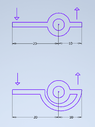
This discussion centers on the mechanical advantage of levers, specifically comparing two lever designs. The first lever is identified as a first-class lever with a mechanical advantage of 2. Participants confirm that regardless of the lever's shape or additional features, such as holes or paint, the mechanical advantage remains constant at 2, as long as the lever is treated as a rigid body. The fundamental principle discussed is that the relationship between the distances and forces on either side of the fulcrum dictates the mechanical advantage, adhering to the equation distance_A x Force_A = distance_B x Force_B.

PREREQUISITES
  • Understanding of first-class levers and mechanical advantage
  • Familiarity with the concept of rigid bodies in physics
  • Knowledge of the work-energy principle in mechanics
  • Basic grasp of force and distance relationships in lever systems
NEXT STEPS
  • Study the principles of mechanical advantage in different types of levers
  • Explore the concept of rigid body dynamics in physics
  • Learn about the work-energy theorem and its applications in mechanical systems
  • Experiment with physical models of levers to observe mechanical advantage in practice
USEFUL FOR

Students of physics, engineers, and anyone interested in understanding the mechanics of levers and their applications in real-world scenarios.

Joorge
Messages
10
Reaction score
0
I have these 2 levers seen from above, that is, gravity does not affect.
In the first one, it is clear to me that it is a first class lever and that the mechanical advantage is 2x.
What about the second one? Does it make any difference?
I'm wondering if I need to 'cross' the fulcrum (so to speak) or not to get mechanical advantage.
 

Attachments

  • Levers.png
    Levers.png
    16.9 KB · Views: 137
Physics news on Phys.org
Welcome!
What do you mean by "to cross the fulcrum"?
Is this homework?
 
What "law" do you use to analyze levers?
 
Lnewqban said:
Welcome!
What do you mean by "to cross the fulcrum"?
Is this homework?
Well, I'm 60 years old... I don't think so. I mean if I need to touch (so to speak) the center. Sorry about my ignorance and my English.
 
Gordianus said:
What "law" do you use to analyze levers?
The only thing I learned long time ago was distance_A x Force_A = distance_B x Force_B.
What is intriguing to me if is passing through the center (so to speak) is needed. Sorry about my English.
 
What if the lever was filled in ? on the right hand side where the gap is ? What if there were holes drilled into it ? in random places.
 
If you want to fill in the right hand is up to you, but that's not my question.
You can make some holes too or paint the whole thing in pink.
Did you get your gold member answering like that? :woot:
 
No, I got the gold membership for the royalties and timeshare on the company jet.

My question was, does it make a difference if it's painted pink ? or a piece of string or welded wire bridged the beginning of the gap on the left side.
 
Last edited:
My question is if the second one could be consider a lever provided that is crossing the fulcrum by outside and if so, if the mechanical advantage would be the same in both cases, or more, or less.

I don't know it because I have very basic understanding of Physics, that's the reason I came here. If you want to laugh at me is ok, I have no trouble with my ego, but I'd prefer to get some kind of coherent answer. Thanx :)
 
  • #10
Not laughing at you.

If you push the leftmost point of the lever down 2cm, how much does the rightmost point push up ? Is it the same, or different from the original lever.
 
  • #11
Joorge said:
Well, I'm 60 years old... I don't think so. I mean if I need to touch (so to speak) the center. Sorry about my ignorance and my English.
The force that you apply will reach that other end via the fulcrum, no matter what trajectory it follows.

Yes, the mechanical advantage will still be 2.
The force that the fulcrum will “feel” will be the same as well.

Perhaps you will feel the lever more springy, due to the additional deflection of the longer trajectory.
I don’t know enough English to see what is wrong with yours. :smile:
 
  • #12
Lnewqban said:
Yes, the mechanical advantage will still be 2.
To expand a bit on this

It is still a rigid object. It still has three points where forces are applied. The positions of those points relative to one another has not changed. Everything else is just pink paint.
 
  • Like
Likes   Reactions: Lnewqban
  • #14
hmmm27 said:
Not laughing at you.

If you push the leftmost point of the lever down 2cm, how much does the rightmost point push up ? Is it the same, or different from the original lever.
I have no idea. That's the reason I'm asking. Thanks anyway.
 
  • #15
Lnewqban said:
The force that you apply will reach that other end via the fulcrum, no matter what trajectory it follows.

Yes, the mechanical advantage will still be 2.
The force that the fulcrum will “feel” will be the same as well.

Perhaps you will feel the lever more springy, due to the additional deflection of the longer trajectory.
I don’t know enough English to see what is wrong with yours. :smile:
Thank you :)
 
  • #16
Joorge said:
I have no idea. That's the reason I'm asking. Thanks anyway.
The attempt was to get you to think of the lever as a rigid body.

No matter how many spurs you hang on it or how serpentine you make it or how many holes you drill into it, it is still a rigid structure. All the points on a rigid body move together with each other.

A rigid body can rotate. Or it can move around from place to place (translate). But it cannot bend, twist, squish, stretch or flow.

With this in mind, if you hold the pivot point fixed and push the left end (the long side) down by two cm, how far must the right end move and in which direction?
 
Last edited:
  • #17
Joorge said:
Thank you :)
You are welcome, Joorge. :cool:

You can also use the concept of work in = work out, considering work as force x length of arc described by that force.
Force out = Force in x (arc of force in / arc of force out)

The less the output end moves respect to the input end, the greater the output force is.
If you could experiment with each of the two shapes that you have shown, you could see that the length of the described arcs are exactly the same in both cases.

Therefore, size matters, but shape does not. :smile:
 
Last edited:
  • Like
Likes   Reactions: jbriggs444

Similar threads

  • · Replies 8 ·
Replies
8
Views
8K
  • · Replies 9 ·
Replies
9
Views
2K
Replies
17
Views
9K
  • · Replies 25 ·
Replies
25
Views
7K
  • · Replies 3 ·
Replies
3
Views
1K
  • · Replies 9 ·
Replies
9
Views
3K
  • · Replies 2 ·
Replies
2
Views
768
  • · Replies 6 ·
Replies
6
Views
13K
  • · Replies 48 ·
2
Replies
48
Views
5K
  • · Replies 5 ·
Replies
5
Views
8K